
Beyond the Power-Law: The Hidden Geometry of Online Controversy in Slashdot
Statistical analysis of the social network and discussion threads in slashdot
2008-04-21
Summary
Problem
Method
Results
Takeaways
Abstract
This paper presents a comprehensive statistical analysis of Slashdot, a prominent technology-news platform, focusing on its implicit social network and discussion thread structures. By analyzing one year of user activity, the authors characterize the network's macroscopic properties and introduce a novel h-index-based metric to quantify comment controversy.
## TL;DR
While most social network lore suggests that a few "superstars" run the show via power-law distributions, this deep dive into Slashdot reveals a different reality. By analyzing over 2 million comments, researchers found that online social interactions are better described by **log-normal distributions** and that "controversy" isn't just about the number of comments, but about the **structural depth** of the conversation—measurable by a clever adaptation of the academic **h-index**.
## Problem & Motivation: Why Implicit Networks Matter
In 2008, social network analysis was largely obsessed with explicit "friendship" links. However, the researchers behind this paper realized that the most interesting social dynamics often happen implicitly. On Slashdot, a user doesn't "follow" another; they *reply* to them.
The problem? Existing models (like USENET studies) focused on visualization or simple "small-world" metrics but didn't account for the **hierarchical nesting** of conversations. Why do some posts spark massive, deep debates while others just gather a pile of shallow "me too" comments? The authors set out to find a mathematical signature for these different types of engagement.
## Methodology: The Anatomy of a Digital Argument
The authors modeled Slashdot through two distinct lenses:
1. **The Interaction Graph**: They filtered out anonymous and low-quality comments to build directed and undirected networks. Using rigorous statistical tests (Kolmogorov-Smirnov), they challenged the "Power-Law" status quo.
2. **The Radial Tree**: To understand thread structure, they modeled discussions as trees growing radially from a central post.
### Structural Visualization
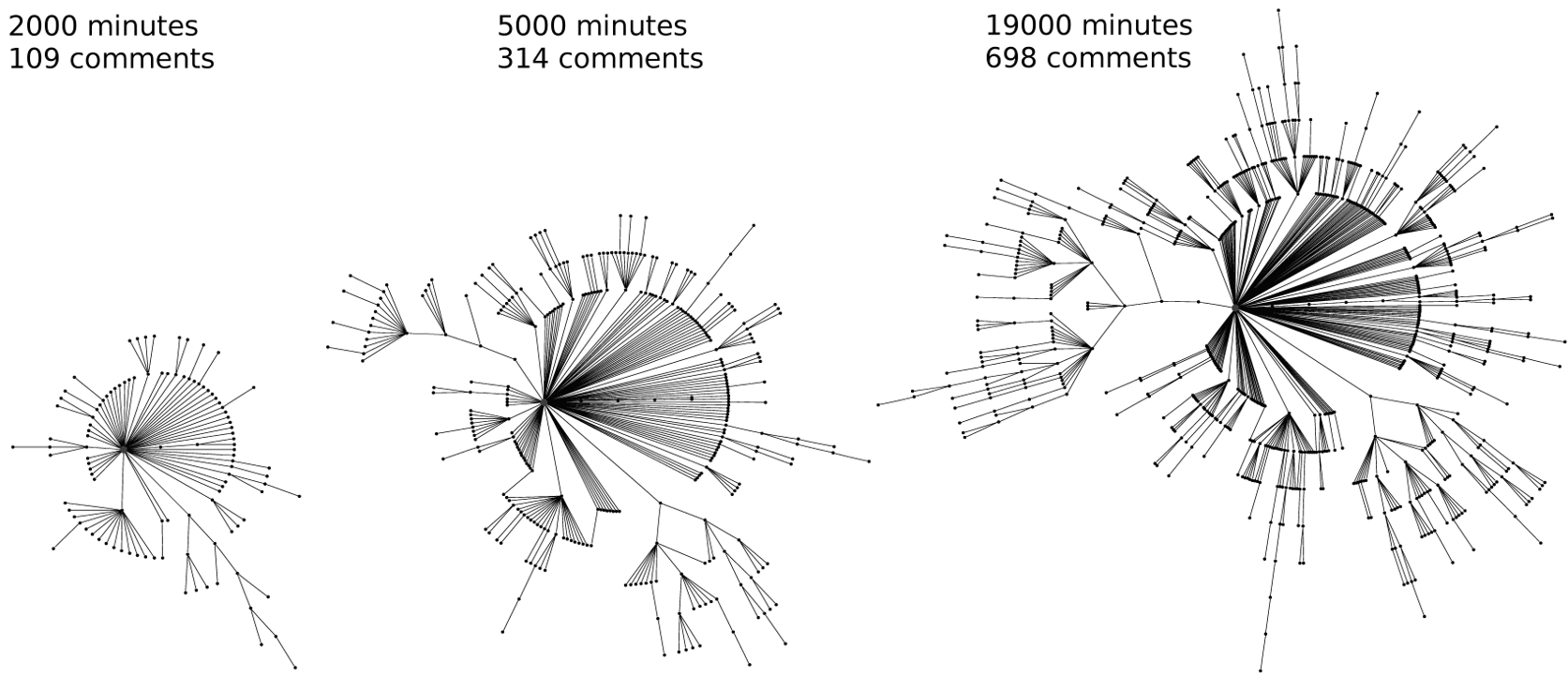
*Figure 1: Evolution of a controversial post (982 comments) visualized as a radial tree, showing how intensity migrates deeper into specific branches.*
## Key Insights: Log-Normal is the New Black
A pivotal discovery in the paper is that Slashdot’s degree distribution—how many people a user interacts with—doesn't follow a power law.
* **The Power-Law Failure**: While many touted "scale-free" networks, the data showed that the power-law only fit the top 5% of users.
* **The Log-Normal Fit**: The log-normal distribution (the $f_{LN}$ formula) explained the *entire* dataset. This suggests that user growth and interaction on the site are driven by **multiplicative processes** (i.e., your next interaction is proportional to your current level of activity).
### Quantitative Snapshot
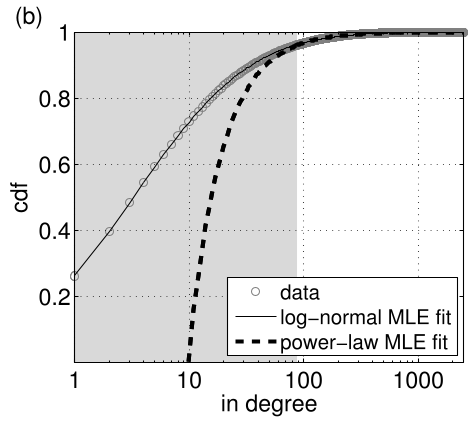
*Figure 2: Statistical evidence showing that in-degree and out-degree distributions align almost perfectly with Log-Normal curves, refuting simple power-law assumptions.*
## Controversy Revealed: The H-Index for Threads
The paper’s most "product-ready" contribution is the **Controversy H-Index**.
* **The Challenge**: A post with 1,000 comments might just be 1,000 people saying "Great post!" (shallow). A post with a depth of 50 levels might just be two people arguing in a circle (narrow).
* **The Solution**: A post has an h-index of $h$ if there are at least $h$ nesting levels that each contain at least $h$ comments.
This metric successfully identifies "The Sweet Spot"—threads that are both popular *and* intellectually deep.
## Critical Analysis & Takeaways
The genius of this work lies in its "structural-first" approach. In an era where we rely heavily on Sentiment Analysis (NLP) to detect toxicity or controversy, this paper proves that **topology alone** can tell us which topics are polarizing the community.
**Limitations**: The study is a snapshot of 2008-era Slashdot. Modern platforms with algorithmic feeds (like Twitter or TikTok) might show different assortativity patterns. However, the neutral assortativity found here—where high-degree "hubs" don't necessarily link to other hubs—suggests that online forums are decentralized platforms for diverse opinion exchange rather than echo chambers of elites.
**Future Impact**: For modern community managers and AI developers, this research suggests that to foster healthy debate, we should optimize for "H-index growth" rather than just click-through rates or raw comment volume.