
Leveraging PRISMA's Potential: Advanced Statistical Classification for Agricultural Land Use
15853_Statistical Classification for Assessing PRISMA Hyperspectral Potential for Agricultural Land Use.
The paper introduces a statistical classification framework for agricultural land use using hyperspectral data, specifically assessing the potential of the PRISMA satellite mission. By employing Independent Component Discriminant Analysis (ICDA) and Principal Component Discriminant Analysis (PCDA), the authors achieve a global success rate of over 95% while significantly reducing dimensionality.
TL;DR
As the next generation of hyperspectral satellites like PRISMA prepares for deployment, the challenge shifts from data acquisition to efficient processing. This research presents a robust framework using Independent Component Discriminant Analysis (ICDA) and Principal Component Discriminant Analysis (PCDA) to achieve over 95% classification accuracy in agricultural land use, significantly outperforming traditional SVMs in reliability and computational efficiency.
Background: Navigating the Hyperspectral Data Deluge
Hyperspectral sensors provide a nearly continuous spectral signature for every pixel. While this wealth of data is a boon for "Precision Farming," it creates a mathematical nightmare known as the "Curse of Dimensionality." When you have hundreds of spectral bands but limited ground truth data, traditional parametric models (like Maximum Likelihood) fall apart.
The Core Challenge: Why Traditional ML Struggles
The authors identify two primary bottlenecks:
- Redundancy: Many spectral bands are highly correlated; processing them all introduces noise without adding discriminatory value.
- Non-Gaussianity: Real-world agricultural classes (like "wheat stubble") rarely follow a perfect Bell curve. Standard Linear Discriminant Analysis (LDA) assumes Gaussianity and homoscedasticity, leading to high misclassification rates.
Methodology: The Power of Independence
The researchers propose a pipeline that transforms the data space before classification.
1. The Transformation (PCA vs. ICA)
To handle the high dimensionality, the data is projected onto Principal Components (PC) or Independent Components (IC).
- PCA de-correlates the bands.
- ICA goes a step further, seeking components that are stochastically independent and non-Gaussian.
2. Non-Parametric Density Estimation
Once the components are independent, the multivariate density can be estimated as a simple product of univariate densities using Kernel Density Estimators (KDE). This removes the need for rigid Gaussian assumptions.
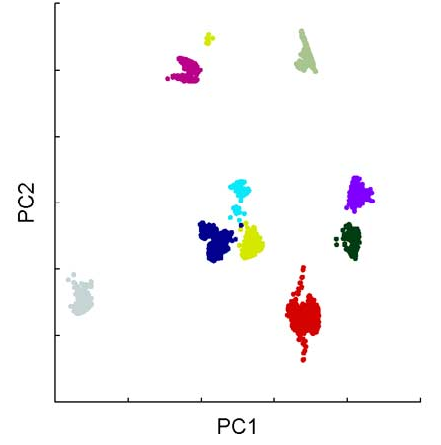 Figure 5: Comparison of original radiance (a) vs. Principal Components (b) and Independent Components (c). Note how the transforms separate the land classes more distinctly in the feature space.
Experiments and Results
The methodology was validated on two MIVIS (airborne) datasets: Tessera (highly cultivated) and Pollino (fragmented ecosystems).
Key Findings:
- Band Selection: By using a "Simple Forward" selection strategy, the model reached peak performance with only 10 spectral bands.
- Robustness: In the Pollino dataset—where training data was sparse—the ICDA method remained stable, whereas the popular SVM (Support Vector Machine) completely failed to detect less-populated classes like "urban" or "mixed woods."
- Accuracy: Global success rates consistently exceeded 95% for the proposed non-parametric methods.
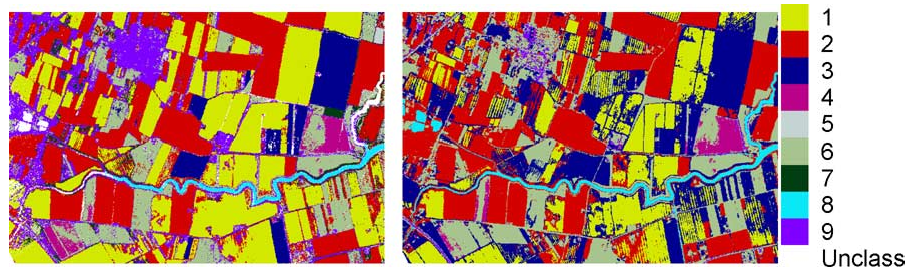 Figure 6: Visual results for the Tessera area. PCDA (left) effectively classifies most crops, while SVM (right) fails to identify the Urban class and introduces "striping" artifacts.
Deep Insight: Why ICA Wins
The brilliance of using ICA in this context is its ability to decorrelate signal from noise. Hyperspectral sensors often have lower Signal-to-Noise Ratios (SNR) in the SWIR (Short-Wave Infrared) region. ICA naturally isolates these noise components, allowing the discriminant analysis to focus on the "pure" independent signals that define a crop's spectral signature.
Conclusion and Future Outlook
This work confirms that forthcoming PRISMA data can be effectively used for end-user agricultural applications. By moving away from "black-box" ML and towards Statistical Discriminant Analysis with prior transforms, researchers can build models that are not only more accurate but also computationally light enough for large-scale satellite imagery processing.
The next frontier? Integrating Multispectral Segmentation to sharpen the boundaries between fields, further refining the "Precision" in Precision Farming.
Takeaways for the Industry
- Feature Engineering > Model Complexity: A simple classifier on well-transformed (ICA) data often beats a complex SVM on raw data.
- Spectral Efficiency: You don't need 100 bands; 10-15 well-chosen bands usually capture the vast majority of variance for land-use tasks.