
Beyond Majority Voting: Statistical Quality Estimation for Creative Crowdsourcing
16555_Statistical quality estimation for general crowdsourcing tasks.
This paper introduces an unsupervised probabilistic generative model for estimating the quality of artifacts in general crowdsourcing tasks with unstructured responses (e.g., logo design, writing). It utilizes a two-stage workflow—creation and review—to effectively aggregate ordinal grades into a single quality score using Item Response Theory.
TL;DR
How do you guarantee quality when asking the "crowd" to design a logo or write an article? Unlike simple multiple-choice questions, creative tasks have no "correct" answer to compare against. This paper presents an unsupervised generative model that solves this by modeling both the ability of the author and the bias of the reviewer, allowing for high-accuracy quality estimation even when you only have a handful of non-expert opinions.
The Problem: The "Agreement" Trap
In traditional crowdsourcing (like image tagging), we use redundancy: if 5 people say a picture contains a "cat," it probably does. But if you ask 5 people to design a logo, you get 5 different logos. You cannot "average" a logo, and no two will be identical.
Current state-of-the-art (SOTA) methods like the Dawid-Skene model work well for labels, but they struggle with unstructured responses. While some have tried manual "Gold Standard" checks, these are expensive and don't scale. The authors identify a massive gap in the marketplace—most high-value crowdsourcing (coding, design, writing) lacks a robust, automated quality control mechanism.
Methodology: The Two-Stage Probabilistic Model
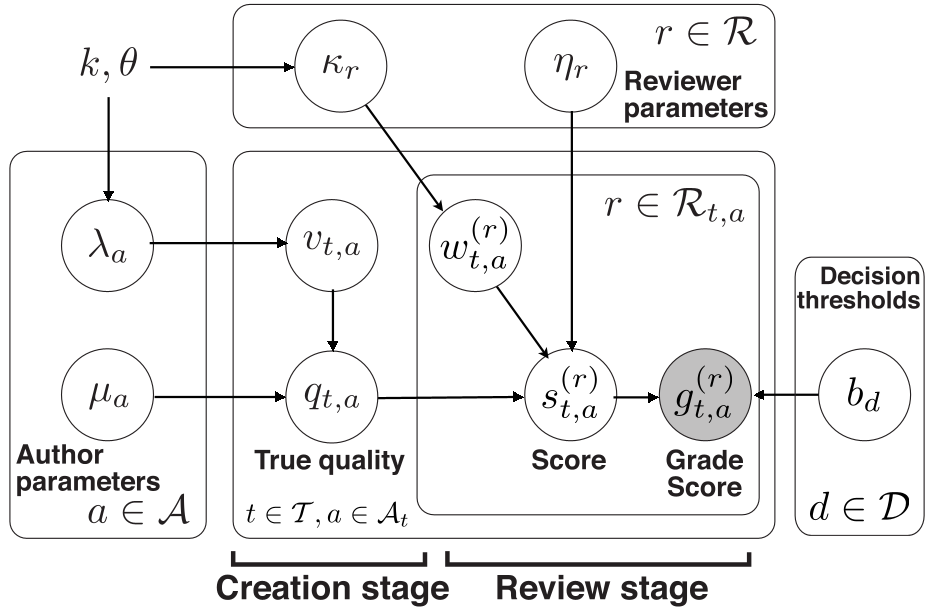
The core insight of this work is to split the process into two latent stages and connect them using a probabilistic bridge.
1. The Creation Stage
The model assumes every author has a latent ability . The quality of an artifact is not just a reflection of that ability, but also task-specific noise .
2. The Review Stage
Since we can't measure directly, we ask reviewers to give a grade (1-5). But reviewers are human—some are harsh, some are lenient. The model accounts for a reviewer's bias and their contextual preference .
The final observed grade is determined by the Graded Response Model (GRM), a staple of psychometrics. It calculates the probability of a reviewer choosing a specific grade based on the gap between the artifact's latent score and set thresholds.
Optimization and Inference
To find the hidden variables (the true quality), the authors use MAP (Maximum A Posteriori) inference. They developed an iterative algorithm that alternates between:
- Closed-form updates for precision parameters.
- Convex optimization (Gradient Ascent/Newton-Raphson) for worker abilities and biases.
This ensures that the model "learns" who the skilled authors are and which reviewers are consistently biased, adjusting the final quality scores accordingly.
Experimental Battleground
The researchers tested their model on three real-world datasets from the "Lancers" marketplace:
- Logo Design: Highly subjective.
- Image Description: Bridging CV and NLP.
- Language Translation: Technical and nuanced.
Results: Doing More with Less
The "Two-Stage Model" consistently outperformed Majority Voting and the Ordinal Dawid-Skene model.
- Finding the Best: In terms of nDCG@1 (the ability to identify the single best artifact), the model showed a clear lead.
- Efficiency: The performance of the proposed model with just one or three reviewers was often comparable to other methods using much larger groups. This translates directly to lower costs for requesters.

Critical Analysis & Takeaways
The brilliance of this paper lies in its application of Item Response Theory—usually used for SATs and IQ tests—to the wild west of crowdsourcing.
Key Takeaways:
- Author Modeling Matters: Simply looking at review scores isn't enough. Knowing the historical performance of the creator provides a vital "prior" that stabilizes the quality estimate.
- Unsupervised Power: Achieving these results without "gold standard" data is a major win for real-world applications where ground truth is non-existent.
Limitations: The model assumes a Gaussian distribution for author performance and reviewer preference, which might not capture "outlier" genius or malicious trolls perfectly. Furthermore, as the number of authors grows, finding the absolute "best" remains statistically challenging.
Future Outlook: As we move into the era of LLMs, this framework could be adapted to evaluate AI-generated content (RLHF), using this two-stage logic to de-bias human preference data.