
STCS Lexicon: Solving the "Sentiment Drift" Problem with Spectral Clustering
STCS Lexicon: Spectral-Clustering-Based Topic-Specific Chinese Sentiment Lexicon Construction for Social Networks
The paper introduces the STCS Lexicon, a method for constructing topic-specific Chinese sentiment lexicons for social networks using spectral clustering and a sentiment relationship undirected graph. By integrating base, topic, and synonym similarities, it achieves superior performance in identifying context-dependent sentiments, effectively producing both 3-division and 5-division sentiment lexicons.
TL;DR
The STCS Lexicon framework addresses a critical flaw in traditional sentiment analysis: the fact that word meanings change across topics. By using a semi-supervised pipeline involving text filtering, multi-dimensional sentiment similarity calculation, and Spectral Clustering (SC), the authors generate high-precision, topic-specific lexicons (3-division and 5-division) that outperform standard universal dictionaries like NTUSD without requiring heavy manual labeling.
Context: Why Universal Dictionaries Fail
In the world of social media, language is fluid. A word like "smooth" (流畅) is a glowing compliment for a smartphone's UI, while "satisfactory" might be lukewarm in a luxury hotel context. Universal lexicons ignore these nuances, leading to severe accuracy drops in specialized domains.
The authors identify three main gaps in current research:
- Topic Dependency: Words change polarity based on the subject.
- Language Evolution: Social media spawns new "Web languages" faster than experts can update manual dictionaries.
- Scalability: Existing domain-adaptation models often require massive cross-topic corpora or significant human intervention.
The Methodology: From Text Influence to Spectral Subgraphs
The STCS (Spectral-clustering-based Topic-specific Chinese Sentiment) Lexicon framework operates through three sophisticated models:
1. Filtering Text (FT) Model
Before building the lexicon, the system filters out "noise" (ads, spam) by calculating a Text Influence Value. This value combines user participation (likes, comments, forwards) with a persistence factor, ensuring the lexicon is built from high-quality, relevant data.
2. Constructing Sentiment Relationship (CRM) Model
This is the core "engine." It measures similarity between words through three distinct lenses:
- Base Similarity: Priors from authoritative universal lexicons.
- Topic Similarity: Based on the physical distance between words in a "Location Relationship Graph." It utilizes a "polarity reversal" logic: if an odd number of privative (negation) words exist between two sentiment nodes, their similarity becomes negative.
- Synonym Similarity: Measured via Jaccard coefficients of their synonym sets.
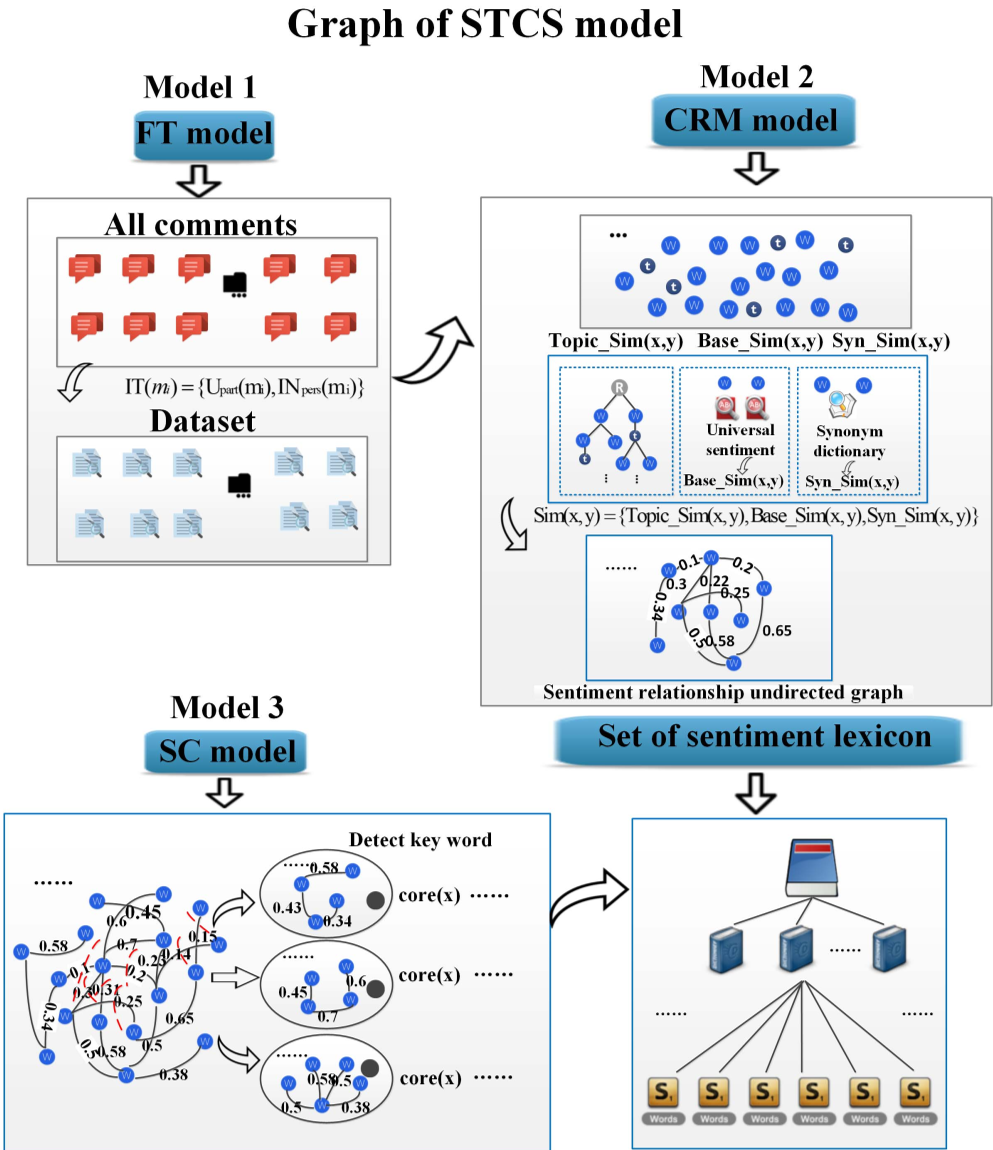
3. Spectral Clustering (SC) Model
The similarity matrix is transformed into a Laplacian matrix. The SC model then segments the sentiment graph into subgraphs. The beauty of this approach is its ability to create a 5-division lexicon (e.g., Very Positive, Positive, Neutral, Negative, Very Negative) by further clustering the initial 3-polar results.
Experimental Proof: SOTA Performance
Testing on real-world data from JD.com (Iphone6) and eLong (Hotels), the STCS method showed significant gains over the NTUSD baseline.
| Method | Precision (Hotel) | Recall (Hotel) | Chi-squared |
|---|---|---|---|
| NTUSD (Universal) | 0.721 | 0.713 | 34.243 |
| STCS (Proposed) | 0.814 | 0.771 | 16.774 |
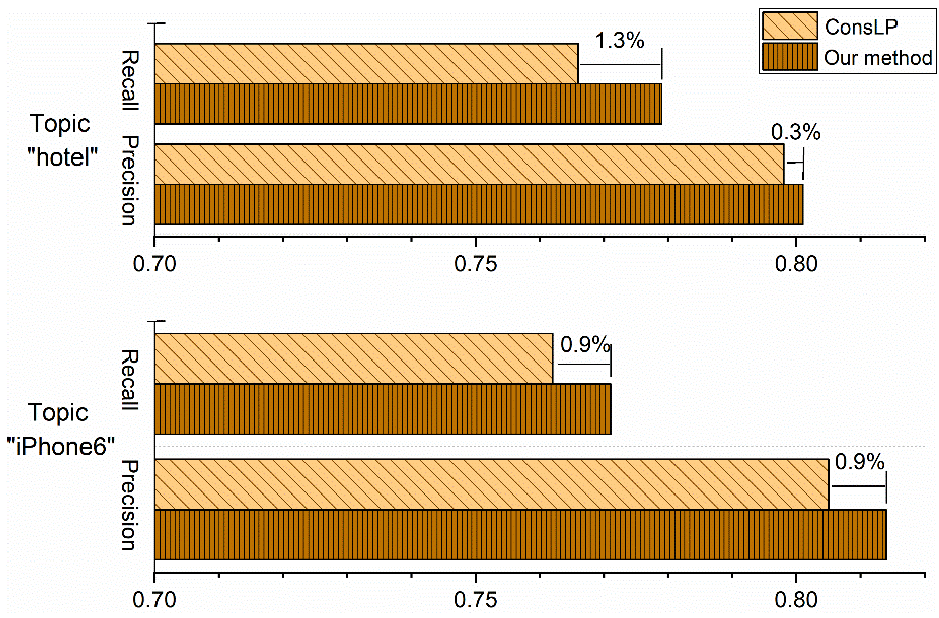 Fig 4: The STCS Lexicon (Our method) consistently maintains higher Precision and Recall compared to ConsLP across different datasets.
Critical Insight: The Value of Key Word Detection
One of the most impressive features of this work is the Key Word Detection within subgraphs. By calculating the core(x)—a metric of node degree and edge weights—the model automatically identifies the most representative word for a cluster (e.g., "Satisfactory" vs "Good"). This allows the system to assign semantic labels to automatically generated clusters without human supervision.
Conclusion & Future Outlook
The STCS Lexicon demonstrates that sentiment analysis is moving away from static lists toward dynamic, graph-based representations.
- Takeaway: The combination of local contextual distance and global lexical synonyms effectively captures "sentiment drift."
- Limitation: While efficient for Chinese social media, the reliance on synonym lexicons and specific privative word tables means some language-specific tuning is still required for expansion into other languages.
- Perspective: Future iterations could integrate Deep Learning embeddings (like BERT or RoBERTa) into the CRM model's similarity calculation to further enhance the capture of semantic nuances.