
SIM: Leveraging Ant Colony Intelligence for Scalable Influence Maximization
Stigmergy-Based Influence Maximization in Social Networks
The paper introduces the Stigmergy-Based Influence Maximization (SIM) approach, a decentralized model that simulates influence propagation using ant colony behaviors. By leveraging indirect communication through virtual pheromones, it identifies influential nodes in large-scale social networks more efficiently than traditional centralized seed selection algorithms.
TL;DR
Influence Maximization (IM) is critical for viral marketing but is traditionally an NP-hard problem that chokes on large-scale data. This paper proposes SIM (Stigmergy-Based Influence Maximization), which replaces heavy centralized computations with a decentralized "Ant Colony" simulation. By letting autonomous agents leave "pheromone" trails on influential nodes, the system identifies top-tier seeds with high effectiveness and orders of magnitude better efficiency than greedy search.
Motivation: The Scale Wall
In the era of massive social graphs, traditional influence models like the Independent Cascade (IC) model face a major bottleneck: they are centralized. Selecting the optimal "k" seeds requires a global view and massive iterations (Greedy selection), which simply doesn't scale. Moreover, real-world networks are dynamic; a centralized model becomes obsolete the moment the graph changes.
The authors' insight is to look toward nature. In an ant colony, no single ant knows the whole map, yet they collectively find the shortest path to food. Can we use this Stigmergy (indirect communication through environmental markers) to find the most influential nodes?
Methodology: The Ant's Trail
The SIM approach decomposes the IM problem into decentralized agent behaviors:
- Path Selection: Ants move between users (nodes) based on a probabilistic formula (Eq. 1) that considers both the relationship strength (edge weight) and the "pheromone" left by previous ants.
- Pheromone Allocation: Instead of just marking a path, ants generate a "sub-network" of their tour. The amount of pheromone dropped is proportional to the local neighbors of the path, rewarding nodes that bridge different clusters.
- Pheromone Evaporation: To prevent the system from getting stuck in local optima (e.g., just picking a few high-degree nodes), pheromones disappear over time, allowing the system to explore new potential influence paths.
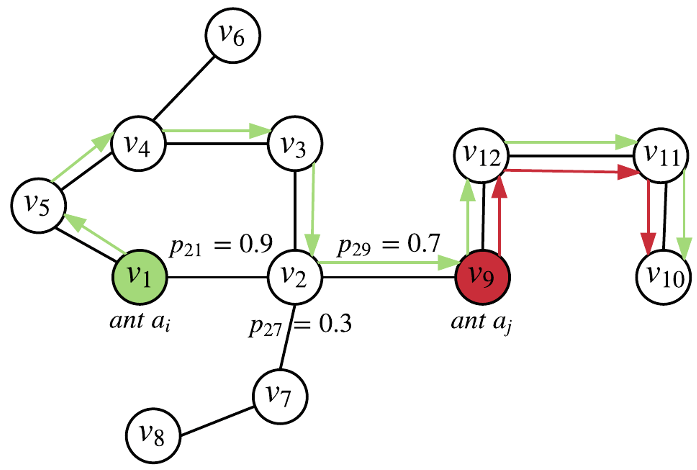 Figure: Path selection mechanism where multiple ants navigate the network independently.
The "Seeds" are eventually selected by ranking the nodes with the highest stable pheromone concentration.
Experimental Evidence
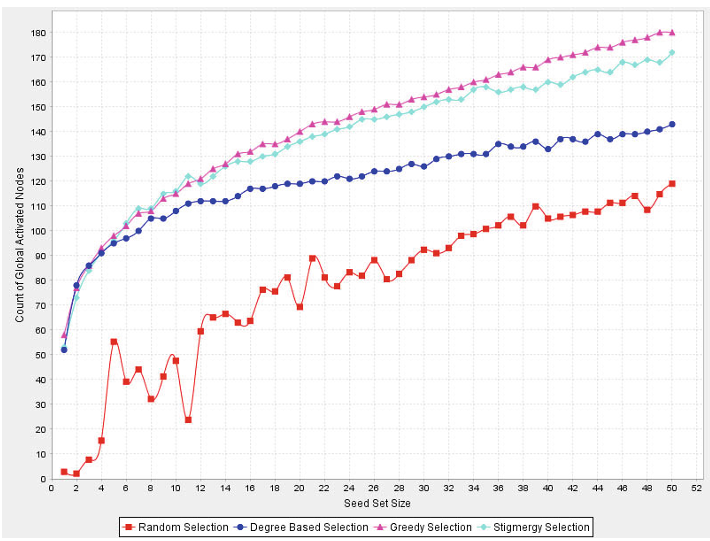
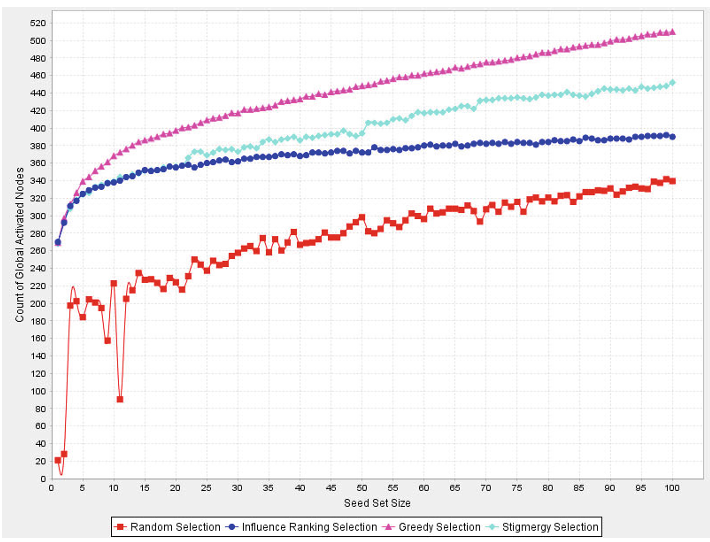
The authors tested SIM against Greedy, Degree-based, and Random selection using MovieLens datasets.
Influence Effectiveness
SIM consistently outperformed degree-based heuristics. In small networks (size=500), its performance was nearly identical to the Greedy algorithm—the gold standard for influence coverage.
Scalability and Efficiency
This is where SIM shines. While the Greedy algorithm's runtime spikes sharply as the number of seeds () increases, SIM's computational cost remains relatively flat. Because the ants work in parallel and only local information is processed, the "Decentralized Advantage" becomes clear as the network scales to 1,000+ nodes.
Critical Analysis & Conclusion
The Takeaway: SIM proves that we don't need a "God View" of a social network to find its leaders. By mimicking biological stigmergy, we can identify influential seeds through local, self-organizing interactions.
Limitations:
- Convergence Speed: While efficient per iteration, the time required for pheromone levels to "stabilize" (Global Pheromone Distribution) can vary based on the evaporation constant .
- Parameter Sensitivity: The performance relies heavily on the probability threshold and evaporation rate, which might require tuning for different types of social graphs (e.g., Twitter vs. LinkedIn).
Future Outlook: Integrating Reinforcement Learning with the ant agents could allow them to "learn" more complex pathing strategies, potentially surpassing the Greedy baseline even in high-sparsity networks.