
Stochastic Agent-Based Simulations: Bridging the Gap Between Narrative and Statistics
Stochastic Agent-Based Simulations of Social Networks
The paper introduces a two-tier stochastic simulation framework (Activity + Observational) for generating high-fidelity social network and human mobility data. It leverages a Mixed-Membership Agent-Based Model to bridge the gap between abstract statistical graphs and hand-crafted narrative simulations, achieving SOTA-level parity with the NGA Baghdad mobility dataset.
TL;DR
In the world of network analytics, data is either real but "messy" (no ground truth, privacy issues) or synthetic but "hollow" (statistically sound but lacking individual narrative). This paper by Bernstein and O’Brien introduces a two-tiered simulation framework that combines the flexibility of Mixed-Membership models with the grounded reality of Agent-Based simulations. By modeling "Roles" and "Actions" separately, they can simulate thousands of agents with realistic 24-hour "lives" that match real-world mobility datasets like the NGA's Baghdad traffic logs.
The Problem: The Synthetic Data Trilemma
Researchers in network science generally choose between three sub-optimal options:
- Real-World Data: Gold standard fidelity, but incredibly hard to "truth" (know exactly what happened) and fraught with privacy regulations.
- Statistical Models (e.g., Blockmodels): Great for matching aggregate distributions (like degree power laws) but they lack "narrative." A node is just a node, not an agent with a morning commute and a workplace.
- Hand-Crafted Agent Models: High narrative fidelity but impossible to scale. The NGA Baghdad dataset, for instance, took 2-man years to create and resulted in only a single instance, making it useless for Monte Carlo testing.
Methodology: The Two-Tiered Approach
The authors' core insight is to decouple Activity (the "Why" and "When") from Observation (the "Where" and "How").
1. The Activity Model (The Brain)
The model uses a plate notation framework familiar to those in the Latent Dirichlet Allocation (LDA) community. Instead of documents and topics, we have Agents and Roles.
- Roles: Hidden intentions (e.g., Work, Home, Social).
- Actions: The physical manifestation (e.g., driving to a specific coordinate).
Using Dirichlet distributions, agents are allowed "mixed-membership," meaning they aren't just "Workers" or "Socialites"—they switch roles dynamically across different timespans (T), allowing for realistic diurnal cycles.
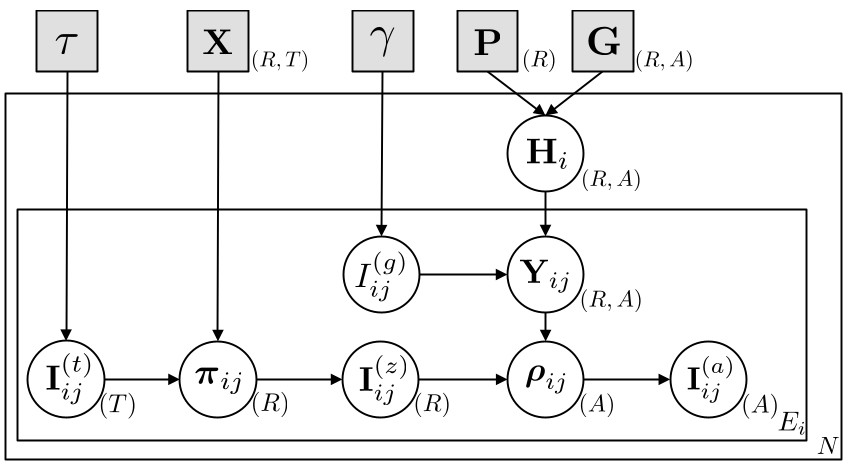 Figure 1: The Plate Model of the Activity Engine. Notice the dependencies between Timespan (), Role (), and Action ().
2. The Observational Model (The World)
To turn abstract "Actions" into "Data," the authors feed the activity into a physical world model. For human mobility, this involves:
- Road Network: Ingesting OpenStreetMap (OSM) data to build a weighted adjacency matrix of actual city streets.
- Pathfinding: Running Dijkstra’s algorithm to calculate the shortest path between "Action" destinations.
- Sensor Noise: Adding Gaussian noise and variable frame rates to the tracks to simulate realistic GPS/Aerial surveillance data.
Experiments & Results: Matching Baghdad
The authors validated their model by attempting to replicate the hand-crafted NGA Baghdad dataset. Since their model is stochastic, they can generate hundreds of "Baghdads" that are statistically identical but narratively unique.
Key Findings:
- Statistical Alignment: The simulated agents' velocity and track length distributions match the target data almost perfectly.
- Narrative Fidelity: Spatio-temporal plots show that agents correctly follow "Realistic" patterns—staying at home at night, moving to work in the morning, and allowing for occasional "abnormal" social deviations.
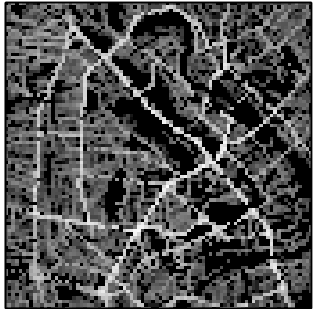 Figure 2: Comparison of Observation Density. The simulation (right) accurately captures the high-traffic arterial roads and secondary road distributions found in the target NGA data (left).
Critical Analysis & Conclusion
Takeaway
The genius of this framework lies in its application-agnostic core. While this paper focuses on cars in Iraq, the same "Activity Model" could be used to simulate email traffic in a corporation or collaboration networks in a lab by simply swapping the "Observational Model."
Limitations & Future Work
The authors acknowledge a current lack of Community Structure. In the current version, agents pick locations based on population-wide propensities. A more advanced version would include "Lifestyles," where groups of agents share specific social circles and favorite "hangout" nodes, creating the community clusters typical of real-world social graphs.
Conclusion: This paper provides a vital tool for algorithm developers. By enabling the generation of truthed, high-fidelity synthetic data in minutes rather than years, it paves the way for more robust Monte Carlo testing in the field of network analytics.