
Tracking the Pulse of Social Networks: A Stochastic Approximation Approach to Node Degrees
A novel use of stochastic approximation algorithms for estimating degree of each node in social networks
This paper introduces a Duplication-Deletion random graph model to simulate evolving social networks where nodes can both join and depart. By employing Stochastic Approximation (SA) algorithms and Markov-modulated dynamics, the authors derive a power-law exponent formula and prove that the estimated node degree distribution converges to the asymptotic distribution with a bounded mean square error.
TL;DR
Social networks are living, breathing entities where users join and leave constantly. This paper introduces a Duplication-Deletion model that captures this volatility and uses Stochastic Approximation (SA) algorithms to estimate node degree distributions in real-time. The authors prove that even when the network's behavior changes according to a Markovian environment, we can accurately track its "power-law" signature with bounded error.
Background: Beyond Growth-Only Models
Most classic graph models, like the Barabási-Albert model, focus on how networks grow. However, social networks like high school friendships or online communities also experience "deletion"—people lose interest, move away, or delete accounts.
The core challenge is: How do we estimate the degree distribution when the rules of the game (connection probabilities) change over time? If we only look at a static snapshot, we miss the underlying dynamics that lead to the "Giant Component"—the critical mass required for information or diseases to spread.
Methodology: The Duplication-Deletion Engine
The authors propose a two-step evolution for the graph :
- Duplication: A new node connects to a random "parent" node and, with probability , connects to each of 's neighbors.
- Deletion: With probability , a random node and all its incident edges are purged from the system.
1. The Power-Law Component
The paper derives a fundamental equation to find the power-law exponent :
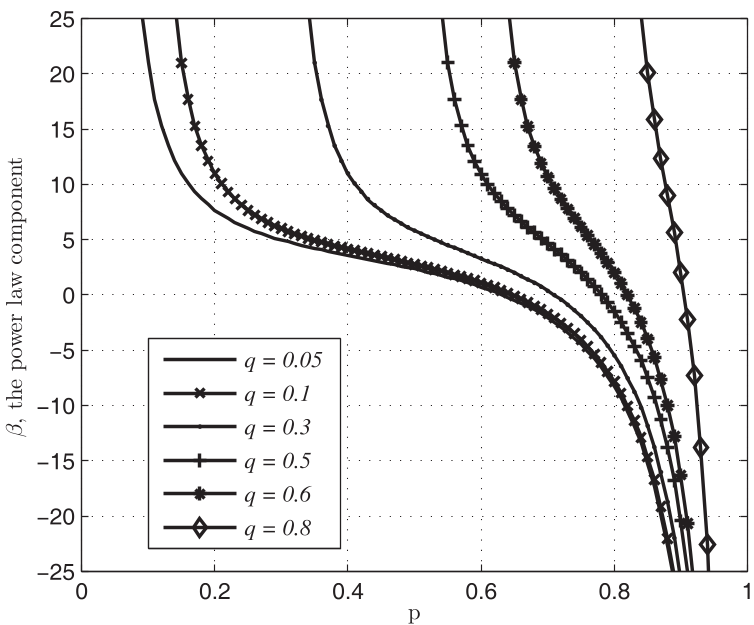 Fig 1: The relationship between connection probability (p), deletion probability (q), and the resulting power-law exponent.
2. Markov-Modulated Dynamics
Real networks don't have a constant . The affinity for new connections might fluctuate based on external "states" (e.g., a marketing campaign making a network more active). The authors model this using a slow Markov chain . To track the Cumulative Distribution Function (CDF) of degrees in this shifting environment, they use a constant step-size SA algorithm: This acts as a "running average" that is flexible enough to adapt when the Markov state switches.
Experiments & Results
The authors validated the model through numerical simulations. By plotting the degree distribution on a log-log scale, the linearity confirms that the duplication-deletion process indeed maintains a power-law structure, a hallmark of real-world "scale-free" networks.
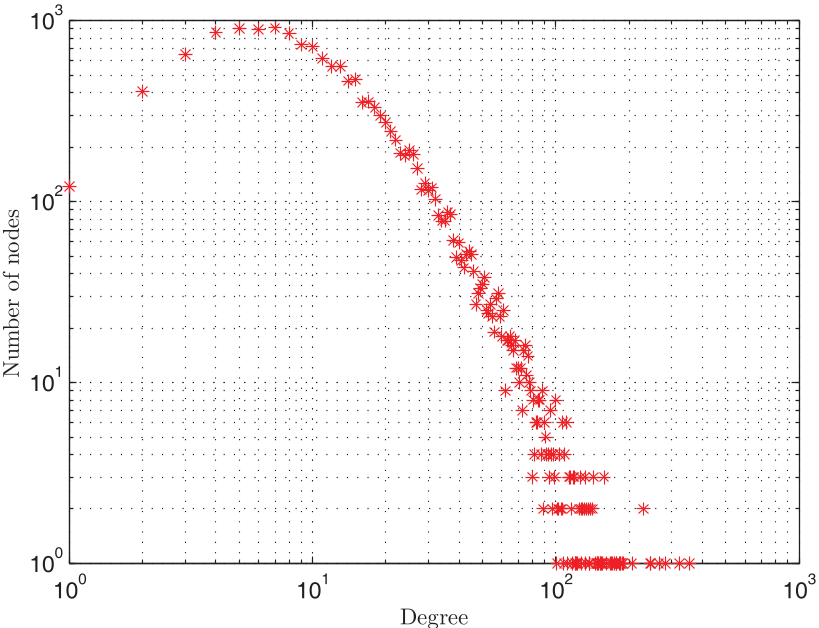 Fig 2: The degree distribution follows a clear linear trend in log-log space, indicating a robust power-law fit.
The theoretical "heavy lifting" is found in Theorem 3.1, which provides an upper bound on the Mean Square Error (MSE). It proves that as long as the environment changes slowly (small ) and the algorithm adapts at a reasonable rate (step size ), the estimation error remains small and manageable.
Critical Insights & Takeaways
- The Power of SA: Stochastic Approximation isn't just for optimization; it's a powerful tool for tracking non-stationary distributions in complex systems.
- Deletion Matters: Adding a deletion step significantly changes the power-law exponent. High deletion rates () lead to higher values, meaning the network becomes more "sparse" with fewer high-degree hubs.
- Future Impact: This framework can be applied to predict the "Giant Component" in epidemiology or viral marketing, allowing researchers to estimate if a network is at risk of a massive outbreak based on localized node observations.
Limitations: The model assumes uniform selection for deletion, whereas in reality, specific "communities" or low-degree nodes might be more likely to leave. Future research exploring non-uniform deletion would bridge the gap between this theory and specific social platform behaviors.