
Stochastic Game Theory: Decoding the Dynamics of Emergency Information Spread
Stochastic game model for information dissemination of emergency events in social network
The paper introduces a Stochastic Game Model to simulate information dissemination of emergency events in social networks. By modeling user interactions as a general-sum stochastic game, it accounts for individual "utility" based on cognition, interest, and reputation to predict spreading patterns.
TL;DR
Information during emergencies doesn't just spread; it interacts. This paper moves beyond simple "contagion" models by treating social network users as strategic players in a Stochastic Game. By defining a utility function based on interest and reputation, the authors demonstrate why certain personalities accelerate rumors and how "truth" eventually outpaces "falsehood."
The Human Factor: Why SIR Models Fall Short
Classic epidemiological models like SIR (Susceptible-Infected-Removed) treat information like a biological virus—if you are exposed, you are "infected." However, human behavior is far more nuanced. We filter information based on our cognitive biases, our level of interest, and the potential impact on our social reputation.
The authors argue that existing models are too rigid to handle the uncertainty and versatility of technological social interactions. To solve this, they shift the perspective from "infection rates" to "utility maximization."
Methodology: The Geometry of Interaction
The core of the paper is the definition of User Utility (), which is a weighted combination of:
- Cognition (): The user's internal understanding.
- Interest (): How much the topic aligns with their hobbies.
- Reputation (): The credence others place in them.
The Stochastic Game Framework
The interaction between a sender and a receiver is modeled as a game where players transition through different states of information. Each user chooses a strategy to maximize their long-term reward, factored by a discount rate .
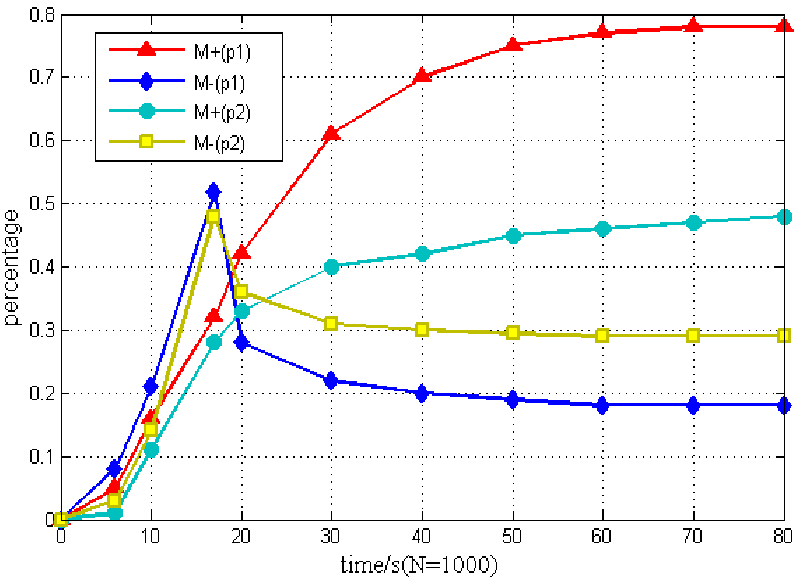 Fig 1: The rise and fall of information variants. Note how M- (false/variant messages) peaks and then declines as "true" information saturates the network.
The model is solved as a Nonlinear Programming (NLP) problem to identify the Nash Equilibrium, where no user has an incentive to change their forwarding behavior unilaterally.
Key Insights from the Case Study
The researchers simulated a network of 1,000 users with two distinct personality types:
- The Enthusiast (p1): High interest, low concern for reputation. Forwarding probability: 0.64.
- The Expert (p2): High reputation focus, cautious approach. Forwarding probability: 0.24.
Does Network Size Matter?
Surprisingly, the study found that network scale (N) has a negligible effect on the rate of information dissemination once the rapid propagation stage is reached. The internal personality weights are far more influential than the total number of nodes.
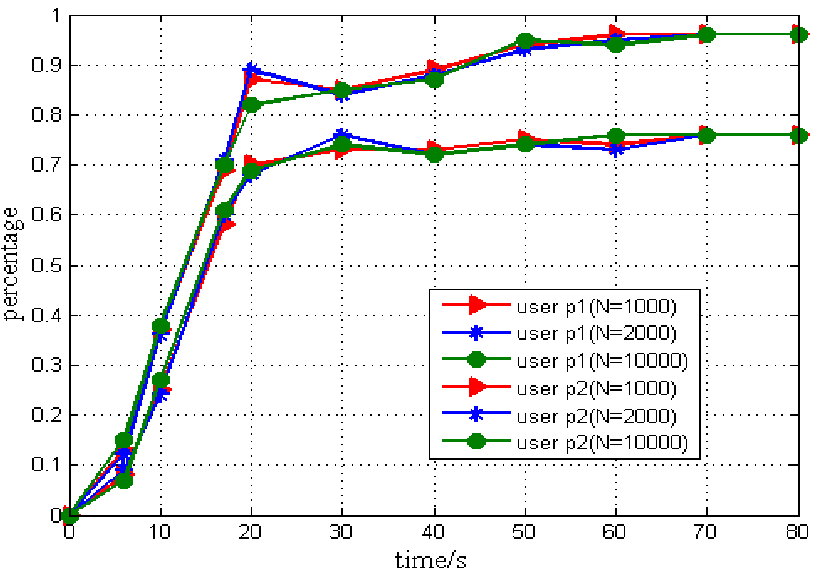 Fig 2: Dissemination patterns across different network sizes (N). The curves show that the fundamental mechanics of the spread remain consistent regardless of scale.
Critical Analysis & Conclusion
This work provides a robust mathematical justification for rapid fact-checking. The simulation proves that "Truth" acts as a counter-agent to "Falsehood." When true messages are introduced, the utility of sharing false variants drops, leading to a natural decline in misinformation.
Limitations: The model assumes a homogeneous network where everyone uses the same utility function. In reality, different sub-communities (echo chambers) might have wildly different weights for reputation versus cognition.
Takeaway: To control a crisis, don't just count the users—understand their motivations. Future research involving dynamic "updating rules" for these utilities could provide even deeper insights into the evolution of emergency events.