
Stochastic Mixed Membership Models: Decoupling Homophily and the "Rich-Get-Richer" Dynamic in Social Networks
A Study of Stochastic Mixed Membership Models for Link Prediction in Social Networks
This paper investigates the alignment of standard Stochastic Mixed Membership Models (SMMM), specifically the Infinite Latent Feature Model (ILFM) and the Infinite Mixed-Membership Stochastic Blockmodel (IMMSB), with fundamental social network properties: homophily and preferential attachment. By introducing formal mathematical definitions for these phenomena, the authors evaluate whether these generative models naturally satisfy the "rich-get-richer" and "birds-of-a-feather" dynamics inherent in real-world link prediction.
TL;DR
Do our standard link prediction models actually understand how social networks grow? This paper puts ILFM (Infinite Latent Feature Model) and IMMSB (Infinite Mixed-Membership Stochastic Blockmodel) to the test. The verdict: while both handle homophily (similarity) well, only IMMSB effectively captures local preferential attachment (the tendency for popular nodes in a niche to get more popular). This structural nuance makes IMMSB surprisingly better at link prediction when data is scarce in "bursty" networks.
Problem & Motivation: The Gap in Generative Logic
Social networks are governed by two "laws":
- Homophily: We connect with those like us.
- Preferential Attachment: The "rich get richer," leading to power-law degree distributions.
Most link prediction research focuses on accuracy (AUC) without asking if the model's generative DNA matches these laws. The authors argue that if a model doesn't theoretically "allow" for preferential attachment, it has to work much harder to "learn" it from data, making it fragile when training data is sparse.
Methodology: Formalizing Social Intuition
The authors define two key metrics to evaluate these models:
- Natural Similarity (): A measure . If a model is homophilic, the probability of a link must increase as increases.
- Local Preferential Attachment: A model satisfies this if the probability of a node gaining a new link in a specific community increases with its current "local" degree.
Architectural Breakdown
The paper compares two primary architectures:
- ILFM (Latent Feature Model): Uses binary features. A node either has a feature or it doesn't.
- IMMSB (Stochastic Blockmodel): Uses a distribution over features (soft membership).
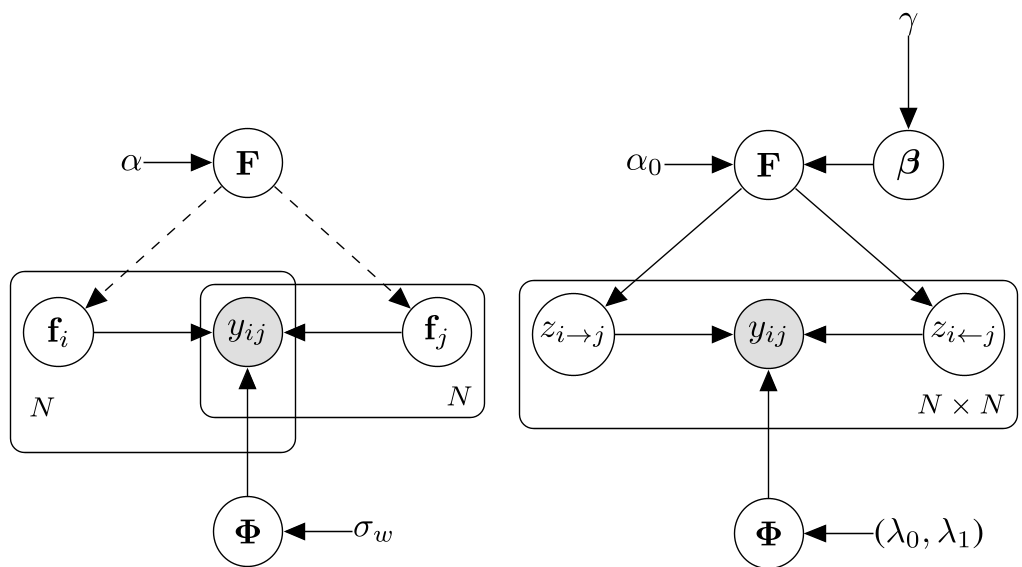 In ILFM (left), node representations are fixed per node. In IMMSB (right), the representation is sampled specifically for each potential interaction, allowing for more fluid "soft" memberships.
Key Insights: Why IMMSB Wins at "Burstiness"
The mathematical "Aha!" moment comes from the Dirichlet Process used in IMMSB. The Dirichlet Process has a "positive reinforcement" property; once a category is chosen, it’s more likely to be chosen again. This mirrors the "burstiness" of social interactions.
Conversely, ILFM uses the Indian Buffet Process (binary features). Because it's a "hard" switch (1 or 0), it lacks the mathematical gradient to favor nodes that are already popular within a feature, thus failing the local preferential attachment test.
Experiments & Results
The authors tested these models on synthetic networks (one bursty, one not) and real networks (political blogs and corporate emails).
1. Homophily Validation
Both models passed the homophily test for "Natural Similarity" but failed for "Latent Similarity" (factors only, ignoring the weight matrix ). This suggests that correlations between communities are vital for link prediction, not just the communities themselves.
2. Preferential Attachment & AUC
The most striking result appears in the link prediction performance under data scarcity.
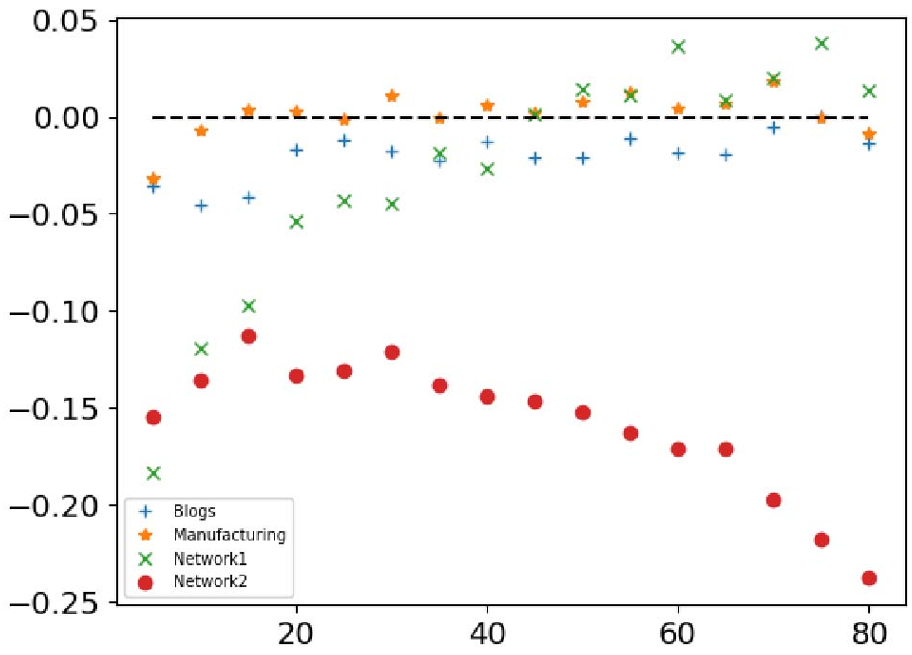 In the bottom graph, when testing data increases (moving right on the X-axis, meaning less training data), IMMSB's relative performance grows on bursty networks (Network1, Blogs). On non-bursty networks (Network2), ILFM remains superior.
Data shows that IMMSB identifies power-law distributions much more accurately (p-values ) than ILFM in local contexts.
Critical Analysis & Conclusion
Takeaway
If you are working with a network where certain nodes or communities exhibit massive growth (like viral trends or celebrity followers), IMMSB is your best bet despite its perceived simplicity compared to feature-heavy models. Its Bayesian prior inherently "expects" burstiness.
Limitations
A major hurdle remains: Global Preferential Attachment. The authors proved that neither model inherently satisfies global preferential attachment due to the independence assumptions in their generative steps. This means neither model can perfectly simulate the emergence of a "super-hub" node from scratch without a massive amount of existing data.
Future Work
The authors suggest moving beyond the exchangeability hypothesis (the idea that the order of nodes doesn't matter). To truly bridge the gap between Bayesian models and real-world "scale-free" networks, we may need models that explicitly account for the temporal arrival order of nodes, breaking the symmetry inherent in today’s SMMMs.