
Stochastic Team Formation: Balancing Expertise and Social Synergy in Mobile Crowdsourcing
A Stochastic Team Formation Approach for Collaborative Mobile Crowdsourcing
This paper introduces a hybrid Stochastic Team Formation approach for Collaborative Mobile Crowdsourcing (CMCS) that optimizes for both worker expertise and social connectivity. By employing a stochastic algorithm based on the "Odds-Algorithm" and optimal stopping theory, the framework identifies high-performing teams while significantly reducing the computational complexity inherent in NP-hard recruitment problems.
TL;DR
As Mobile Crowdsourcing (MCS) evolves from simple sensing to complex project execution, the focus must shift from individual tasking to Collaborative MCS (CMCS). This paper presents a breakthrough stochastic recruitment framework that uses Optimal Stopping Theory to form teams that are both highly skilled and socially cohesive, achieving near-optimal results with a fraction of the computational cost required by traditional methods.
The "Collaboration Paradox" in Crowdsourcing
Most crowdsourcing systems treat workers as isolated nodes. However, complex "projects"—such as emergency response or infrastructure monitoring—require workers to communicate and coordinate.
The problem is twofold:
- The Skill-Social Gap: Hiring the 5 best experts is useless if they cannot communicate due to language or geographical barriers.
- The Complexity Wall: Finding an optimal team from a pool of workers with skills is an NP-hard combinatorial nightmare. For a small pool of 6 workers, there are 720 combinations; for real-world scales, this becomes impossible to solve in real-time.
Methodology: The Leader-Centric Odds-Algorithm
The authors suggest a hybrid "Leader-Delegate" model. Instead of the platform managing every worker, it selects a Leader who has better "local knowledge" of their Social Network (SN) neighbors.
1. The Multi-Objective Metric
The efficiency of a team is calculated through a weighted function that balances:
- Skill Level: Estimated by the leader (including a confidence variance ).
- Confidence: Preferring workers the leader knows well.
- Financial Cost: Minimizing the requester's budget.
- Social Relationship: Maximizing the connectivity (hop-count) between all team members.
2. The Strategy (Optimal Stopping)
To avoid checking every possible combination, the algorithm treats team selection as a sequence of random events. It follows the Odds-Algorithm:
- Exploration Phase: Sample the first of possible team combinations without hiring.
- Exploitation Phase: Hire the very first team that outperforms the best one found during the exploration phase.
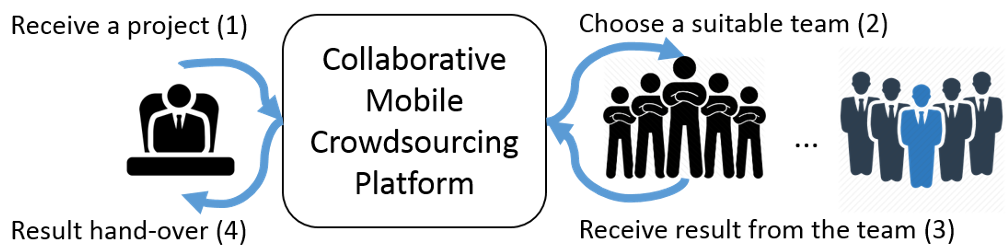 Fig 1: The architecture of the CMCS platform where the platform facilitates a workflow between the initiator and the leader-led team.
Experiments: Performance vs. Speed
The researchers compared their stochastic approach against a benchmark Integer Linear Programming (ILP) solution (using CPLEX).
Key Findings:
- Accuracy: The stochastic method consistently found the optimal or second-best team with high probability.
- Metric Gap: In social relationship degrees and skill levels, the stochastic approach trailed the optimal solution by less than 20%, a negligible trade-off given the speed gains.
- Computational Efficiency: While ILP scales exponentially, the stochastic approach provides a "one-pass" selection process that is drastically faster.
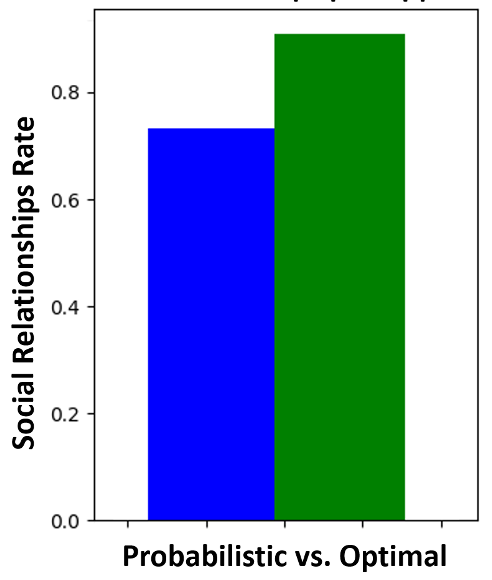 Fig 2: Comparison across six metrics showing that the probabilistic approach (left bar) remains competitive with the optimal solution (right bar) while requiring significantly less time.
Critical Insight: Why This Matters
The true brilliance of this work lies in its Inductive Bias toward social localism. By delegating recruitment to a leader, the system mirrors how professional teams are formed in the real world—through trusted referrals.
Limitations & Future Work
The current model assumes a static social graph and cost structure. In the future, exploring Dynamic SNs (where relationships evolve via past collaborations) and Incentive Mechanisms (preventing leaders from picking only friends regardless of cost) would be a logical next step.
Conclusion
This paper proves that we don't need to "solve" the NP-hard problem to get effective outcomes. By leveraging the mathematical elegance of optimal stopping, CMCS platforms can form capable, social teams on-the-fly, paving the way for more complex, collaborative IoT applications.