
Scaling the Long Tail: How Facebook Optimized Storage with Probabilistic Cache Promotion
Storage and performance optimization of long tail key access in a social network
This paper introduces a tiered caching architecture (L1/L2) and a novel probability-based promotion algorithm to optimize Memcached for social network workloads. By isolating "hot" data in frontend clusters and centralizing "long-tail" cold data in regional clusters, the authors significantly improved memory efficiency and cache hit rates at Facebook scale.
TL;DR
Facebook's engineering team tackled the "Long Tail" problem in social network data—where a few celebrity posts are intensely hot, but the vast majority of content is rarely accessed. By moving from a flat caching model to a Thin L1 (Cluster) / Fat L2 (Regional) architecture driven by a probabilistic promotion algorithm, they reduced cache misses by over 50% and saved significant global RAM by eliminating redundant copies of cold data.
Context & Motivation: The Tax of Duplication
In a global social network, caching strategy is a balancing act between latency and efficiency.
- Prior Approach: Key-value pairs (like photo metadata) were cached in every frontend cluster (L1).
- The Pain Point: If a region has frontend clusters, a piece of "cold" data accessed once in each cluster would end up having identical copies in RAM. For 90% of Facebook's data, this duplication provides no performance benefit but consumes massive amounts of expensive memory.
- The Insight: We only need duplicates of "hot" keys to prevent a single server's NIC from being overwhelmed. Cold data should only exist in one place within a region.
Methodology: Thin L1 and Fat L2
The authors proposed a tiered hierarchy:
- L1 Cache (Frontend Cluster): Small, fast, and contains only replicated hot items.
- L2 Cache (Regional): Large, shared by all clusters in the region, containing the "long tail" of cold data.
The Secret Sauce: Probabilistic Promotion
The core challenge is: How do you decide if a key is "hot" enough to move from L2 to L1 without keeping complex counters for billions of keys?
The authors used a brilliantly simple Probabilistic Model. When a key is found in L2, it is promoted to L1 only if a random check passes:
if (rand(1, N) % N == 1) { promote_to_L1(); }
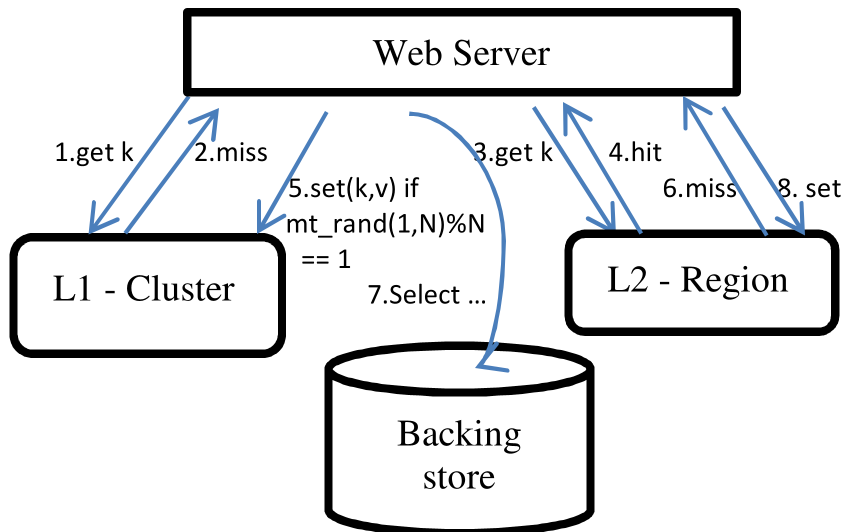 Figure 1: The L1/L2 Promotion Workflow
Mathematics of "Hotness"
Using the binomial distribution, the probability that a key is promoted within accesses is: By setting , a key accessed only a few times has a very low chance of polluting L1. However, a "hot" key accessed 100 times has a 95.48% chance of being promoted. This acts as a natural frequency filter with zero additional memory overhead for tracking.
Experimental Validation
The team tested this on the "Photo Tier," a dedicated Memcached pool for photo objects.
1. Cache Hit Ratio Boost
By adding the L2 layer and using , the aggregate hit ratio climbed from ~88% to over 93%. This represents a massive reduction in "expensive" misses that have to go all the way back to the persistent database.
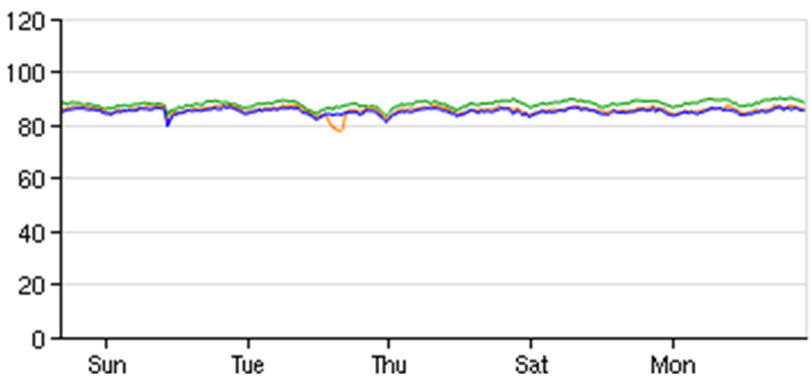 Figure 2: Impact of different threshold (N) values on promotion probability.
2. Eviction Age & Efficiency
When the promotion algorithm was enabled, the Eviction Age (how long an item stays in cache before being kicked out) in L1 increased significantly. This proves that L1 was no longer being "polluted" by one-hit-wonder cold data, allowing the truly relevant hot data to stay resident longer.
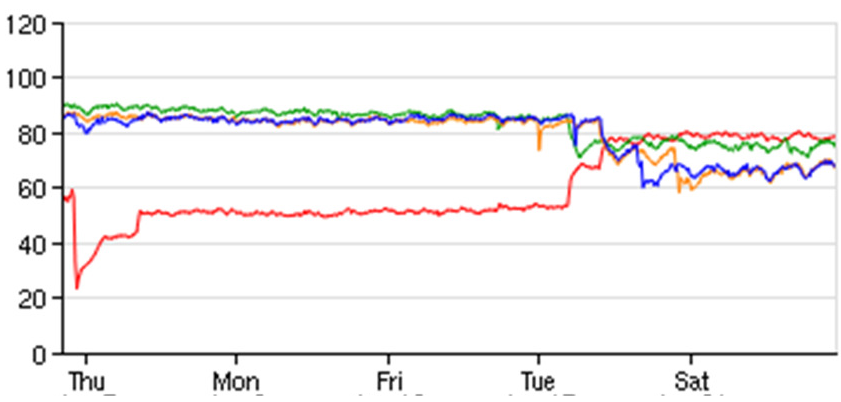 Figure 3: Network traffic shifting from L1 to L2 as the threshold is tuned.
Critical Insight & Analysis
The beauty of this work lies in its stochastic nature. In distributed systems, keeping global state (like a global "Top K" list of keys) is incredibly expensive due to synchronization requirements. By using local randomness ( probability), Facebook achieved global frequency awareness without any communication between servers.
Limitations
- Threshold Sensitivity: The value of must be carefully tuned. If is too high, even hot keys stay in L2 too long, potentially bottlenecking the L2 network.
- Access Patterns: This assumes a "Zipfian" or "Long Tail" distribution. In workloads where access is uniform, this architecture might add unnecessary latency (L1 miss -> L2 hit).
Conclusion
This paper is a masterclass in pragmatic distributed systems engineering. It shows that by understanding the underlying data distribution (the Long Tail) and applying simple probabilistic theory, one can achieve massive gains in storage efficiency and performance without the need for complex, stateful coordination.
Takeaway for Architects: Don't treat all cache misses equally. Use probability to let your "hot" data organize itself.