
StoryDrawer: Empowering Children’s Imagination Through Human-AI Collaborative Drawing
StoryDrawer: A Co-Creative Agent Supporting Children's Storytelling through Collaborative Drawing
StoryDrawer is a co-creative AI agent designed to assist children (aged 5-10) in oral storytelling through real-time collaborative drawing. By employing voice-driven sketching and an interactive "IDEA" button for generative inspiration, it transforms abstract stories into visual illustrations, achieving significant improvements in story novelty.
TL;DR
StoryDrawer is an intelligent co-creative agent that helps children overcome "writer's block" by turning their spoken words into real-time drawings. By combining Natural Language Processing (NLP) with generative sketch models (Sketch-RNN), the system acts as a creative partner that not only illustrates stories but also provides visual inspiration when children get stuck.
Positioning: This work is a significant contribution to the field of Child-Computer Interaction (CCI), moving beyond passive digital books toward active, generative AI partners in education.
Problem & Motivation: The "Blank Canvas" Paradox
Storytelling is vital for a child's development of logic and communication. However, the transition from a mental image to a coherent oral and visual narrative is cognitively demanding. Children frequently experience:
- Fear of the Blank Canvas: Not knowing where to start.
- Writer's Block: Losing the thread of the story midway.
- Perfectionism: Frustration when their drawing skills cannot match their imagination.
The authors' insight is that collaborative drawing can serve as an "external structure" for the inner world. If an AI can handle the burden of visualization, the child can focus on the creative act of narration.
Methodology: How StoryDrawer Works
The system architecture is bifurcated into two distinct interaction modes that facilitate a seamless creative flow.
1. Child Says and AI Draws
As the child speaks, a Voice-Driven Drawing Module uses NLP to extract nouns, quantities, and colors. These are mapped to the Quick Draw Dataset, producing real-time illustrations that reflect the story's progress. This provides immediate visual feedback and reinforces the child's narrative trajectory.
2. Child Scribbles and AI Completes
When a child is "stuck," they can scribble an abstract shape and press the physical IDEA button. The system uses a modified Sketch-RNN model to predict what the child might be attempting to draw, offering figurative sketches that serve as new story prompts.
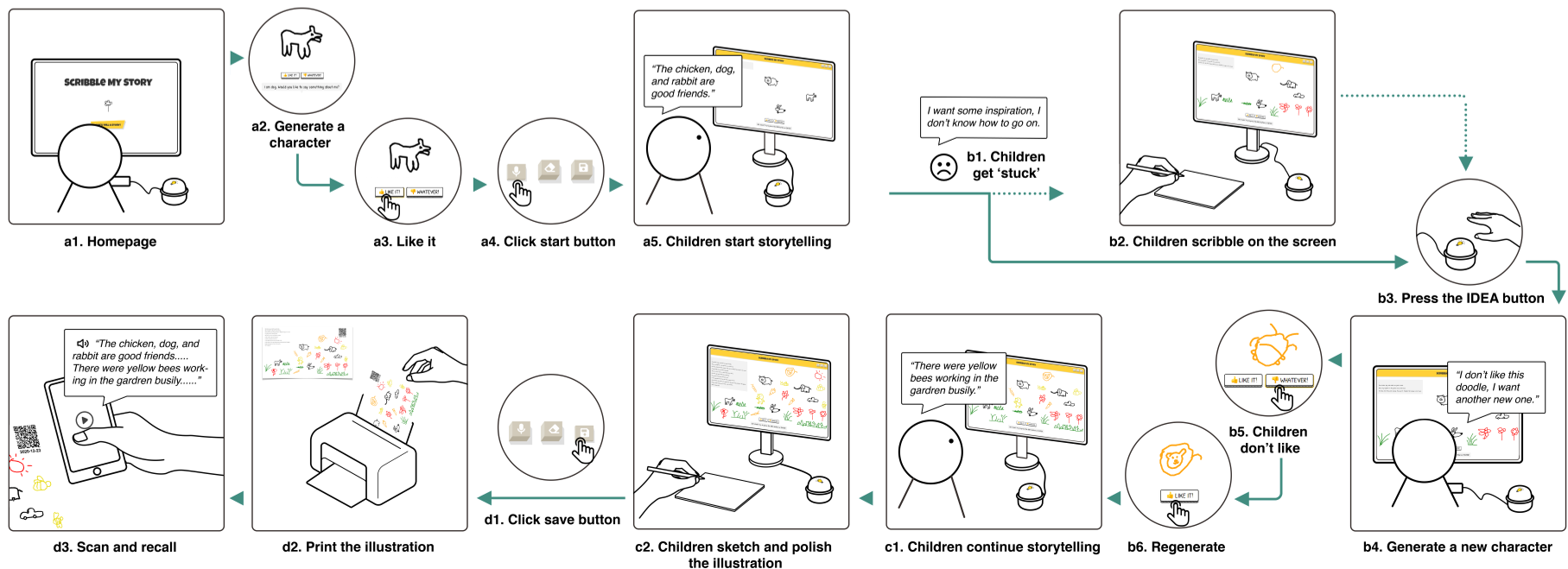
Figure 1: The workflow showing oral description extraction and the generative inspiration loop via the IDEA button.
Experiments & Results: Beyond Just Fun
The researchers conducted a within-subject study comparing StoryDrawer against a control group of traditional storytelling.
- Novelty Boost: StoryDrawer stories were rated significantly higher in novelty by expert teachers. The AI's ability to suggest "unexpected" elements helped children break out of repetitive narrative patterns.
- Integrity: While integrity scores were higher with the AI, the difference wasn't statistically significant, suggesting the AI's primary strength lies in creativity rather than structure.
- User Perception: Interestingly, younger children (approx. 5-7) viewed StoryDrawer as a "friend" or "partner," while older children viewed it as a "magic tool."
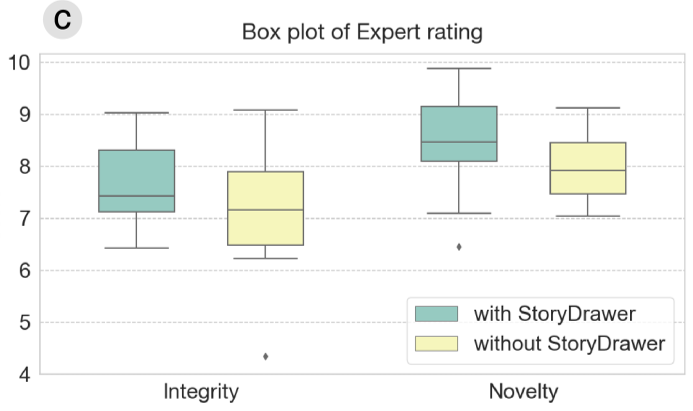
Figure 2: Statistical analysis showing the significant lead in Novelty scores (c) and positive participant feedback (a, b).
Critical Analysis & Conclusion
The Takeaway
StoryDrawer proves that AI doesn't have to "replace" human creativity; instead, it can act as a cognitive bridge. By reducing the technical barrier of drawing, it unlocks the sophisticated storytelling potential inherent in children.
Limitations & Future Work
- Semantic Depth: Currently, the AI maps keywords to individual doodles but lacks an "understanding" of the overall scene context.
- Social Extension: The current model is single-player. Future iterations could explore multi-child collaboration where the AI acts as a mediator.
- Dependency: There is a risk that children might become overly reliant on the "IDEA" button rather than exercising their own divergent thinking—a crucial area for longitudinal study.
In conclusion, StoryDrawer represents a shift toward Co-Creative Intelligence, where the value of AI is measured not by its autonomy, but by how well it empowers the human user.