
Strategic Players: Precision Targeting in Social Network Interventions
Strategic players for identifying optimal social network intervention subjects
The paper introduces "Strategic Players" (SP), a social network intervention (SNI) method designed to identify behavioral leaders who maximize influence on a target group while minimizing "leakage" or "contamination" to an avoid group. This approach extends the classical Key Player Problem (KPP-Pos) by incorporating node-level characteristics and a tunable trade-off parameter ().
TL;DR
In social network interventions (SNIs), the goal is often to pick "opinion leaders" to spread healthy behaviors. However, global influencers aren't always the best choice—especially if you need to avoid "contaminating" a control group or triggering antagonistic actors. The Strategic Players (SP) method provides a mathematical framework to pick a set of nodes that are "close" to your targets but "far" from everyone else you want to avoid.
The Problem: The High Cost of "Global" Influence
Most network studies rely on Centrality (Degree, Betweenness) or KPP-Pos (Cohesion). These methods ask: "Who can reach the most people the fastest?"
While this works for viral marketing, it fails in behavioral health for two reasons:
- Inefficiency: You waste resources training leaders who primarily talk to people who aren't at risk.
- Contamination: In research settings, if your intervention "leaks" from the treatment group to the control group, your entire study's validity is compromised.
The authors recognize that influence isn't just a matter of position; it's a matter of who is being influenced.
Methodology: The Strategic Trade-off
The core of the SP method is a modification of the distance-weighted reach formula. Instead of maximizing reach to the whole network, the algorithm optimizes the following objective function:
- (Target Group): The subset you want to change.
- (Avoid Group): The subset you want to shield.
- (Theta): The "Strategic Lever." A high focuses on reaching targets; a low focuses on staying away from the avoid group.
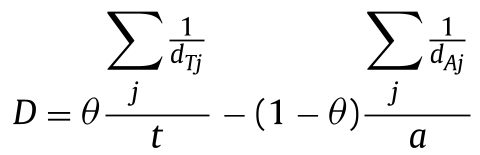
The authors use a greedy optimization (swapping nodes until no further improvement is found) to solve this, as calculating every possible combination of players is computationally impossible for large networks.
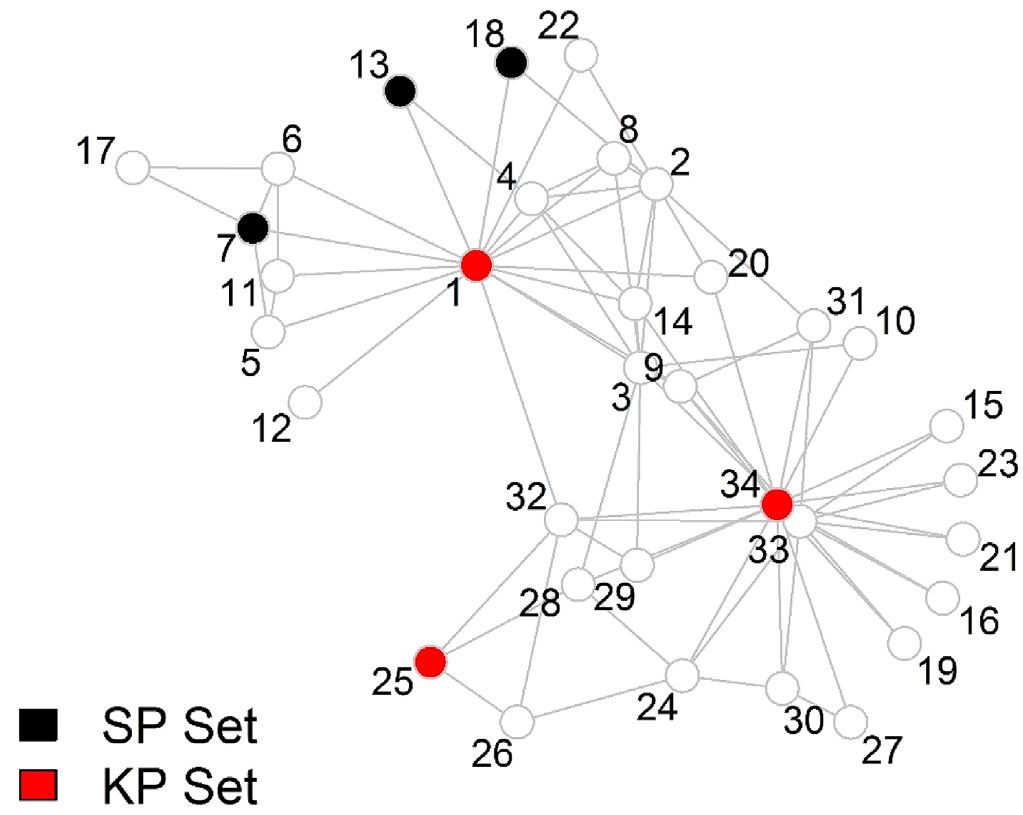
Case Study 1: Zachary’s Karate Club
In this classic social network (34 members), the authors split the club into a "Target" faction and an "Avoid" faction.
- KPP-Pos Results: Picked "Hubs" (Nodes 1, 34). These are high-degree, high-betweenness nodes. However, they were directly connected to the "Avoid" group.
- SP Results (): Picked "Strategic Niche" nodes (7, 13, 18). These nodes had significantly lower degrees (2-4) but were perfectly positioned to influence the target group while maintaining a "geodesic buffer" of at least 2 steps from the avoid group.
Case Study 2: The UrWeb Dormitory Study
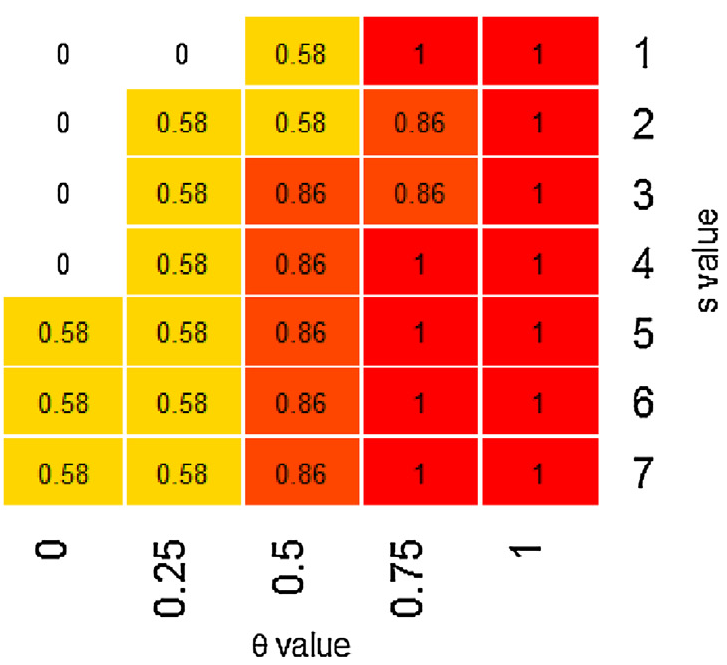
The researchers applied SP to a network of 44 college students across two dorms. The goal was to reach "Heavy Drinkers" in Dorm 1 while avoiding "Heavy Drinkers" in Dorm 2 (the control group).
The results showed a clear sensitivity to :
- As increased, the "reach" to the target group grew rapidly.
- By carefully selecting an (set size) of 4 and of 0.75, researchers could achieve 100% reach to targets with 0% leakage to the avoid group within one social step.
Critical Insights & Takeaways
- Local vs. Global: High centrality is often a liability in controlled interventions. Strategic players are often "community anchors" rather than "global hubs."
- Neutral Nodes as Bridges: The SP method smartly utilizes "Neutral" nodes. These individuals aren't targets, but the algorithm recognizes they are essential pathways (bridges) that facilitate influence.
- Flexibility: The ability to tune allows this method to be applied to diverse scenarios—from highly sensitive clinical trials to aggressive public health campaigns.
Limitations: The current model assumes influence "decays" linearly with distance (). Future work could explore more complex diffusion models (like Independent Cascade) within this strategic framework.
Conclusion
The Strategic Players method turns social network intervention into a precision tool. By moving beyond simple "popularity" metrics, it allows researchers and policy makers to navigate complex social landscapes with surgical accuracy, maximizing impact while minimizing unintended consequences.