
Beyond Static Spread: Strategy Evolution in Generalized Networks with Time-Varying User Behavior
Strategy evolution of information diffusion under time-varying user behavior in generalized networks
This paper proposes a Graphical Evolutionary Game Theory (graphical EGT) framework to model information diffusion in "generalized networks"—multi-layer structures combining social and physical substrates. The core contribution is the analysis of strategy evolution (forwarding vs. non-forwarding) under time-varying user interests and fitness values, identifying Evolutionary Stable States (ESS) that adapt dynamically to user behavior.
TL;DR
Information diffusion is not just a biological spreading process; it is a strategic choice made by users. This paper reframes information propagation as a Graphical Evolutionary Game played over multi-layer "Generalized Networks" (GN). By introducing time-dependent fitness values, the authors show how "Evolutionary Stable States" (ESS) move along trajectories—or ESS loci—providing a predictive tool for the cumulative behavior of users in social-physical hybrid systems.
The "Generalized" Context: Social Meets Physical
The advent of mobile social networks created a dual dependency:
- Social Layer: Dictates who we want to share information with based on interests.
- Physical Layer: Dictates if we can actually transmit data (e.g., wireless multihop constraints).
Prior works treated these as "flat" networks with static payoffs. However, user interest in a hashtag or a product isn't constant—it peaks and fades. This paper tackles the "Why" and "How" of diffusion when the rules of the game change every day.
Methodology: The Dynamic Replicator Equation
The authors utilize the Replicator Equation but adapt it for graphs. In a standard EGT model, the better-performing strategy grows. Here, the "performance" (fitness) of a forwarding strategy () vs. a non-forwarding strategy () is defined by:
- Baseline Fitness (): The inherent value of the user.
- Interactive Payoff (): The benefit gained from interacting with neighbors.
Architecture & Update Rule
The authors propose a modified Birth-Death (BD) update rule for GNs. A layer is selected (social with probability , physical with ), a "parent" is chosen proportional to fitness, and their strategy replaces a neighbor's.
 Figure 1: Illustration of a two-layer Generalized Network (GN) where physical and social substrates interact.
The system dynamics are captured by the state variables (percent of forwarding nodes) and (percent of edges connecting forwarders). These evolve according to non-linear differential equations (), where the equilibrium points effectively track the user interest fluctuations.
Experimental Insights: Oscillating Stability
The researchers tested two primary scenarios for user interest:
- Periodic/Sinusoidal: Modeling seasonal interests (e.g., vacation ads).
- Logarithmic/Exponential: Modeling the "hype cycle" of new information that saturates quickly.
Key Result: The Impact of Topology
A critical finding is that the Social Layer acts as a catalyst. Because social networks are often scale-free (power-law degree distribution), a few "hubs" with high interests can flip the entire network into a forwarding-dominant ESS.
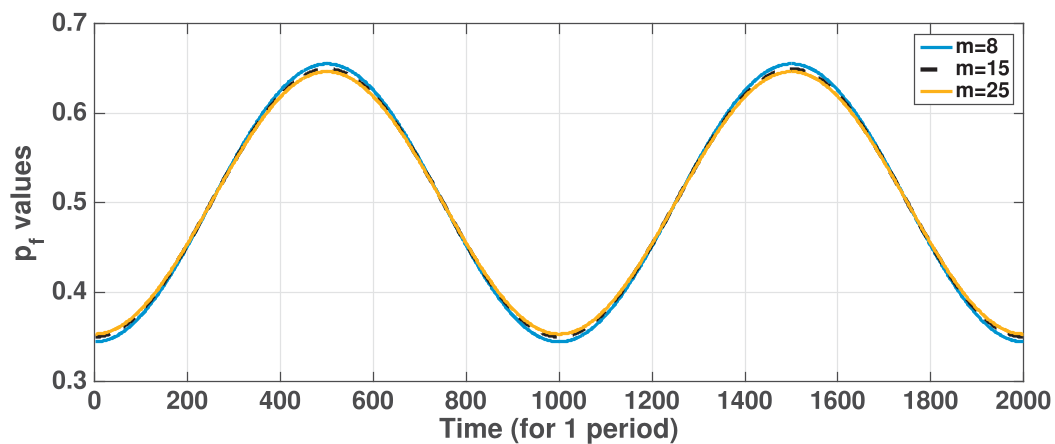 Figure 2: The ESS curve () follows the periodic payoff . Higher average degrees in the social layer boost the stable percentage of forwarders.
Connecting EGT to Epidemics
The paper concludes with a high-level mapping:
- EGT answers Strategy Selection: "Should I forward this?"
- Epidemics answers Spreading Dynamics: "How many people are informed?"
The authors argue that EGT-derived stable states should feed into the infection rates of epidemic models (like SIS or SIR). This "sequential" modeling (EGT Epidemics) is far more realistic than assuming a fixed transmission probability , as it grounds the spread in individual rational choice.
Critical Analysis & Future Outlook
While the modeling is robust, the paper assumes that all nodes adopt the same strategy across both layers. In reality, a user might be active socially but restricted by physical battery life or signal strength, leading to "strategy divergence."
Takeaway: For tech leaders and network architects, this research suggests that "viral" growth can be engineered by matching the timing of information release with the peak of the ESS loci, and by specifically targeting the social hubs in generalized multi-layer infrastructures.
Conclusion
By moving beyond static "average" behaviors, this work provides a rigorous mathematical foundation for understanding how the shift in user sentiments translates into physical network load. The introduction of Time-Varying Fitness is a major step toward a truly "user-aware" theory of network science.