
StreamingTalker: Enabling Real-Time 3D Digital Humans with Autoregressive Diffusion
StreamingTalker: Audio-driven 3D Facial Animation with Autoregressive Diffusion Model
StreamingTalker is a real-time speech-driven 3D facial animation framework that utilizes an Autoregressive (AR) Diffusion Model. It achieves state-of-the-art results in lip synchronization and facial dynamics while supporting streaming output for arbitrary length audio with low latency.
TL;DR
StreamingTalker is a breakthrough in speech-driven 3D facial animation. By shifting from batch processing to an autoregressive diffusion framework, it solves the "long-audio lag" and "horizon collapse" problems typical of current SOTA models. It achieves a 25ms start-up latency and maintains high-fidelity lip-sync across sequences of any duration.
Background: The Latency vs. Quality Trade-off
Speech-to-mesh generation is a classic "one-to-many" mapping problem. While Diffusion Models have become the gold standard for producing expressive, non-deterministic facial movements, they come with a heavy price: Temporal Inflexibility.
Previous SOTA models (like DiffSpeaker or FaceDiffuser) are designed to "see" the entire audio clip before they start denoising. This leads to two critical failures:
- Generalization Gap: If the training data is 5 seconds long, the model "chokes" or drifts on a 60-second audio input.
- Inference Lag: You cannot start the animation until the audio file is fully uploaded/processed—a dealbreaker for real-time AI avatars.
The Core Insight: Autoregressive Conditioning
The authors observe that facial motion is inherently local and causal. You don't need the end of a sentence to know how the mouth should move at the beginning. StreamingTalker reformulates full-sequence generation into an AR diffusion process.
1. Model Architecture
The pipeline consists of three main modules:
- VQ-VAE Latent Space: To simplify the complex mesh space, a VQ-VAE learns a compact, discrete codebook of "motion primitives."
- AR Condition Predictor: This is the "brain" of the system. It takes frames of past motion and the current audio embedding (from a pre-trained HuBERT model) to predict a dynamic condition vector .
- Lightweight Diffusion Head: Unlike heavy Transformers used in batch models, StreamingTalker uses a single-layer MLP as the denoising head. Because the condition is so information-rich, a simple MLP can recover the high-quality latent code in real-time.
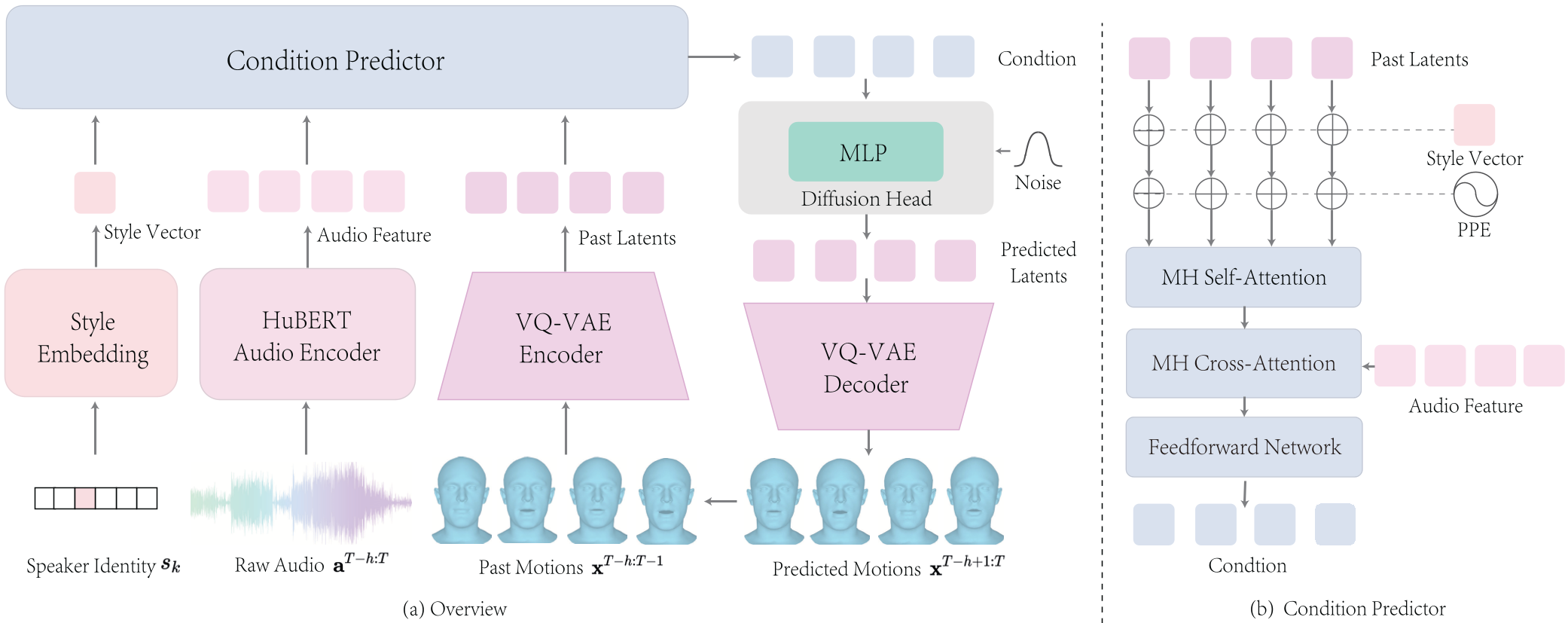 Figure 1: The dual-stage pipeline showing the fusion of audio and historical motion via a biased causal attention mechanism.
Experiments: Breaking the Length Barrier
The most impressive result is the model's performance on Long-Sequence Generation. In tests with sequences over 2000 frames (60+ seconds), StreamingTalker maintained its accuracy (LVE 4.45), while previous batch-based models saw significant performance degradation as they drifted further from their training window.
Quantitative SOTA Comparison
| Methods | LVE (VOCASET) ↓ | MOD (VOCASET) ↓ | LVE (BIWI) ↓ | FDD (BIWI) ↓ |
|---|---|---|---|---|
| DiffSpeaker | 3.1478 | 3.5339 | 4.2829 | 3.8535 |
| Ours | 2.7206 | 3.4987 | 4.2504 | 3.6690 |
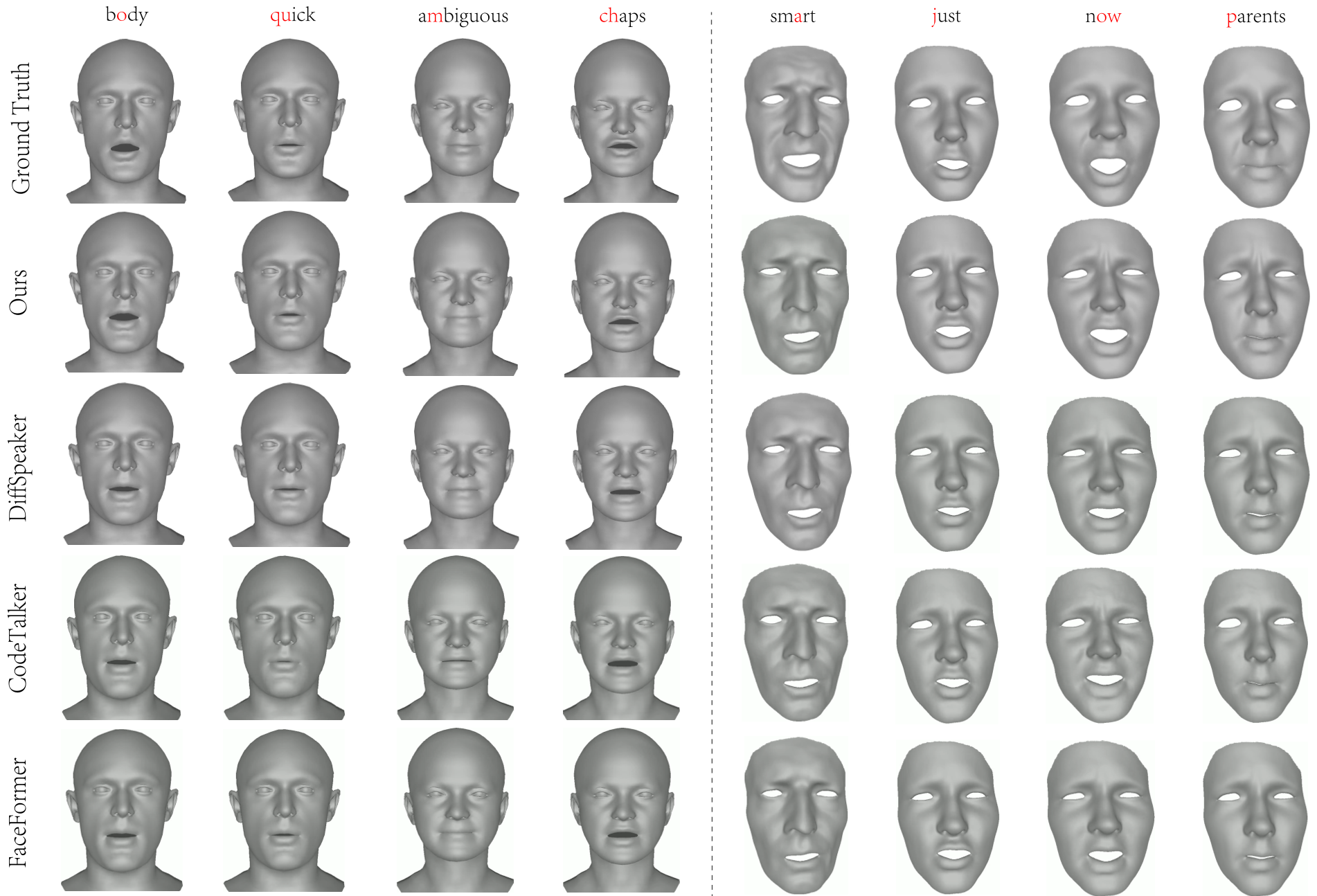 Figure 2: Visual analysis shows that StreamingTalker produces more rounded mouth shapes for vowels (o, u) and perfect lip closure for bilabial sounds (m, p).
Real-Time Latency Analysis
Efficiency is the primary differentiator here. By using a streaming approach, the "Inference Latency" (time to the first frame) remains a constant 25ms, regardless of whether the audio is 3 seconds or 30 seconds long. In contrast, batch models see their latency grow linearly with audio length.
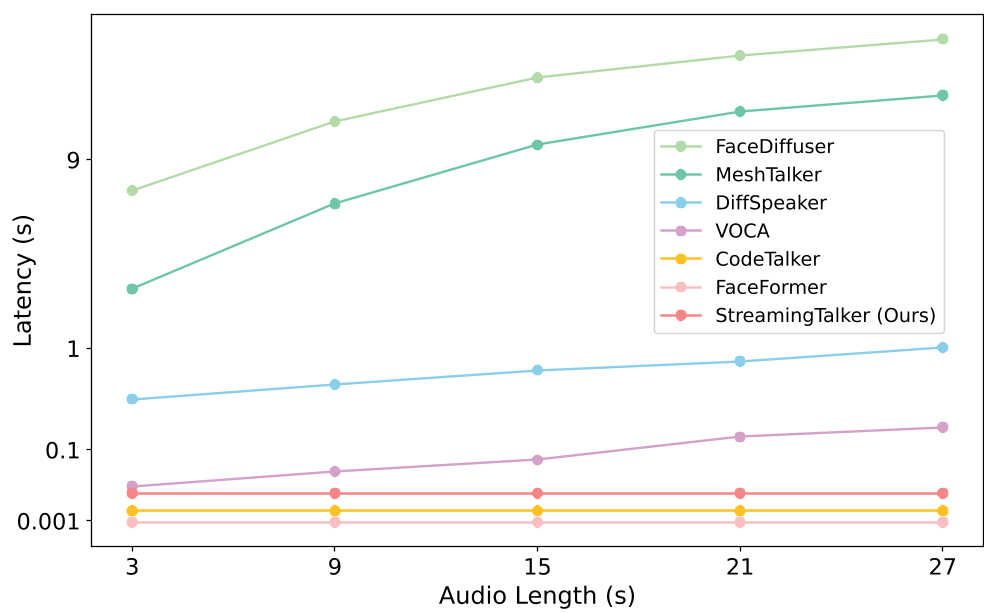 Figure 3: Inference latency comparison. StreamingTalker (Ours) maintains a flat horizontal line, ensuring real-time interactivity.
Conclusion & Insights
StreamingTalker successfully bridges the gap between the high-quality generation of Diffusion Models and the practical requirements of real-time applications.
The Key Takeaway: The success of the MLP-based diffusion head suggests that if the conditioning signal is sufficiently localized and accurate (via the AR Transformer), the actual denoising network doesn't need to be massive to produce SOTA results. This opens doors for deploying high-fidelity digital humans on edge devices.
Limitations: The model still struggles with global head pose and rich emotional variations, as the current datasets (BIWI/VOCA) are relatively limited in affective range. Future work integrating emotion-specific encoders (like EMOCA) will be the next frontier for this architecture.