
Beyond the Scoreboard: How Collective Intelligence Fuels Winning Teams in League of Legends
What Makes a Strong Team?: Using Collective Intelligence to Predict Team Performance in League of Legends
This study investigates the presence and impact of Collective Intelligence (CI) in the high-stakes environment of League of Legends (LoL). By analyzing 248 self-organized teams, the researchers demonstrate that CI accurately predicts future competitive performance (MMR and Skill Tier), establishing CI as a robust metric for team capability in highly virtual, fast-paced digital settings.
TL;DR
Is a winning team just a collection of five high-skill players, or is there a "hidden factor" that makes the group greater than the sum of its parts? This research proves that Collective Intelligence (CI)—a team's general ability to perform across diverse tasks—is a statistically significant predictor of success in League of Legends. Crucially, the study reveals that in fast-paced virtual worlds, tacit coordination and social perceptiveness matter more than talking a lot.
The "Virtuality" Challenge: Why Traditional Team Metrics Fail
In the modern era, teams are increasingly "dispersed, digital, and dynamic." Traditional management theory, built on face-to-face office interactions, often struggles to explain why some remote teams thrive while others crumble.
The authors identified League of Legends (LoL) as the ultimate "virtual laboratory." With 67 million monthly players and a high-stakes competitive environment, LoL teams face intense time pressure and sparse communication. The core question: Does the "Collective Intelligence" factor—previously seen in lab groups—actually translate to the chaotic Rift?
Methodology: Measuring the "Mind" of the Team
The researchers didn't just look at KDA (Kill/Death/Assist) ratios. They utilized a three-pronged approach:
- The TCI Battery: Teams performed 11 diverse tasks (brainstorming, memory, Sudoku) to extract a single CI factor.
- Social Perceptiveness: Individuals took the Reading the Mind in the Eyes (RME) test to measure their ability to read subtle social cues.
- Real-World Validation: Data was linked to internal MMR (Match Making Rating) provided by Riot Games, tracked over a six-month period.
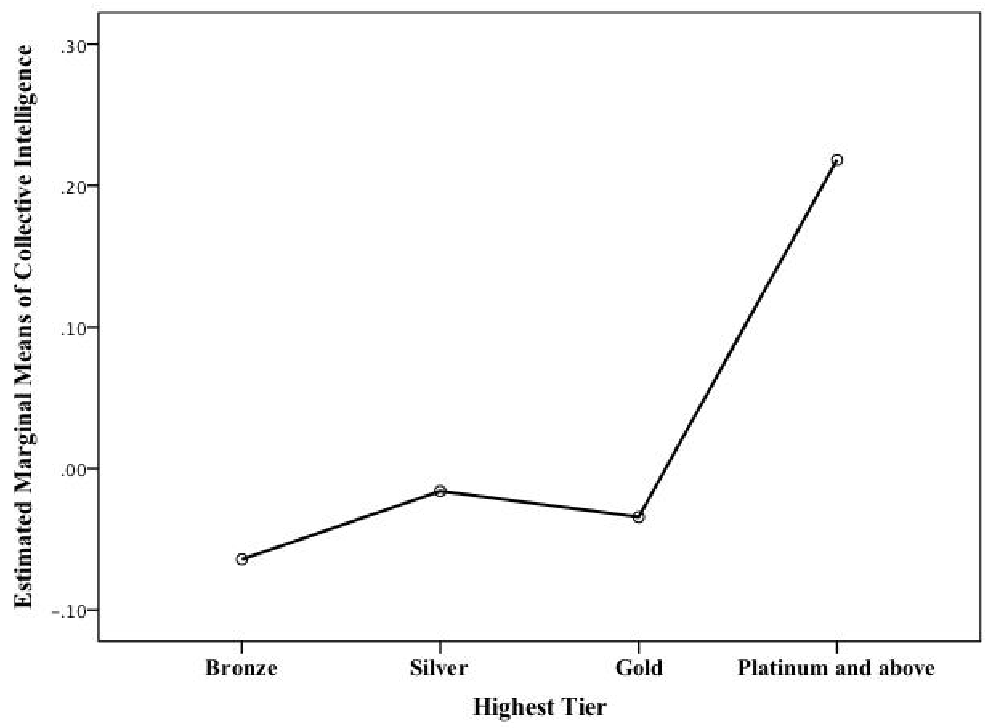 Figure 1: Higher Collective Intelligence scores correlate directly with reaching higher Skill Tiers (Platinum and above).
The Core Insight: Tacit Coordination > Constant Talking
One of the most radical findings of this study is the departure from traditional CI correlates. In face-to-face groups, "equality of conversational turn-taking" usually predicts a smarter team. In League of Legends, the opposite happened.
The Power of Silence
The study found that:
- Hierarchy is Helpful: Teams with more centralized decision-making actually had higher CI.
- Less is More: High game-related communication was sometimes negatively correlated with CI.
- Tacit Coordination: Collectively intelligent teams "make sense" of each other’s actions without needing to type or speak. They use pings and visual cues (like ward placement) to harmonize their behavior instinctively.
Key Results & Evidence
The data confirms that CI isn't just a byproduct of playing a lot; it's a unique capability:
- Persistence: CI predicted performance even 6 months after the initial test.
- The Gender Factor: The presence of even a single female team member was positively correlated with higher CI, likely due to higher average social perceptiveness.
- Stability Matters: The link between CI and performance was significantly stronger in "Lasting Teams" compared to "Temporary Teams."
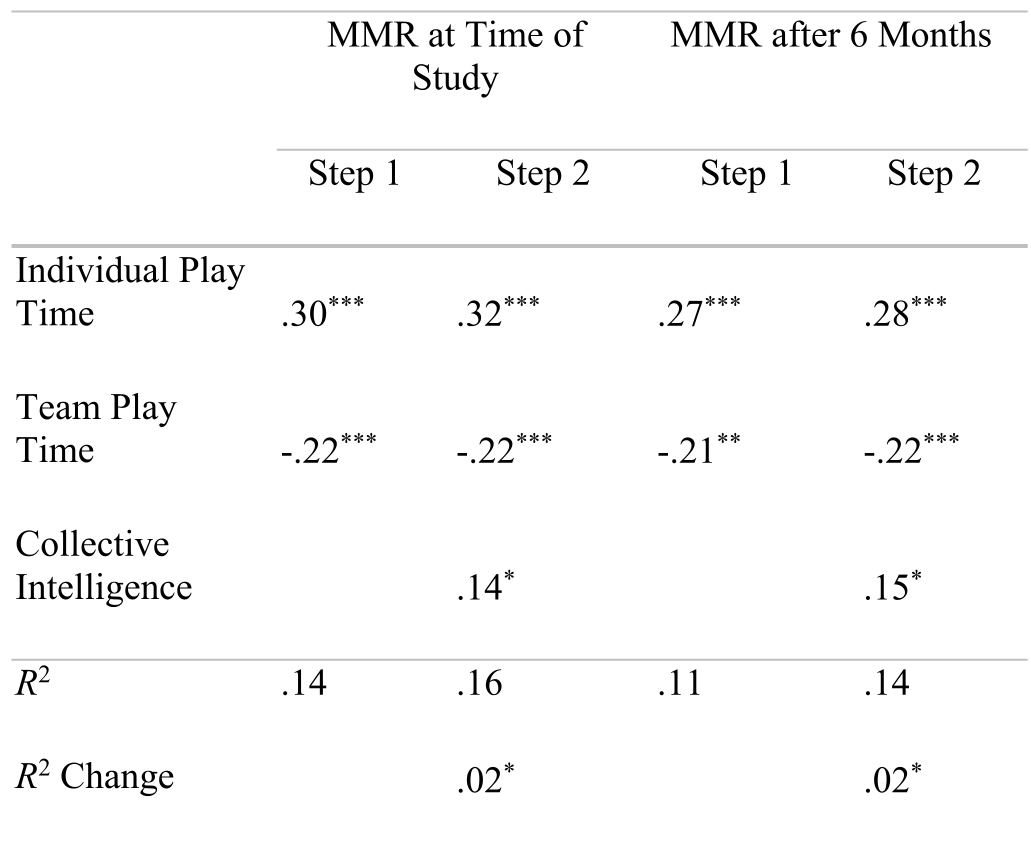 Table 1: Note that while individual play time is the strongest predictor, Collective Intelligence provides a distinct and significant boost to MMR.
Critical Analysis & Conclusion
This paper fundamentally shifts how we view "gaming skill." It suggests that the best players aren't just mechanical gods; they are socially perceptive individuals who can synchronize with others with minimal friction.
Strategic Takeaways:
- For Game Designers: Systems like "Honor" badges and "Pings" are not just social fluff; they are the infrastructure of tacit coordination. Improving non-verbal cue systems (facial expressions or bio-signals) could revolutionize team play.
- For eSports Coaches: When scouting, look for "Social Perceptiveness." A player who can read the room (or the map) without being told what to do is the engine of a high-CI team.
- The "Stability" Trap: Simply playing together for a long time doesn't guarantee success. In fact, "Team Play Time" showed a slight negative correlation with MMR when not backed by high CI.
The Bottom Line: To build a strong team in a fast-paced digital world, focus less on "talking it out" and more on recruiting members who can "read" the team without a word being said.