
Decoding Social Bonds: Inferring Tie Strength via Network Topology
Using Structural Features to Characterize Social Ties
This paper presents a supervised learning framework using a Logistic Regression model to distinguish between strong and weak social ties based exclusively on network topology. The authors introduce two novel structural metrics, Cliqueness and Linkness, and incorporate the Strong Triadic Closure (STC) principle as a global constraint, achieving high classification accuracy across multiple social network benchmarks.
TL;DR
Researchers from Peking University have developed a way to identify your "true friends" versus "mere acquaintances" by looking only at the shape of your social network. By using a Logistic Regression model equipped with novel metrics like Cliqueness and Linkness, and enforcing the classic Strong Triadic Closure (STC) principle, they achieved up to 94.3% accuracy in predicting tie strength without needing to read a single private message or profile bio.
Background: The Structural Mystery of Friendship
In social network analysis, not all connections are created equal. Mark Granovetter’s seminal work on "The Strength of Weak Ties" highlighted that while close friends (strong ties) provide support, acquaintances (weak ties) are often the bridges to new information and job opportunities.
The problem? Most AI models today need "heavy" data—chat frequencies, shared interests, or demographics—to tell these ties apart. This data is hard to get and raises massive privacy concerns. This paper asks a bolder question: Can we see the "strength" of a bond just by looking at the geometry of the graph?
The Core Insight: Beyond Simple Overlap
Simple metrics like "Embeddedness" (how many mutual friends you share) can be misleading. You might share 50 mutual friends with a colleague, but they are all in one work "silo." A true best friend might share fewer mutual friends, but those friends come from different parts of your life (college, family, work).
To capture this, the authors introduce two powerful new features:
- Cliqueness: Measures the extent to which your mutual friends are also friends with each other. A high cliqueness suggests a robust, "clique-like" core of a strong tie.
- Linkness: A broader version of cliqueness that considers the connectivity of the entire union of two users' neighborhoods.
Methodology & The STC Constraint
The authors formulate this as a binary classification task (0 for Weak, 1 for Strong). They use the Strong Triadic Closure (STC) principle as a guardrail. STC posits that if Node A has a strong tie to B and a strong tie to C, B and C must at least have a weak tie between them. If they don't, the A-B or A-C bonds cannot both be strong.
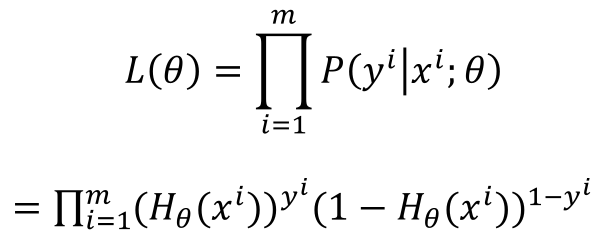 The training objective uses maximum likelihood estimation to optimize the parameters of the logistic sigmoid function.
Experimental Results: Proving the Geometry
The model was tested on four iconic datasets, ranging from the small Zachary's Karate Club to a large-scale Facebook ego-network.
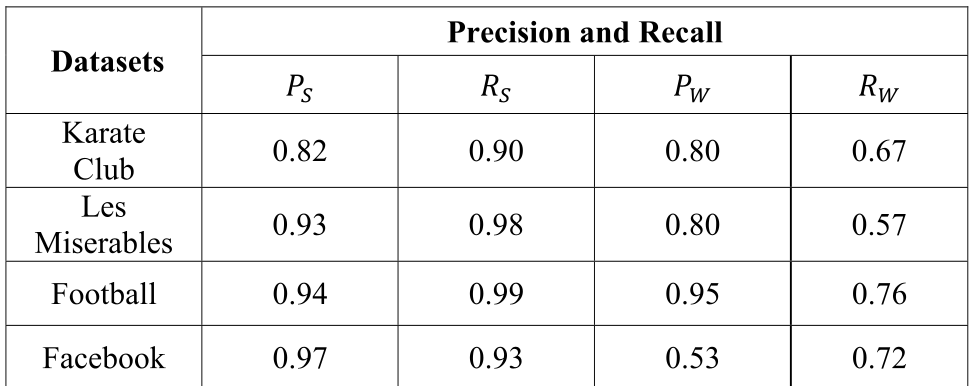
Key Findings:
- Scale Matters: The model performed significantly better on larger, more complex networks (Facebook) where structural signals are richer.
- The "Weak Tie" Bridge: Experimental data confirmed that edges bridging different communities were almost always labeled "Weak" by the model, matching sociological theory.
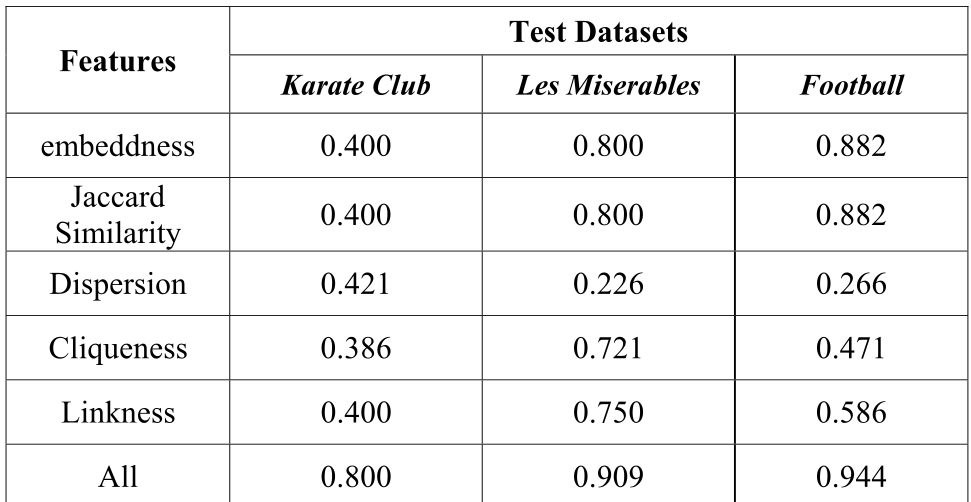
- Synergy: Ablation studies (shown in the table below) reveal that using "All" features provides a massive jump in F-score compared to using Jaccard Similarity or Cliqueness alone.
Critical Insight & Future Outlook
The brilliance of this work lies in its simplicity. By stripping away "content" (what people say) and focusing on "context" (who they know), the authors have created a model that is inherently more privacy-friendly and domain-agnostic.
However, the reliance on the STC principle assumes a certain level of social "rationality" that might not exist in modern, hyper-fragmented digital spaces. Future iterations could benefit from Graph Neural Networks (GNNs) to learn these structural features automatically rather than hand-crafting them.
Takeaway for Practitioners
If you are building recommendation engines or community detection tools, don't just count mutual friends. Look at the internal density (Cliqueness) and the external dispersion of those friendships to find the true backbone of your social graph.