
Decoding Social Topology: A Comparative Study of Real vs. Synthetic Networks
On the structural properties of social networks and their measurement-calibrated synthetic counterparts
This study presents a large-scale structural analysis of 120 real-world social networks across friendship, communication, and collaboration domains. Using measurement-calibration via grid search, it evaluates four generative models (2K, SBM, CBA, FF) to determine their fidelity in mimicking authentic social topologies.
TL;DR
Researchers analyzed 120 diverse social networks to understand the correlation between graph metrics and the descriptive power of generative models. By calibrating four major network models (2K, SBM, CBA, FF), they discovered that while SBM and 2K models excel at mimicking degree distributions, almost all current models struggle to replicate the specific "clustering vs. diameter" relationship found in real human social structures.
Background: Why Synthetic Networks Matter
From the "six degrees of separation" to the "friend of my friend" principle, social networks possess unique structural signatures. Understanding these signatures is vital for two reasons:
- Privacy: Generating synthetic graphs that maintain the statistical properties of real data (like Facebook friendships) allows researchers to share datasets without compromising individual privacy.
- Robustness: Testing algorithms on measurement-calibrated models ensures that results are representative of real-world performance.
The Problem: Redundancy and Domain Variance
Many graph metrics (density, max degree, betweenness) are highly redundant. Prior works often overlook how these indicators correlate differently across domains (e.g., a "retweet" network looks very different from a "co-authorship" network). The authors' first task was to map this "metric space" to find a non-redundant set of features that can uniquely identify a network's soul.
Methodology: The Fusion of Measurement and Calibration
The authors utilized a 17-measurement framework but narrowed it down using a Correlation Network. They only kept metrics that were size-independent and not strongly cross-correlated.
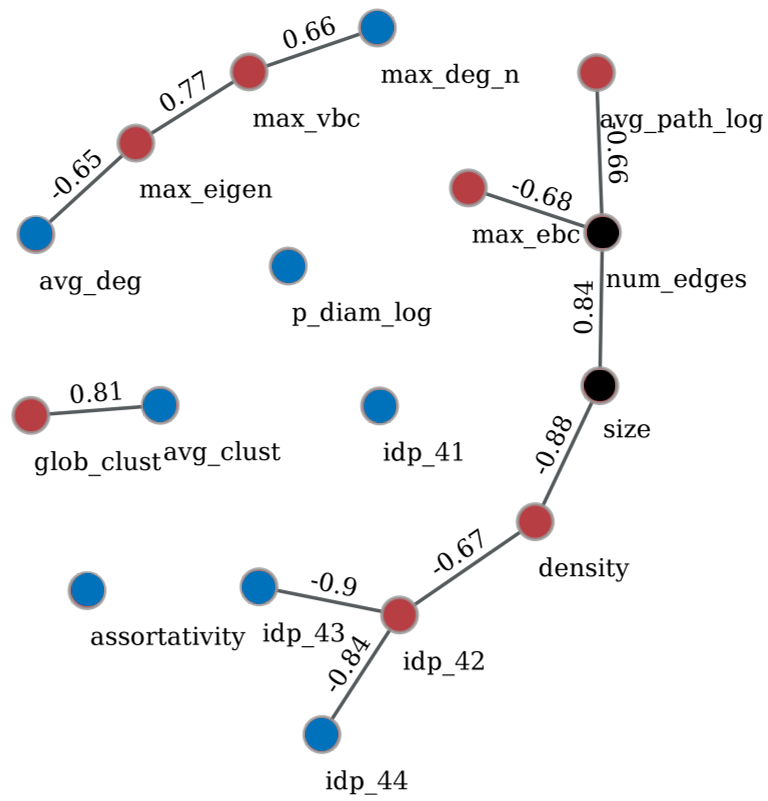 Fig 1: The correlation network revealing redundant clusters of metrics (black nodes) vs. selected descriptive metrics (blue nodes).
Once the "fingerprint" (feature vector) of each real network was defined, they used Grid Search to calibrate the parameters () of four models:
- 2K Model: Focuses on joint degree distribution.
- Stochastic Block Model (SBM): Mimics community structures.
- Forest-Fire (FF): Captures densification and shrinking diameters.
- Clustering Barabási-Albert (CBA): Adds clustering to traditional preferential attachment.
Experiments & Results: Where Models Fail
The benchmarking revealed a stark contrast in model performance. The SBM and 2K models were the champions of local structure, effectively overlapping with real data points in degree-related scattering plots.
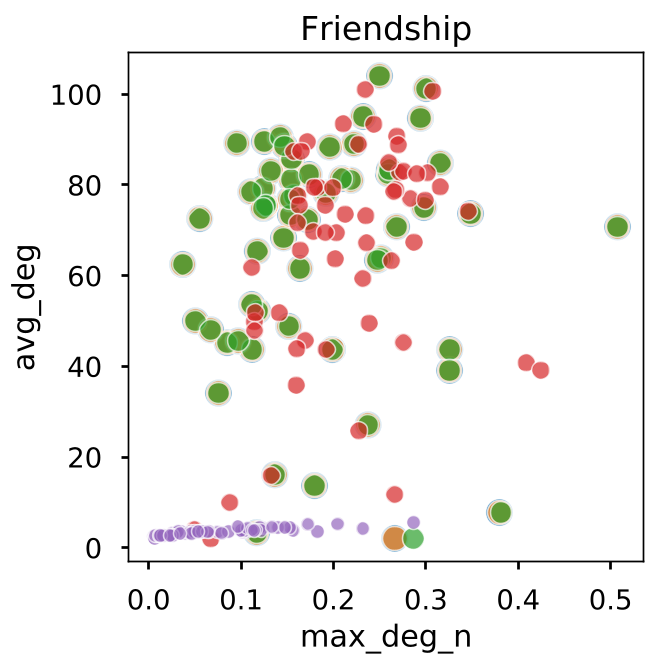 Fig 2: 2K and SBM models perfectly capturing degree-related metrics (overlapping dots).
However, a critical "structural blind spot" was identified: The Clustering-Diameter Trade-off. Real social networks often maintain a high diameter and a high average clustering coefficient simultaneously. Most models (especially SBM and 2K) were "too efficient," creating graphs that were either too tightly clustered with small diameters or vice-versa.
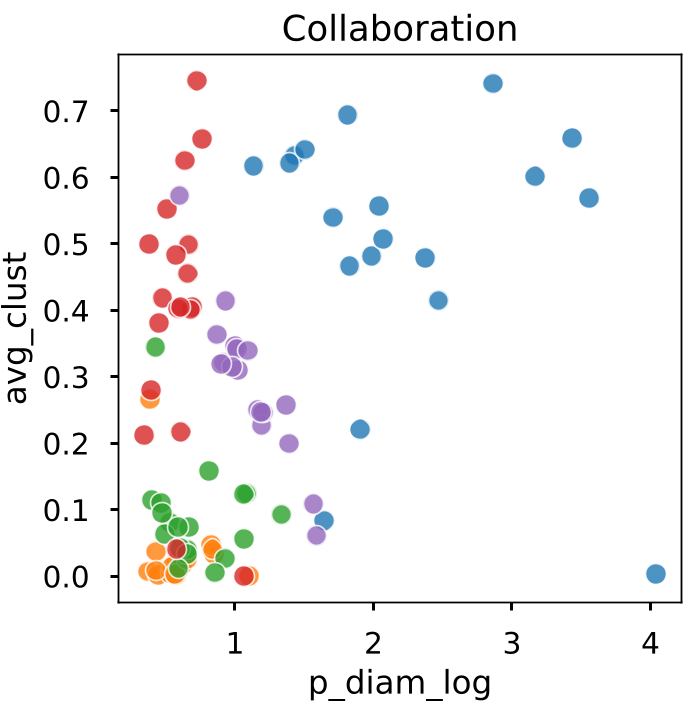 Fig 3: The mismatch between models and real data regarding Average Clustering vs. Pseudo Diameter.
Critical Insight & Conclusion
This study proves that there is no "one-size-fits-all" model for social networks. While communication networks are relatively easy to synthesize (likely due to their sparse, star-like retweet structures), collaboration and friendship networks possess deeper topological dependencies that current generative mechanisms cannot fully replicate.
Takeaway for Practitioners: If your application relies on the "Small World" property (short paths) or local community tightness, SBM is your best bet. However, if your research depends on the global structural "stretch" of a network, currently used synthetic models may lead to biased conclusions. Future work involving Graph2Vec or deep generative models (VAEs/GANs) may be needed to bridge this "structural gap."