
Structural vs. Socioacademic: What Really Drives Scientific Collaboration?
On the relationship between the structural and socioacademic communities of a coauthorship network
This study evaluates the alignment between structural communities identified via network topology and the socioacademic attributes of scholars within a coauthorship network. Using four community detection algorithms—leading eigenvector, walktrap, edge betweenness, and spinglass—the authors analyzed an interdisciplinary research center (CENS) and identified that institutional and departmental affiliations are the primary drivers of collaboration.
Executive Summary
TL;DR: By analyzing the Center for Embedded Networked Sensing (CENS), this paper concludes that academic "silos" are incredibly resilient. Despite the interdisciplinary mission of the center, community detection algorithms found that scientists still primarily coauthor with those in their own department or institution, rather than across disciplinary or national boundaries.
Positioning: This work serves as a critical bridge between topology-based network science and sociological scientometrics, providing a quantitative framework to validate the "meaning" behind detected clusters in social graphs.
The "Interdisciplinary" Illusion
Modern science is marketed as a boundary-less endeavor where ideas flow freely across institutions. However, the authors argue that "cliquishness" in networks is often a black box. We can see that a group of people forms a community (the "What"), but we rarely understand the "Why." Is it because they share a research interest, or simply because their offices are in the same hallway?
Methodology: Bridging Topology and Society
The researchers mapped a coauthorship network of 291 scholars and 2,536 coauthoring events. To ensure the results weren't an artifact of a specific math model, they used four different community detection strategies:
- Leading Eigenvector: Matrix-based modularity optimization.
- Walktrap: Based on the intuition that random walks stay trapped in dense areas.
- Edge Betweenness: Removing "bridge" edges to isolate clusters.
- Spinglass: Using statistical mechanics (simulated annealing).
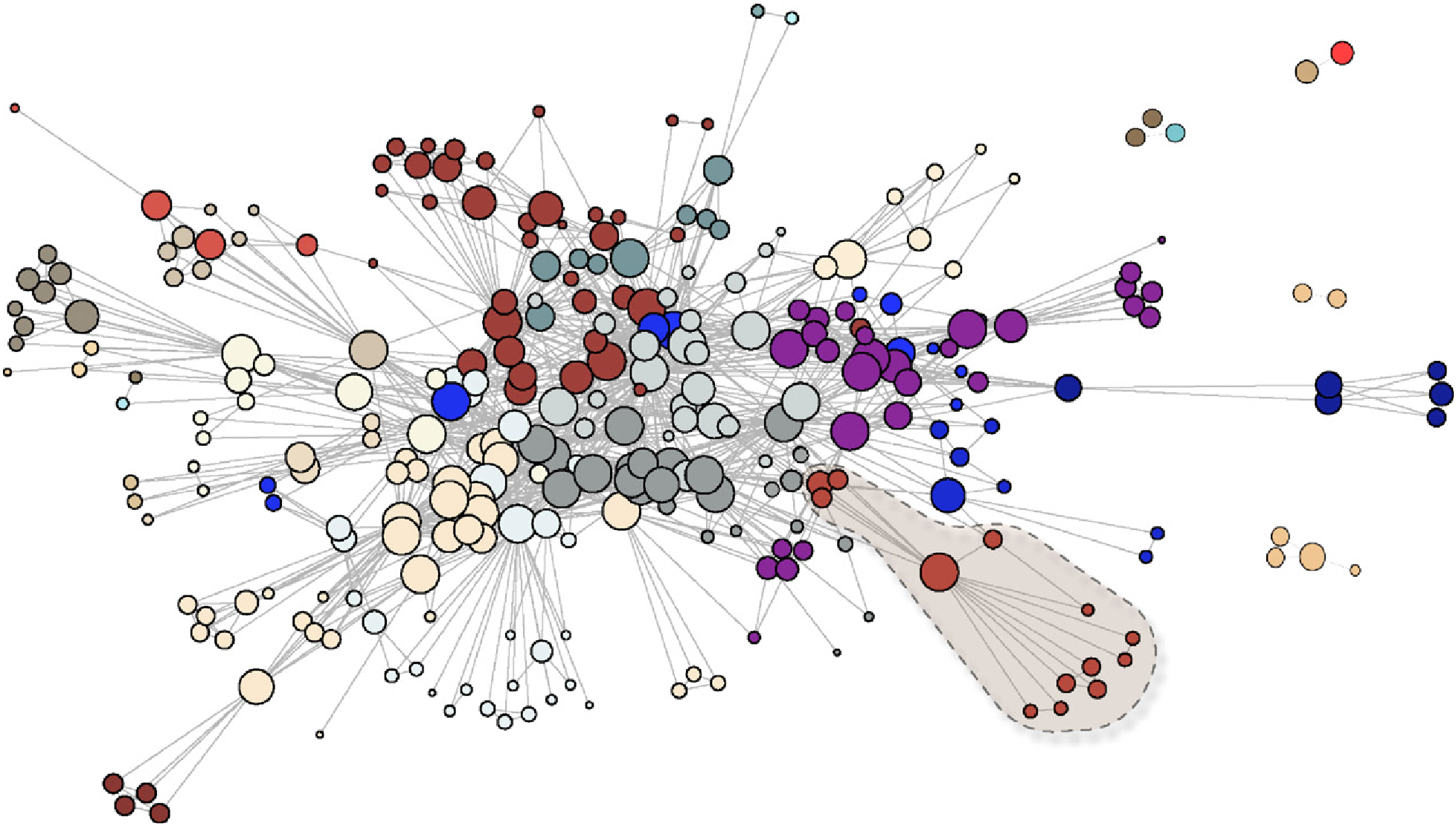 Fig 1: The CENS coauthorship network. Colors represent different structural communities, while node size indicates centrality.
The Core Finding: Institutional Gravity
The researchers compared these structural clusters against four "socioacademic communities":
- Department (e.g., Computer Science vs. Biology)
- Affiliation (e.g., UCLA vs. Caltech)
- Origin (Country)
- Position (PhD Student vs. Professor)
Using a Pearson’s test with Monte Carlo simulation, they found a striking correlation. The structural communities detected by the algorithms were not random; they mapped almost perfectly to Department and Affiliation.
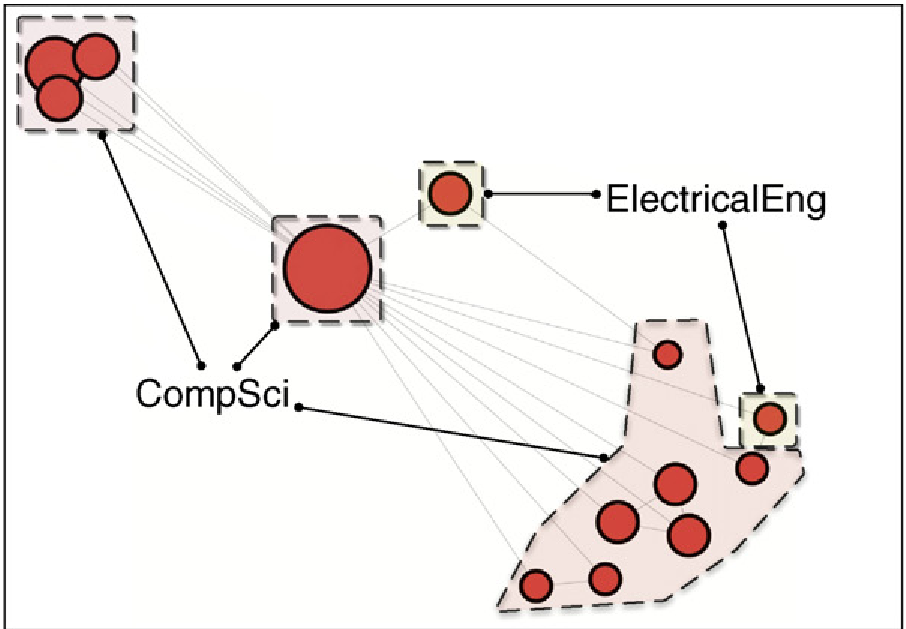 Fig 2: Analysis of a specific cluster showing high homogeneity in department (Computer Science) and affiliation (UCLA), but high diversity in origin and position.
Deep Insights & Implications
- The Resilience of Silos: Even within a multi-institutional NSF center, the strongest predictor of coauthorship is administrative. This suggests that "interdisciplinary" grants might change what people work on, but they struggle to change whom they work with.
- The Clustering Coefficient: At 0.33, the network is significantly less "cliquish" than biology but similar to mathematics. This indicates that while scholars are connected, the interdisciplinary community remains somewhat fragmented into specialized sub-bubbles.
- Predictive Potential: Because topology and socioacademic data are so tightly linked, the authors suggest we could potentially "predict" a scholar's department or institution just by looking at their position in a coauthorship graph.
Conclusion
This paper provides a sobering reality check for research administrators. Structural communities in scientific networks are primarily "administrative communities" in disguise. For future research centers to be truly interdisciplinary, they must find ways to overcome the gravity of departmental and institutional proximity.
Limitations: The study is based on a single research center (CENS) within a specific era (1998-2007). The impact of digital collaboration tools (like Slack/GitHub) in a post-2020 world might have reduced the "institutional gravity" observed here.