
SybilSCAR: Bridging Random Walks and Belief Propagation for Billion-Scale Sybil Detection
Structure-Based Sybil Detection in Social Networks via Local Rule-Based Propagation
2018-03-08
Summary
Problem
Method
Results
Takeaways
Abstract
This paper introduces SybilSCAR, a novel structure-based framework for Sybil detection in social networks that unifies Random Walk (RW) and Loopy Belief Propagation (LBP) methods. By designing a linearized "local rule" for label propagation, SybilSCAR achieves state-of-the-art accuracy and handles large-scale graphs like Twitter (41.7M nodes) with high efficiency.
## TL;DR
SybilSCAR is a breakthrough framework that unifies the two dominant paradigms of social network security: Random Walks (RW) and Loopy Belief Propagation (LBP). By introducing a linearized multiplicative local rule, it offers the best of both worlds—the scalability of RW-based methods and the accuracy/noise-robustness of LBP-based methods. On real-world Twitter data, it outperformed traditional methods by nearly 20% in precision while remaining an order of magnitude faster than graphical model approaches.
## The Dilemma: Accuracy vs. Scalability
In the "Sybil hunt," researchers have traditionally chosen between two flawed weapons:
1. **Random Walks (e.g., SybilRank):** Fast and convergent, but they usually only use benign labels. This makes them blind to known Sybil patterns and fragile when labels are "noisy" (mistakenly tagged).
2. **Loopy Belief Propagation (e.g., SybilBelief):** Academically superior at combining global information and resisting noise, but they are a nightmare to scale. Because they pass different "messages" along every edge, they consume massive memory and often fail to converge, oscillating forever on complex real-world loops.
The authors of SybilSCAR identified that these methods are actually just different versions of **Local Rule-Based Propagation**.
## Methodology: The "Best of Both Worlds" Local Rule
The core innovation of SybilSCAR is the design of a novel local rule that models neighbor influence.
### The Unified Framework
The authors prove that both RW and LBP can be viewed as iteratively applying a local rule to every node:
$$p_{u} = ext{Combine}( ext{Prior Knowledge}, ext{Neighbor Influences})$$
### The SybilSCAR Innovation
SybilSCAR adopts a **multiplicative influence** (from LBP) to maintain robustness against noise but **linearizes** the update equation:
$$ \hat{\mathbf{p}}^{(t)} = \hat{\mathbf{q}} + 2 \hat{\mathbf{W}} \hat{\mathbf{p}}^{(t-1)} $$
This matrix-form representation is the "secret sauce." It allows the algorithm to be implemented using high-performance linear algebra libraries, ensuring the system is both **Scalable** and **Convergent**.
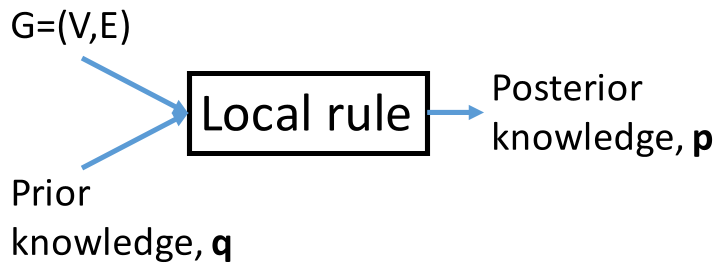
*Figure 1: The proposed framework unifying RW-based and LBP-based methods under a single propagation paradigm.*
## Experimental Powerhouse: 1.2 Billion Edges
The researchers didn't just test on small academic graphs; they went after a snapshot of Twitter with **41.7 million nodes and 1.2 billion edges**.
### Accuracy and Robustness
Unlike SybilRank, which struggled with the weak homophily (many attack edges) of the real Twitter graph, SybilSCAR maintained high precision.
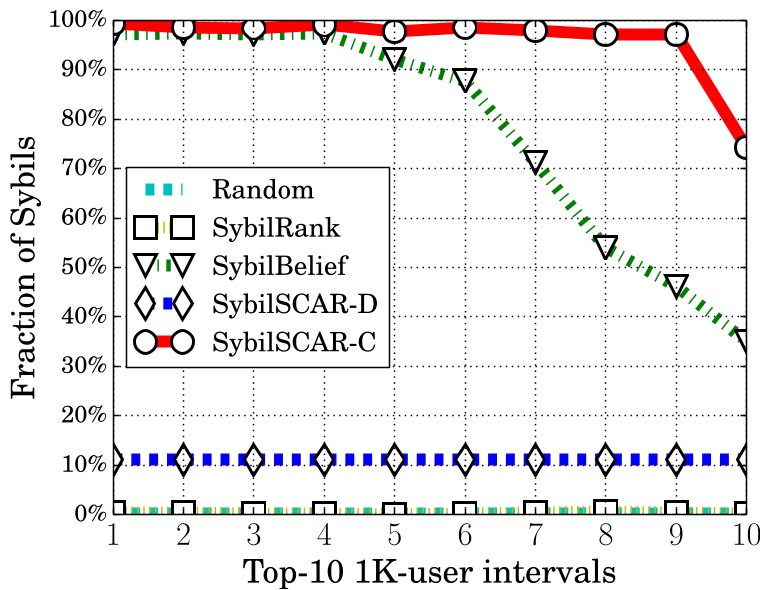
*Figure 2: Fraction of real Sybils found in the top-ranked suspected accounts. SybilSCAR-C consistently locates more real attackers than competitors.*
### Computational Efficiency
The scalability results are striking. SybilSCAR uses significantly less memory and is **10x faster** than LBP-based SybilBelief, making it viable for production-level social network monitoring.
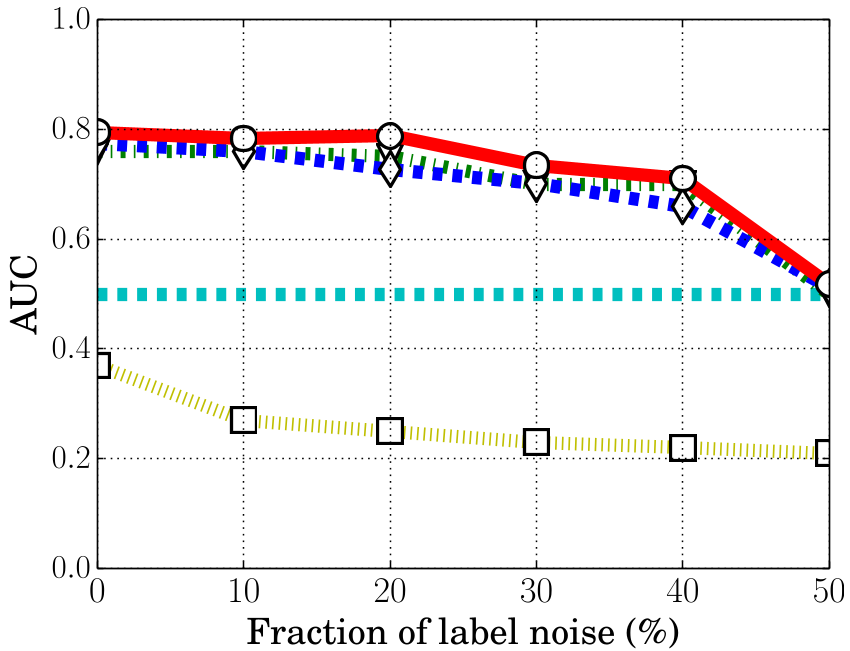
*Figure 3: Time and memory scalability comparison. SybilSCAR matches the efficiency of simple Random Walks while providing LBP-level accuracy.*
## Academic Insight & Future Outlook
SybilSCAR provides the first tight theoretical bound on accepted Sybils, proving that if a Sybil region is densely connected (high $d(S)$), it is mathematically easier to detect.
**Critical Analysis:** While SybilSCAR is a massive leap forward, its reliance on the "homophily assumption" remains a bottleneck. In networks where Sybils carefully mimic benign behavior to create a "mixed" graph (as seen in some modern botnets), the structural gap narrows. Future work in learning edge-specific homophily weights through machine learning (as suggested by the authors) will be the next frontier in this arms race.
## Takeaway for the Industry
If you are building trust and safety systems, SybilSCAR demonstrates that you don't have to sacrifice theoretical rigor for speed. By linearizing your graphical model updates, you can run sophisticated semi-supervised learning across your entire user graph in minutes rather than hours.