
FRUI-P: Unlocking Cross-Platform User Identification Without Prior Knowledge
Structure Based User Identification across Social Networks
This paper introduces FRUI-P (Friend Relationship-based User Identification without Prior Knowledge), an unsupervised algorithm for identifying identical users across different social networks. By leveraging network structure and embedding-based similarity, it achieves state-of-the-art performance without requiring manually labeled seed users.
TL;DR
Researchers have developed FRUI-P, a novel unsupervised algorithm that identifies identical users across social networks (like Twitter and Facebook) using nothing but the "friendship" structure. By ditching the need for manually labeled "seed users," FRUI-P slashes computational complexity from the traditional to a scalable , while maintaining high precision even in noisy, real-world datasets.
The Identification Crisis: Beyond Profiles
In the era of heightened privacy, "Find Friend" mechanisms via email or phone numbers are increasingly restricted. Most existing strategies rely on Profile-based (usernames, bios) or Content-based (post history, writing style) analysis. However, profile data is easily faked, and content is often sparse or private.
Network Structure—who you follow and who follows you back—is far more reliable. But there's a catch: most structural algorithms are supervised; they need a list of known "anchor" users to start the mapping. Obtaining these seeds is laborious and often impossible in large-scale, anonymous datasets.
Methodology: High-Dimensional Social Circles
The core intuition behind FRUI-P is that an individual’s circle of mutual friends remains relatively consistent across platforms. If you have the same five best friends on Sina Microblog as you do on RenRen, you are likely the same person.
1. Friend Feature Vector Model (FFVM)
Instead of comparing graphs directly, FRUI-P borrows from Natural Language Processing (NLP). Just as Word2Vec identifies a word's meaning by its surrounding context, FRUI-P identifies a user by their "social context."
- The Context: Generated via Random Walks focused strictly on mutual friend relationships (friendships confirmed by both parties), which are more stable than one-way follows.
- The Embedding: It uses a Negative Sampling-based CBOW model to map every user into a low-dimensional Friend Feature Vector.
2. Multi-Dimensional Matching
Unlike previous methods that looked at one neighbor at a time, FRUI-P looks at the entire vector space.
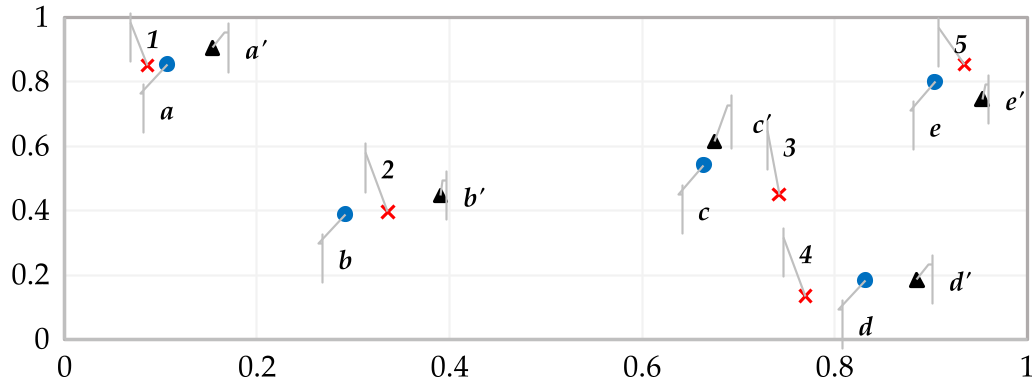 The FFVM architecture bridges the gap between raw social graphs and deep feature learning.
Experiments: Performance and Scalability
The authors tested FRUI-P against Neighbor Matching (NM), the previous gold standard for unsupervised de-anonymization.
- Complexity: NM’s complexity makes it unusable for networks larger than 1,000 nodes. FRUI-P’s approach allows it to handle 50,000+ nodes with ease.
- Accuracy in Noise: In real-world social networks where platforms only partially overlap, NM fails almost entirely. FRUI-P, however, maintains high precision.
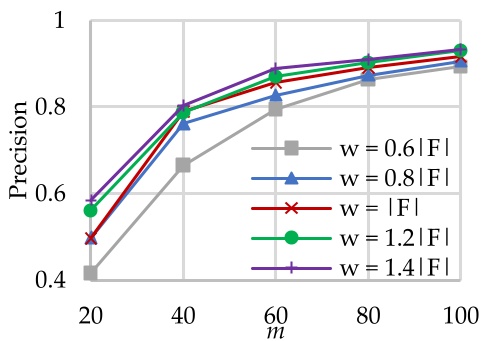 In synthetic BA networks, FRUI-P consistently outperforms traditional structural benchmarks as edge overlap increases.
Real-World Impact: Sina Microblog vs. RenRen
Testing on the Chinese social giants Sina and RenRen, FRUI-P achieved:
- Precision over 90% for users with a significant number of mutual friends.
- The ability to identify ~20% of the entire overlapping population with zero prior knowledge.
Critical Insights & Future Outlook
Why it works: By treating social identification as an embedding problem rather than a graph-matching problem, the authors avoided the "curse of dimensionality" and the brittle nature of exact structural matching.
Limitations: The "Cold Start" problem remains. If a user has very few friends (e.g., <5), their "social context" is too thin for the algorithm to learn an accurate vector.
Conclusion: FRUI-P represents a shift towards autonomous social computing. Its primary value lies in its role as a "bootstrap" mechanism—generating high-confidence seed users for even more powerful supervised systems without a single second of human intervention.