
Deciphering the Skeleton of Virality: Structure and Evolution of Large Social Cascades
The Structure and Evolution of Large Cascades in Online Social Networks
This paper investigates the topological characteristics of over 45,000 large-scale information cascades on the KaiXin social network. It introduces the "Combined Graph" concept to analyze the interplay between diffusion paths and underlying social ties, identifying four distinct structural patterns of viral growth.
TL;DR
Why do some posts reach millions while others die in obscurity? By analyzing 45,000 massive cascades on the KaiXin network, this study reveals that viral growth isn't about "explosions" in a dense core. Instead, large cascades are surprisingly sparse, fragile, and decentralized. The researchers introduce the Combined Graph to prove that even the most "viral" content spreads through a low-efficiency, high-persistence mechanism.
Backgound: The Mystery of Sparse Virality
In the world of social networks, we often imagine "going viral" as a wildfire consuming a dense forest. However, empirical data shows that even when a piece of content reaches 400,000 users, the underlying network of people who actually shared it is remarkably thin. This paper sets out to bridge the gap between the Diffusion Tree (who sent what to whom) and the Social Substrate (who is friends with whom) to understand why these massive structures don't collapse into dense clusters.
Methodology: The Combined Graph
The authors propose a new lens: the Combined Graph (). Prior research often looked at the tree or the subgraph separately. By merging them, we see not just the "path" of the information, but the "potential paths" that were ignored.
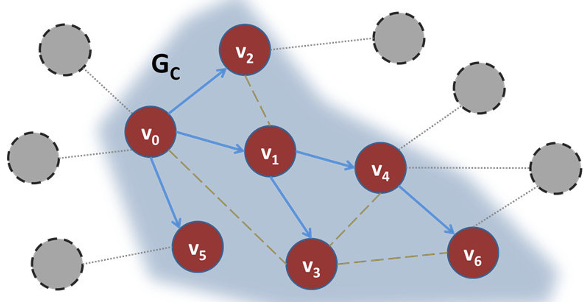
In the figure above, solid lines show the actual diffusion (Tree), while dashed lines represent existing friendships that didn't result in a share. The combination is the Combined Graph.
Key Insights: Why Virality stays Sparse
The most counter-intuitive finding is that as cascades grow larger, they don't necessarily get "denser." The Average Degree in discovery is ~3.6, while the underlying social network has an average degree of over 100.
1. The Low Infection Rate
The study found an average infection rate of just 0.022. If you have 100 friends, on average, only 2 will reshare your post. This prevents the "dense core" from ever forming.
2. Diminishing Returns of Exposure
Does seeing a post 10 times make you more likely to share it? No. The researchers found that the adoption probability peaks early and then declines. This "persistent adoption" means that "echo chambers" are actually poor environments for wide-scale spread; information needs to "escape" to new, fresh branches.
(Note: Refer to Figure 3c in the paper for the exposure curve showing declining adoption probability over time.)
The Four Faces of Virality
The paper categorizes large cascades into four structural patterns based on their growth mechanism:
- Long Chains (Viral): Deep, thin structures where information travels through many generations. No single hub dominates.
- One-step Broadcast (Star): A single "super-hub" (like a celebrity) shares content, and thousands reshare it directly.
- Multi-step Broadcast: A hybrid where several influential hubs drive the spread at different stages.
- Combination: The most common form of big cascades, mixing deep chains with occasional broadcast bursts.
 (Visualized in Figure 5 of the paper, showing the varying skeletons of diffusion.)
Critical Analysis & Conclusion
This work challenges the "jellyfish" model of social networks (a dense core with small whiskers). In the context of active diffusion, the "core" is irrelevant. Large cascades are "skeletal"—they rely on reaching many diverse communities through thin, long bridges rather than saturating a single dense cluster.
Limitations: The data is from 2009. modern algorithmic feeds (like TikTok's For You Page) might introduce more "external influence" than the friendship-based links studied here. However, the fundamental insight—that high-scale spread requires low-density persistence—remains a cornerstone for understanding social influence.
Takeaway: To make something go viral, don't focus on "dense" groups. Focus on "branching factor." If your content can't survive a multi-generational hop across "long chains," it will never reach the thousands.