
Bridging the Micro-Macro Gap: How Local Interactions Shape Global Online Social Networks
Structure in online social networks: Bridging the micro-macro gap
This paper explores bridging the gap between micro-level social processes and macro-level structural patterns in Online Social Networks (OSNs). It proposes the application of two advanced statistical frameworks, Exponential Random Graph Models (ERGM) and Stochastic Actor-Oriented Models (SIENA), to identify the specific social forces (e.g., reciprocity, homophily, transitivity) that drive global network evolution.
TL;DR
Most OSN research describes what a network looks like (e.g., "it's a small world"), but neglects how it got that way. This paper proposes using ERGM and SIENA—two powerhouse statistical modeling frameworks—to decode the hidden micro-rules (like reciprocity and homophily) that aggregate into massive social structures. While computationally demanding, these models offer a way to move beyond simple data mining toward true sociological understanding.
The "Missing Why" in Social Network Analysis
Since the late 90s, we have been obsessed with the macro-topology of the internet. We know that Facebook, Twitter, and LinkedIn exhibit "scale-free" properties and high clustering coefficients. However, the academic community has hit a wall: Equifinality.
Equifinality occurs when different micro-processes lead to the same macro-result. For example, if you see a triangle of three friends (A-B-C), did it form because A introduced B to C (Transitivity), or because all three happen to be amateur boxers (Homophily)? Descriptive statistics cannot answer this; generative models can.
Methodology: The Generative Approach
To "disentangle" these forces, the paper introduces two distinct methodologies:
1. ERGM (Exponential Random Graph Models)
ERGM treats a network snapshot as a realization of a probability distribution. It asks: "Given the observed triangles and stars, what are the underlying weights of the social rules that produced this specific graph?"
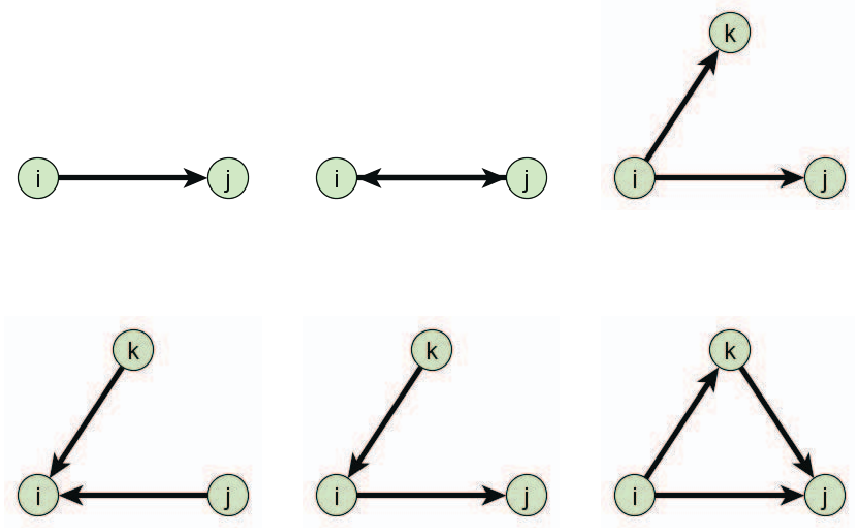 Figure 1: Examples of local configurations (Reciprocity, Stars, Transitivity) modeled as parameters in ERGM.
The probability is defined as: Where each represents the "strength" of a specific social tendency (e.g., the urge to reciprocate a friend request).
2. SIENA (Simulation Investigation for Empirical Network Analysis)
Unlike ERGM's static view, SIENA is longitudinal. It assumes the network evolves through a continuous-time Markov chain. Actors (users) are "agents" who get opportunities to change their ties to maximize their "objective function"—essentially a personal score based on local network benefits.
The Reality Check: Performance vs. Complexity
The paper provides a candid look at the computational cost of these models. Unlike simple PageRank or clustering algorithms, ERGM and SIENA rely on MCMC (Markov Chain Monte Carlo) simulations, which are notoriously expensive.
| Network Size | Avg. Degree | Estimation Time |
|---|---|---|
| ~200 nodes | 4.0 - 5.0 | Minutes to Days |
| >1000 nodes | Variable | Extremely difficult / Needs Supercomputers |
The author notes that while frameworks like Statnet (R) have optimized the process, "model degeneracy"—where the simulation fails to converge on a realistic graph—remains a significant hurdle for directed OSN data.
Critical Insight: The OSN Challenge
The author identifies a fundamental mismatch between traditional sociometrics and modern OSNs:
- State vs. Event: SIENA assumes ties are "states" (friendships that last). But what about "likes" or "comments"? These are "events." Applying these models to messaging networks requires clever "time-windowing" or new algorithmic extensions.
- The Visibility Problem: In a small classroom, everyone knows everyone. In an OSN with 1 million users, an actor cannot "consider all possible outgoing links" as SIENA assumes.
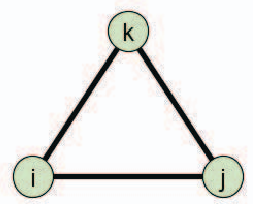 Figure 2: The classic triangular structure—the smallest unit of the micro-macro bridge.
Conclusion & Future Outlook
This paper serves as a roadmap for the next generation of OSN analysis. To move forward, we must stop treating OSNs as mere "big data" problems to be described and start treating them as "dynamic systems" to be modeled.
The immediate path forward? Start small. By analyzing high-resolution data from smaller, niche OSNs, we can refine the parameters of ERGM and SIENA before scaling them to the giants of the social web. Bridging the micro-macro gap is not just a mathematical challenge; it is the key to understanding the fabric of digital society.