
Beyond the Hairball: Preserving the Structural Backbone of Social Networks
Structure-Preserving Sparsification of Social Networks
This paper presents a systematic evaluation of edge sparsification methods for social networks, introducing a novel technique called Local Degree (LD). By scoring edges based on their structural importance and applying a global filter, these methods reduce network size while preserving critical properties like diameter and centrality.
TL;DR
Analyzing massive social networks often feels like untangling a "hairball." This paper provides a rigorous comparison of edge sparsification techniques and introduces Local Degree (LD)—a simple yet powerful method that removes 80% of a network's edges while keeping its diameter, connectivity, and node rankings almost intact.
Context: Why Spare the Edges?
In network science, we often face a paradox: social networks are "sparse" mathematically (O(n) edges), yet they are too "dense" for our eyes and many algorithms. Traditional sampling often removes nodes, but in social contexts, every person (node) matters.
The authors argue that not all edges are equal. A few "shortcut" edges maintain the small-world phenomenon, while others are redundant. The goal is to find the backbone: a fraction of edges that represents the true essence of the network.
Methodology: The "Hub" Intuition
The researchers break down sparsification into two steps:
- Scoring: Assign an "importance" value to every edge.
- Filtering: Keep only edges above a certain percentile.
While existing methods like Simmelian Backbones focus on "triangles" (local cliques), the authors propose Local Degree (LD).
The Intuition: In a social network, information flows through hubs. If you want to keep the network connected and the distances short, you must keep the paths leading to the most connected people. LD does this by looking at every node and ensuring it keeps its edges to its most "famous" (high-degree) neighbors.
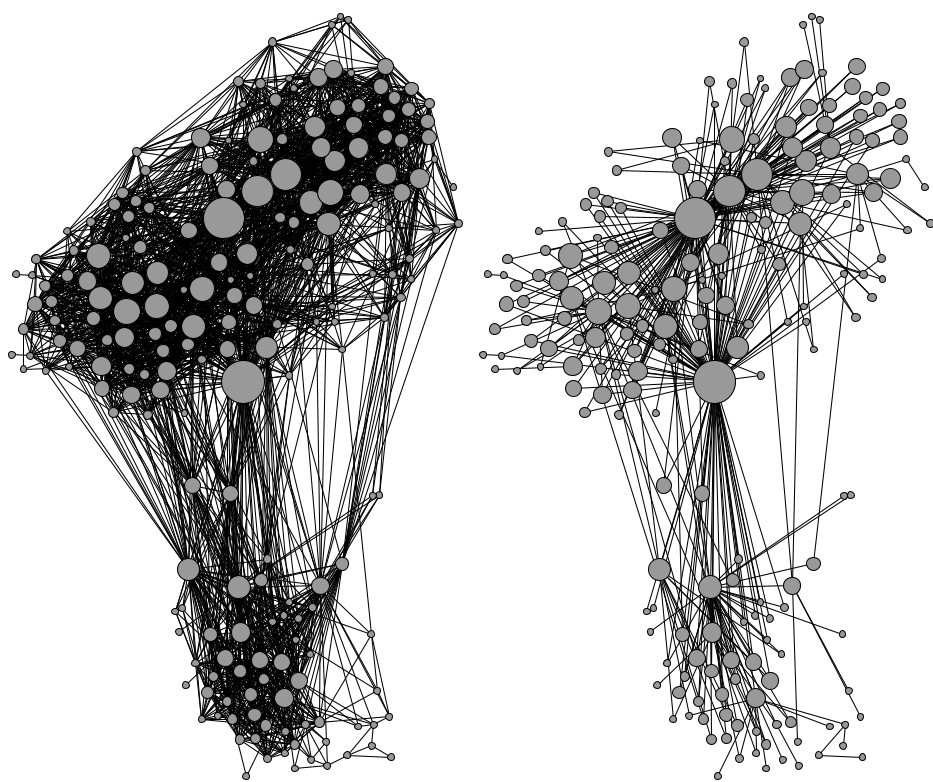 Figure 1: The Jazz musicians network reduced to a 15% LD backbone. Notice how the central hub structure remains clear.
Experiments: What Stays and What Goes?
The authors tested these methods against 100 real-world Facebook networks. They measured how well the "backbone" resembles the original using metrics like Spearman’s rank correlation (for centrality) and Normalized Mutual Information (for communities).
Key Findings:
- Diameter Preservation: LD is the champion here. While triangle-based methods (Simmelian) accidentally "shatter" the network into pieces, LD keeps the "small-world" property alive.
- Centrality: If you need to know who the most influential people are, LD maintains PageRank and Betweenness rankings even at 20% edge density.
- Efficiency: LD runs in linear time , making it vastly more scalable than quadrangular-based methods.
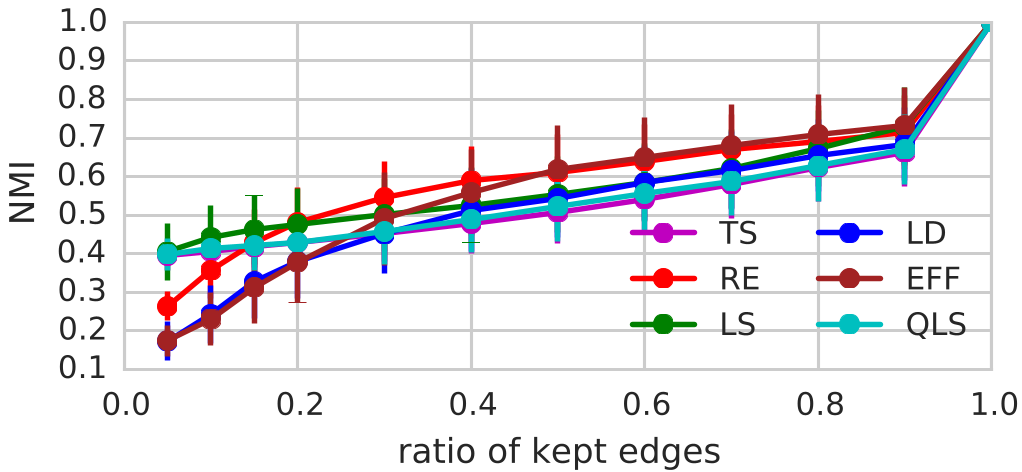 Figure 2: Spearman’s rank correlation for node degree (left) and betweenness (right). LD and Random Edge (RE) consistently outperform specialized Simmelian methods.
Critical Analysis & Conclusion
The biggest surprise of the study is that Random Edge (RE) selection—the simplest possible baseline—is actually incredibly robust for preserving community structures. However, for anything relating to connectivity or distance, the Local Degree approach is the clear winner.
Limitations: LD is "hub-greedy." It might over-simplify the network by pulling every node toward a central hub, potentially masking smaller, nuanced sub-communities.
Takeaway: If you are dealing with a massive "hairball" graph and need to run expensive algorithms like Betweenness Centrality, use Local Degree to prune the graph first. You'll get roughly the same results in a fraction of the time.
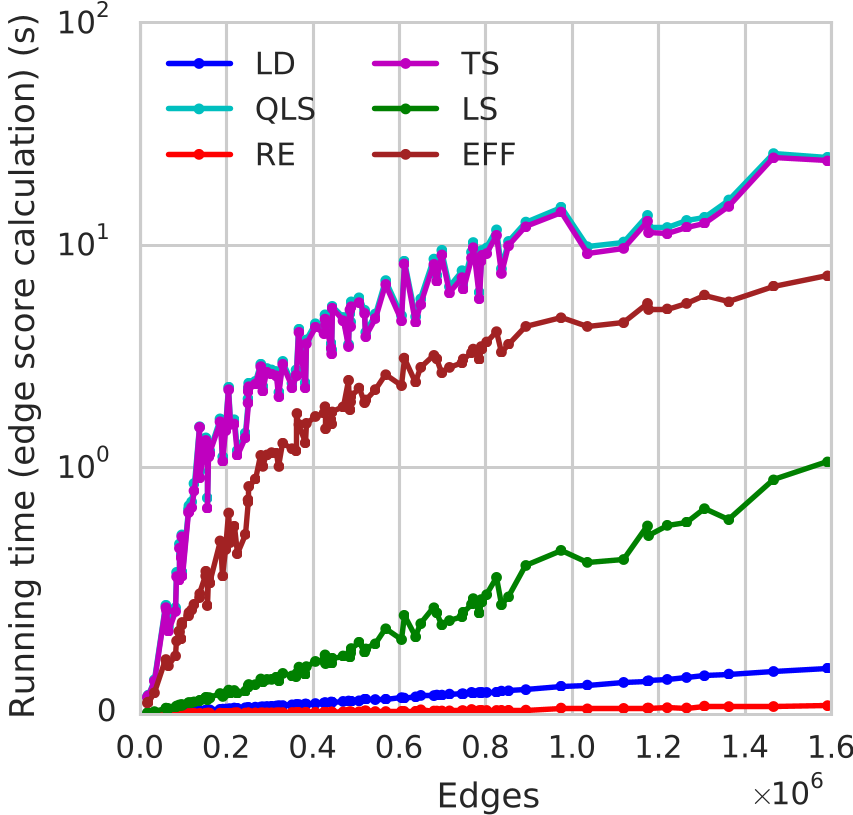 Figure 3: Computational efficiency. LD is nearly as fast as random selection, making it feasible for "Big Data" scales.