
Beyond the Enterprise: Reimagining Virtualization for a Social Cloud
A Structured Approach to Virtualization in Order to Support a Social Media Oriented Cloud Computing
This paper explores a structured approach to Virtualization to support "social media oriented Cloud Computing" in the Digital Humanities. It introduces a cognitive framework that bridges low-level Operating System virtualization with high-level application containers, demonstrated through Virtual Heritage projects like NU.M.E. 2010.
TL;DR
While the tech industry often views Cloud Computing through the lens of business agility and transactional databases, this paper argues for a paradigm shift. By introducing a structured cognitive framework for Virtualization, the authors demonstrate how we can move beyond the "OS-centric" view to create participatory, social-media-oriented cloud environments for the Digital Humanities.
Background: The Misconception of the Cloud
Cloud Computing is frequently treated as a "black box" of resources (IaaS). To the end-user, however, the Cloud is a pervasive metaphor for sharing and constructing knowledge. The author posits that the difficulty in formalizing this "Social Cloud" stems from a lack of a unified theory of its enabling technology: Virtualization.
Current literature (e.g., Popek and Goldberg) focuses on Server Consolidation. This paper argues that we need a "finer-grained" approach that recognizes virtualization as an isomorphism mapping resources across any abstraction layer—be it the OS, middleware, or the application level.
Methodology: The Cognitive Framework
The core contribution is a multi-disciplinary framework that defines virtualization independently of the OS. To analyze any virtualization solution, one must identify:
- The Interface: Where the boundary exists.
- Resource Mapping: What is being simulated.
- Real Instructions: The actual mechanics (e.g.,
ptrace(), system calls). - The Virtualization Metaphor: The conceptual model (e.g., "The Mount Metaphor" or "The System Call Trap").
Architechture Comparison: OS vs. Middleware
The paper compares traditional OS virtualization (like User-Mode Linux) with high-level application servers (like J2EE).
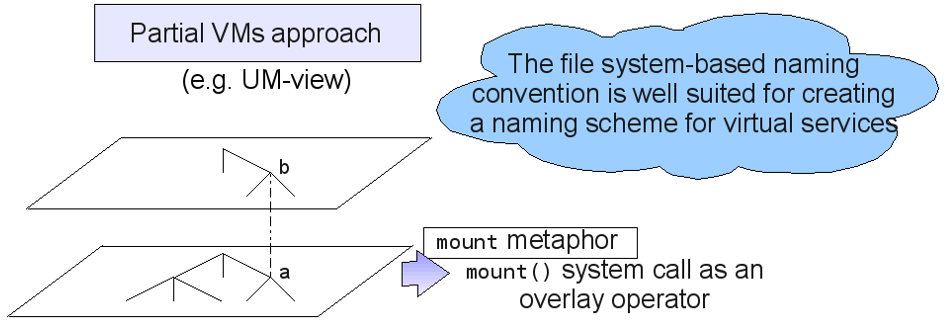 In UML, the virtualization metaphor is "System Call Trapping," allowing a kernel to run as a process on another kernel.
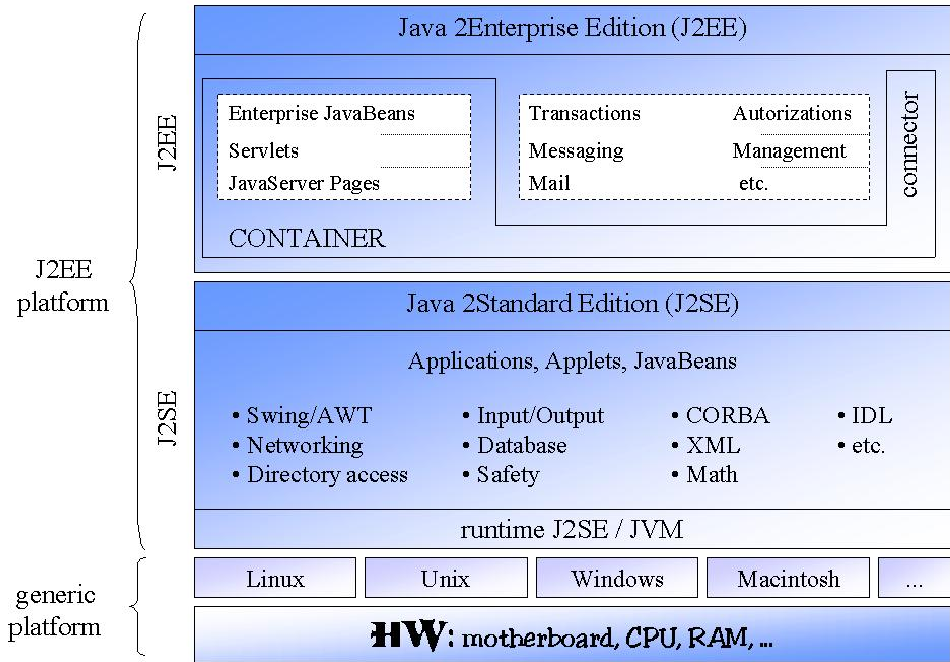 The "Extended Container" concept (derived from Arjuna) moves away from monolithic VMs toward nested, service-oriented environments that host collaborative "gadgets" and "mashups."
Case Study 1: Virtual Heritage in Second Life
The NU.M.E. 2010 project used the Metaverse as a spatial interface for cloud-distributed cultural data. By integrating Google Warehouse and Panoramio directly into Second Life, the research showed that virtualization facilitates a "participatory model." Users didn't just consume data; they manipulated 3D models and annotated historical spaces, effectively turning the cloud into a social epistemic process.
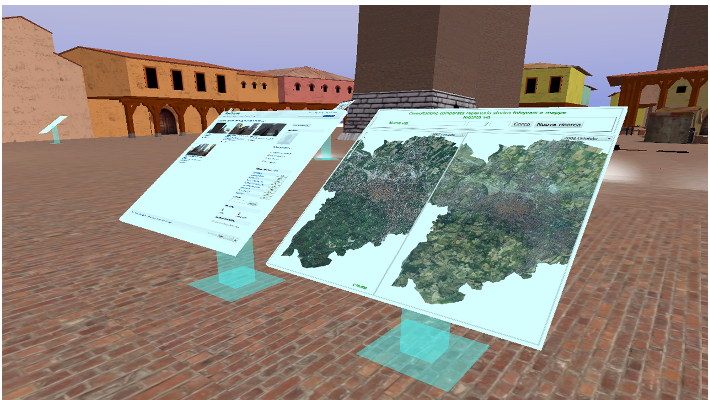 The Shared Media feature acts as a high-level container, embedding external cloud services into the 3D interactive space.
Case Study 2: The CINECA MDC Pipeline
For the project "Museo della Città," the team had to coordinate a distributed 3D animation pipeline. Traditional IT architectures (like NFS) were incompatible across different partner sites (Cineca vs. Spark Digital).
The solution? Using Google Docs as a low-fidelity "Cloud Prototype" for asset management. The author suggests that moving forward, using finer-grained virtualization (like Apache Shindig/OpenSocial) could automate these pipelines by embedding workflow tools into a unified web-based container.
Critical Insight & Future Outlook
The paper’s strength lies in its philosophical reassessment of virtualization. By treating virtualization as a "linguistic" instruction set for mapping interfaces, we can build more flexible cloud systems.
Limitations: The paper leans heavily on early 2010s technology (Second Life, Google Warehouse). Today, these would likely be replaced by WebGL, Docker, and Kubernetes. However, the Cognitive Framework remains highly relevant for modern "Serverless" and "Edge Computing" architectures where the boundary between application and environment is increasingly blurred.
Takeaway: For researchers in Digital Humanities and CS alike, the message is clear: The Cloud is not just a server; it is a collaborative environment enabled by the metaphors we build through virtualization.