
SCFM: Bridging the Gap Between Generative Fidelity and Latent Interpretation
Structured Coupling for Flow Matching
The paper introduces Structured Coupling for Flow Matching (SCFM), a framework that integrates structured latent-variable learning into continuous normalizing flows. By replacing the standard Gaussian noise source with an augmented, learnable structured prior and utilizing a shared time-dependent recognition network, SCFM achieves SOTA unsupervised clustering (NMI +8 pts on MNIST) and competitive image generation quality (2.11 FID on CIFAR-10).
TL;DR
The research community has long faced a trade-off: use Flow Matching (FM) for crisp, high-quality images, or use Variational Autoencoders (VAEs) for interpretable, structured latent spaces (useful for clustering and disentanglement). Structured Coupling for Flow Matching (SCFM) eliminates this trade-off. By transforming the "noise" source of a flow model into a learnable, structured latent space, SCFM achieves SOTA clustering performance while maintaining the generative power of continuous normalizing flows.
The Problem: The "Black Box" of Flow Matching
Standard Flow Matching is efficient because it learns to transport a simple distribution (usually Gaussian noise) to a complex data distribution (images). However, this "noise" is semantically empty. If you want to perform unsupervised clustering or manipulate specific features (like the elevation of a car in a 3D renders), standard FM gives you no direct handles to do so.
On the flip side, VAEs give you those handles by organizing data into a latent space . But VAEs are notorious for producing blurry samples because their "decoders" are often too simple to capture the manifold of real-world data perfectly.
Methodology: The Best of Both Worlds
SCFM's core insight is to treat the source of the flow as a structured latent variable.
1. The Augmented Source
Instead of , SCFM defines the source as .
- : Follows a learnable Gaussian Mixture Model (GMM) prior designed to capture semantic clusters.
- : Provides the remaining degrees of freedom (noise) needed for high-fidelity transport.
2. The Shared Recognition Network
A single neural network performs double duty:
- At (Data Endpoint): It acts as a VAE encoder, mapping data to the latent .
- At (Intermediate Times): It estimates the posterior mean of the source to define the flow's velocity.
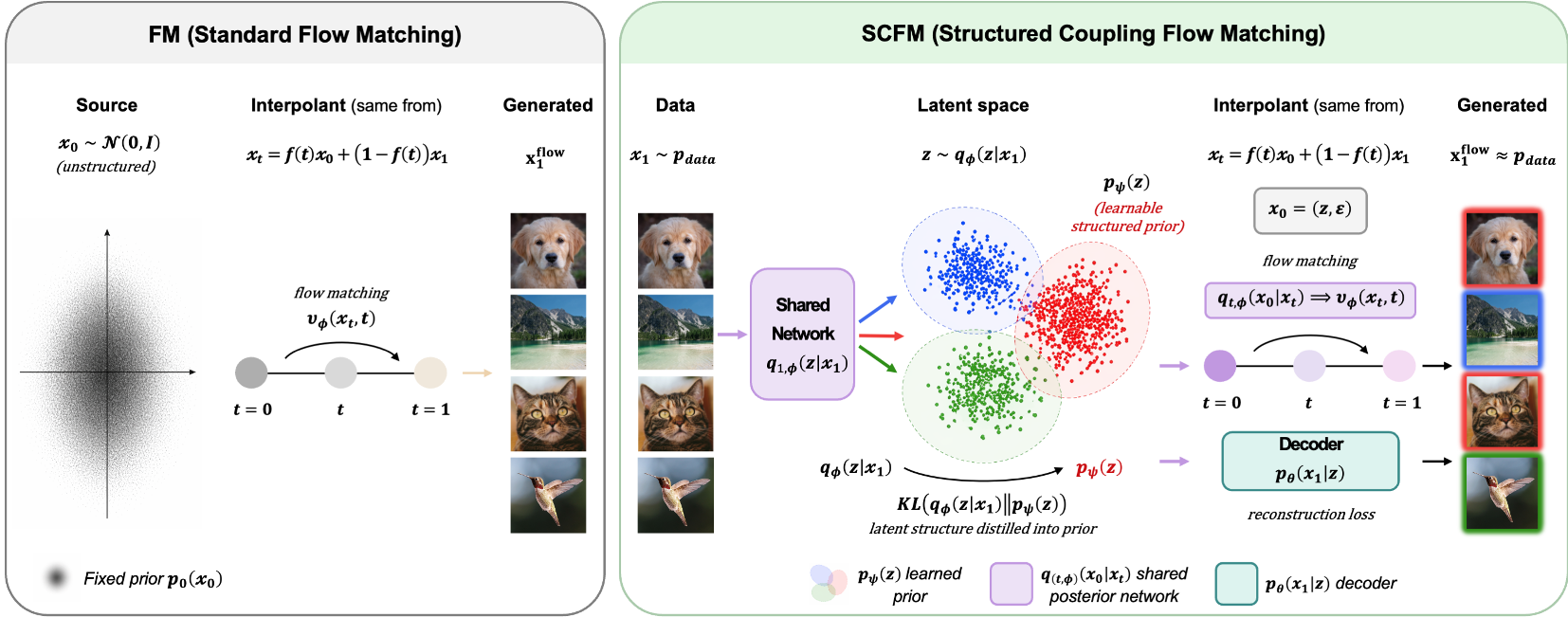 Figure 1: While standard FM (left) uses unstructured noise, SCFM (right) distills structure into a GMM prior via an encoder-induced coupling.
Experiments: Superior Structure, Zero Quality Loss
The authors tested SCFM across multiple domains including MNIST, CIFAR-10, and ImageNet-128.
Unsupervised Clustering & Disentanglement
On MNIST, SCFM didn't just generate digits; it learned to categorize them without labels. It achieved a Clustering Accuracy of 90.4%, a massive leap over established baselines like VaDE (77.3%).
For disentanglement (using Cars3D and Shapes3D), SCFM proved it could isolate factors like rotation and scale. By "swapping" latent coordinates, the model could change the azimuth of a car while keeping its identity intact—a feat standard FM cannot perform natively.
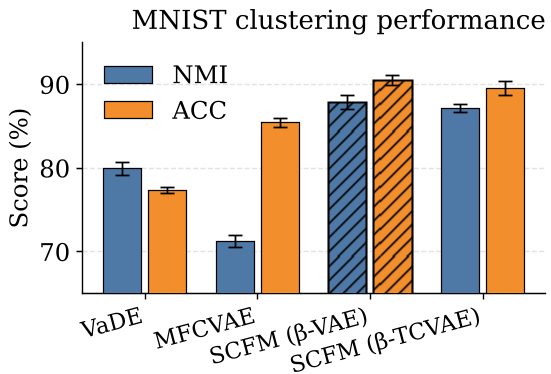 Figure 2: Left: MNIST clustering metrics showing SCFM's lead. Middle/Right: Probing shows the latents retain more class information than standard encoders.
Generative Fidelity
Crucially, this added structure doesn't hurt image quality.
- CIFAR-10: SCFM achieved an FID of 2.11, matching the original Flow Matching paper.
- ImageNet-128: It achieved an FID of 17.18, which is actually better than the standard class-conditional SiT baseline (17.24). This suggests that the learned GMM structure actually helps the model navigate the complex ImageNet manifold better than random noise.
A New Way to Sample: Decoder-Initialized Refinement
Because SCFM has a decoder, it introduces a "shortcut" for sampling. Instead of integrating the ODE from to (which is slow), you can:
- Generate a rough sketch using the VAE decoder ().
- Jump back to .
- Run a "short" flow refinement to . This provides a 3-5x speedup in sampling with minimal impact on quality.
Critical Insight & Conclusion
SCFM proves that source distribution design is a powerful lever for generative modeling. By moving away from fixed Gaussian noise and toward "Structured Couplings," we can build models that are not just artists, but also analysts.
Limitations: The primary drawback is computational overhead. Training an auxiliary decoder and the dual-purpose recognition network increases parameter counts (e.g., from 675M to 1.1B on ImageNet). However, for applications where data interpretation is as important as generation, this is a price well worth paying.
Final Takeaway: The future of flow-based models lies in "Smart Sources"—making the noise meaningful is the key to the next generation of interpretable AI.