
STSCR: Mastering the Spatial-Temporal and Social Dynamics of Location Recommendation
STSCR: Exploring spatial-temporal sequential influence and social information for location recommendation
The paper introduces STSCR (Spatial-Temporal aware Social Collaborative Ranking), a multi-dimensional recommendation framework for Location-Based Social Networks (LBSNs). It integrates five-tuple tensor factorization with Bayesian Personalized Ranking (BPR) to model user-friend-POI-time-location interactions, achieving state-of-the-art performance on Foursquare and Gowalla datasets.
TL;DR
Recommending your next favorite hangout isn't just about where you've been; it's about when you went, who you trust, and the sequence of your journey. The STSCR (Spatial-Temporal aware Social Collaborative Ranking) model represents a major leap in Location-Based Social Networks (LBSNs) by unifying five distinct interaction dimensions into a single tensor framework, optimized specifically for ranking rather than simple score prediction.
The Problem: Beyond a "Bag of Check-ins"
Most early recommenders viewed check-in history as a simple matrix or a "bag of locations." However, academia has identified three critical gaps that these models couldn't bridge:
- Temporal Naivety: They failed to properly model the probabilities of visiting POIs in different time slots (e.g., a gym is more likely at 6 PM than 2 PM).
- Weak Social Links: They assumed all friends influence you equally, ignoring that "trust" is non-linear and context-dependent.
- Point-wise Flaws: Treating missing check-ins as "negative" (0) rather than "unobserved" led to poor ranking results.
Methodology: The Five-Tuple Tensor Optimization
STSCR moves beyond Matrix Factorization into a 5D space. The model captures the complex interplay between:
- User & POI: General preference.
- User & Friend: Social trust.
- Location & Location: Sequential "where to next" logic.
- Location & Time: Temporal suitability.
- Friend & POI: Word-of-mouth influence.
The RBF-SVR Secret Sauce
Instead of using simple cosine similarity for friends, the authors use Support Vector Regression (SVR) with a Radial Basis Function (RBF) kernel. This allows the model to capture the non-linear intensity of social connections, essentially learning how much a specific friend's check-in should influence your recommendation.
 Note: The architecture combines spatial-temporal sequence influence with dynamic social weighting.
Optimization via Bayesian Personalized Ranking (BPR)
To solve the "Implicit Feedback" problem, STSCR uses BPR. Instead of predicting if you will visit a place, it optimizes the model to ensure that locations you did visit are ranked higher than those you didn't, utilizing pairwise constraints.
Experiments: Dominating the Leaderboard
The authors tested STSCR on two massive public datasets: Foursquare and Gowalla.
Key Findings:
- Consistency is Key: STSCR consistently beat 7 state-of-the-art baselines (including BPRMF and LORE) across Precision, Recall, MAP, and NDCG.
- Social Impact: The SVR-based social modeling provided a better "lift" than traditional similarity measures (Trust-FCF or USG), particularly in sparse data scenarios.
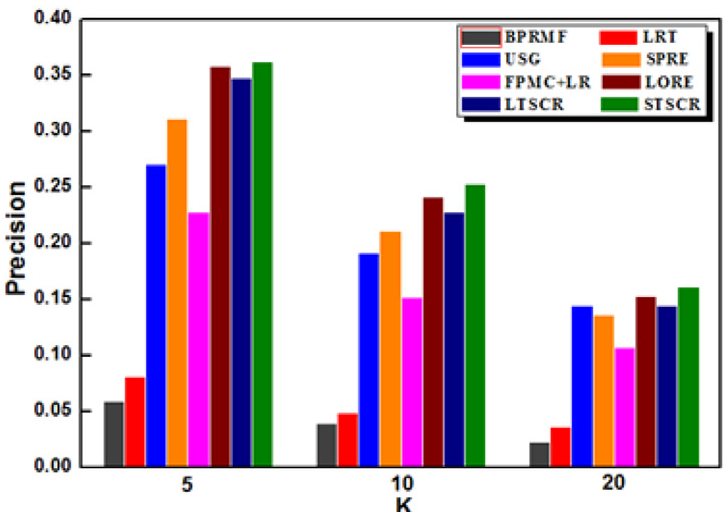 Fig: STSCR (top line) demonstrates superior precision as the recommendation list (k) grows.
Ablation Study: Does Every Part Matter?
By systematically removing the Time (T-), Social (S-), and Sequential (L-) components, the research proved that all three are essential. The removal of the "last-checked-in POI" correlation (L-SCSTR) typically caused the sharpest drop in performance, suggesting that the sequence of movement is the strongest predictor in LBSNs.
Critical Insight & Future Work
The strength of STSCR lies in its holistic approach. By combining non-linear social modeling (SVR) with high-dimensional tensor factorization, it addresses the data sparsity inherent in LBSNs.
Limitations: The model is computationally expensive. Calculating the social weighting function is in the worst case, making it heavy for real-time updates on low-end hardware without offline pre-computation.
Future Outlook: The authors suggest that moving into Deep Metric Learning and Neural Tensor Networks could further improve performance by capturing even more complex non-linearities that traditional factorization techniques might miss.
Conclusion
STSCR proves that in the world of spatial data, context is king. By accurately modeling who you are with, when you are moving, and where you just came from, we can build recommendation systems that feel less like algorithms and more like personal concierges.