
Beyond Local Minima: Strengthening Student Modeling with Convex Factorization Machines
Verification of Usefulness of Student Modeling with Real Educational Data using Convex Factorization Machines
The paper introduces Convex Factorization Machines (CFM) for student modeling in Intelligent Tutoring Systems (ITS). By formulating student performance prediction as a convex optimization problem, the authors achieve higher prediction accuracy (AUC and ACC) on both synthetic and real-world educational datasets (Algebra I 2008-2009) compared to standard Factorization Machines.
TL;DR
Understanding a student's knowledge state is the "Holy Grail" of Intelligent Tutoring Systems (ITS). While Factorization Machines (FM) have been the go-to for handling sparse education data, they suffer from the pitfalls of non-convex optimization. This paper proposes using Convex Factorization Machines (CFM) to guarantee global optimality, leading to more accurate predictions of whether a student can solve a specific problem.
Context & Motivation: The Sparsity Trap
Student modeling is inherently difficult because the "Student-Question" matrix is extremely sparse; no student solves every question in a system. Traditional Support Vector Machines (SVM) fail here because they don't model the latent interactions between specific students and specific skills effectively.
Standard Factorization Machines (FM) bridged this gap by factorizing these interactions into low-dimensional vectors. However, FM's objective function is non-convex. This means:
- The model often converges to local minima, making results sensitive to initial values.
- Researchers must manually tune the rank (k)—the size of the latent space—which is extremely time-consuming and prone to error.
Methodology: The Shift to Convexity
The authors pivot to CFM, where the prediction equation is rewritten to represent second-order interactions via a matrix . Unlike FM, which forces to have a fixed rank , CFM uses the Nuclear Norm () as a regularizer.
Why this matters:
- Global Optimum: The error function becomes a second-order differentiable convex function. If you find a minimum, it is the minimum.
- Automatic Rank Discovery: Instead of guessing , the parameter encourages a low-rank structure naturally.
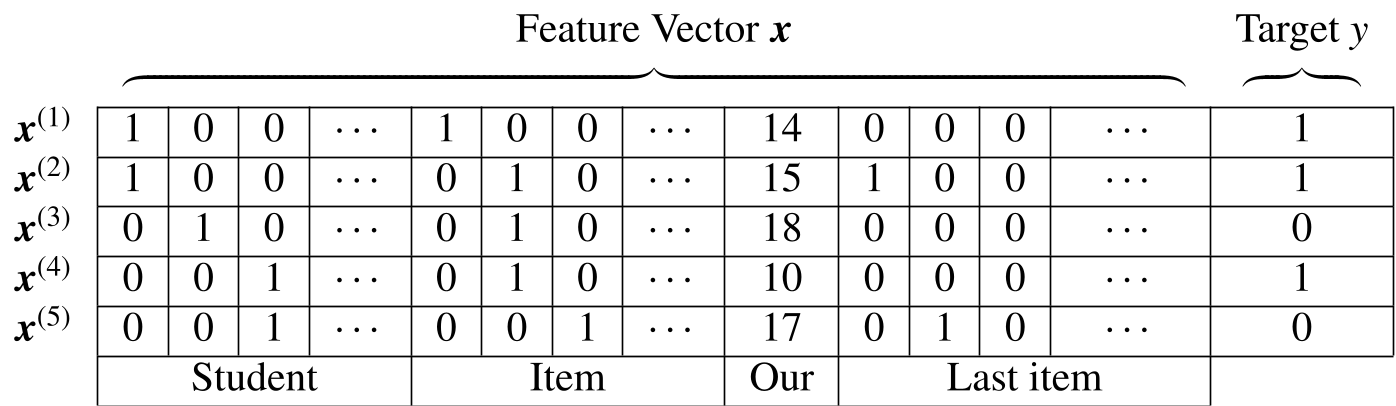 The figure above illustrates the multi-hot feature vector design, integrating Student IDs, Items, and Skills into a unified input for the machine.
Experimental Validation
The researchers tested their approach on two fronts: Synthetic data (generated via Item Response Theory) and the Algebra I 2008-2009 dataset (KDD Cup 2010).
Key Findings:
- Feature Importance: Removing "skills" as a feature caused accuracy to plummet across all models, proving that "Skill" markers are the strongest inductive bias in educational data mining.
- Performance Boost: On real-world data, CFM consistently outperformed FM in AUC (Area Under the Curve), reaching 0.741 compared to FM's 0.713.
- The Overfitting Warning: Interestingly, adding too many features (like "previous items solved") actually lowered the accuracy of CFM on real data, likely due to over-fitting on highly specific patterns.
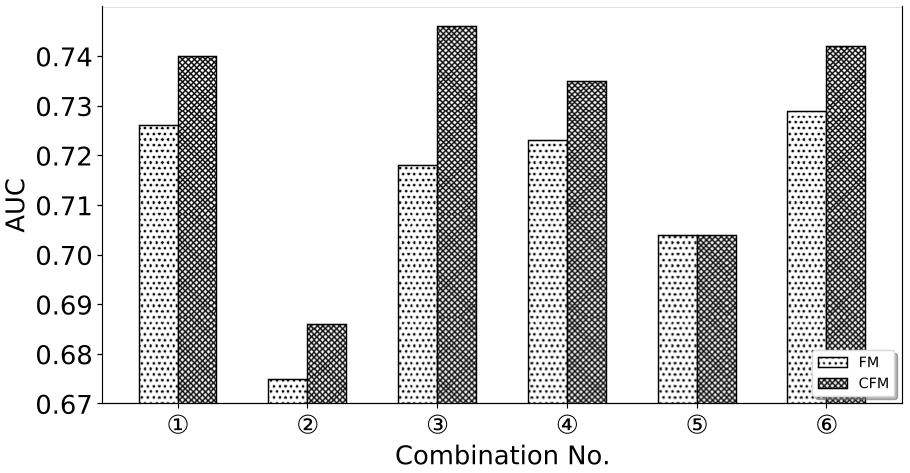 The comparison shows that while CFM requires more training time, its ability to minimize RMSE and maximize AUC is superior in most sparse scenarios.
Critical Insights & The "Time-Accuracy" Trade-off
The primary drawback of CFM noted by the authors is computational complexity. Because CFM involves nuclear norm minimization (often requiring Singular Value Decompositions), training is significantly slower than the SGD-based FM.
However, as the authors astutely point out: In education, accuracy trumps speed. An e-learning system doesn't need millisecond-level updates to a student's knowledge profile; it needs the most accurate assessment possible to recommend the next best learning step.
Conclusion
This work demonstrates that by revisiting the mathematical foundations of Factorization Machines, we can achieve more reliable student models. By moving from non-convex heuristics to convex guarantees, CFM provides a more stable backbone for the next generation of Intelligent Tutoring Systems.
Takeaway for Practitioners: When working with sparse, high-stakes data where "getting it right" is more important than "doing it fast," convex formulations of latent factor models should be your first choice.