
Student Performance Analysis: Closing the Temporal Gap in Educational Data Mining
Student performance analysis and prediction in classroom learning: A review of educational data mining studies
This paper presents a systematic review of 140 Educational Data Mining (EDM) studies focusing on student performance analysis and prediction within classroom-based learning. It introduces a comprehensive research taxonomy and identifies student background, behavior, and internal assessments as primary predictors, with Artificial Neural Networks and Decision Trees achieving SOTA-level accuracy (often >90%) during the course tenure.
TL;DR
Predicting student success is a cornerstone of "Precision Education." This systematic review of 140 studies identifies a critical "Temporal Gap": while we can predict student outcomes with >80% accuracy once a semester starts, our ability to forecast success before the first day of class remains significantly lower (~71%). The paper highlights the untapped potential of tracking "Value Addition" and teaching quality over traditional raw grades.
Contextual Positioning
Within the Educational Data Mining (EDM) landscape, this work serves as a foundational "meta-map." Unlike general surveys, it focuses exclusively on classroom-based learning, addressing the unique variables of face-to-face instruction that online-only studies often miss.
The Problem: The "Cold-Start" of Academic Prediction
Most SOTA (State Of The Art) models rely on "Proximal Data"—information generated during the course, such as quiz scores, attendance, and forum activity. However, for an educational intervention to be truly proactive, it must happen before the student begins to fail.
The authors identify three main friction points in current literature:
- Temporal Blindness: Existing surveys don't differentiate between when a prediction is made.
- The Gender Paradox: While many studies track gender, the meta-analysis suggests it rarely provides significant predictive lift.
- Quality vs. Outcome: We often blame student failure on the student, ignoring the "Value Addition" (or lack thereof) provided by the teacher and the student's prior "Domain Knowledge."
Methodology: A Multi-Dimensional Taxonomy
The paper organizes the EDM territory into a specific taxonomy of predictors and methods.
1. Predictor Categories
- Student Background: Demographics and socio-economics.
- Internal Assessments: The meat of most models (quizzes, mid-terms).
- Behavioral Data: Temporal patterns in answering questions or library usage.
- External Factors: Teaching excellence (SETE) and domain-specific prerequisites.
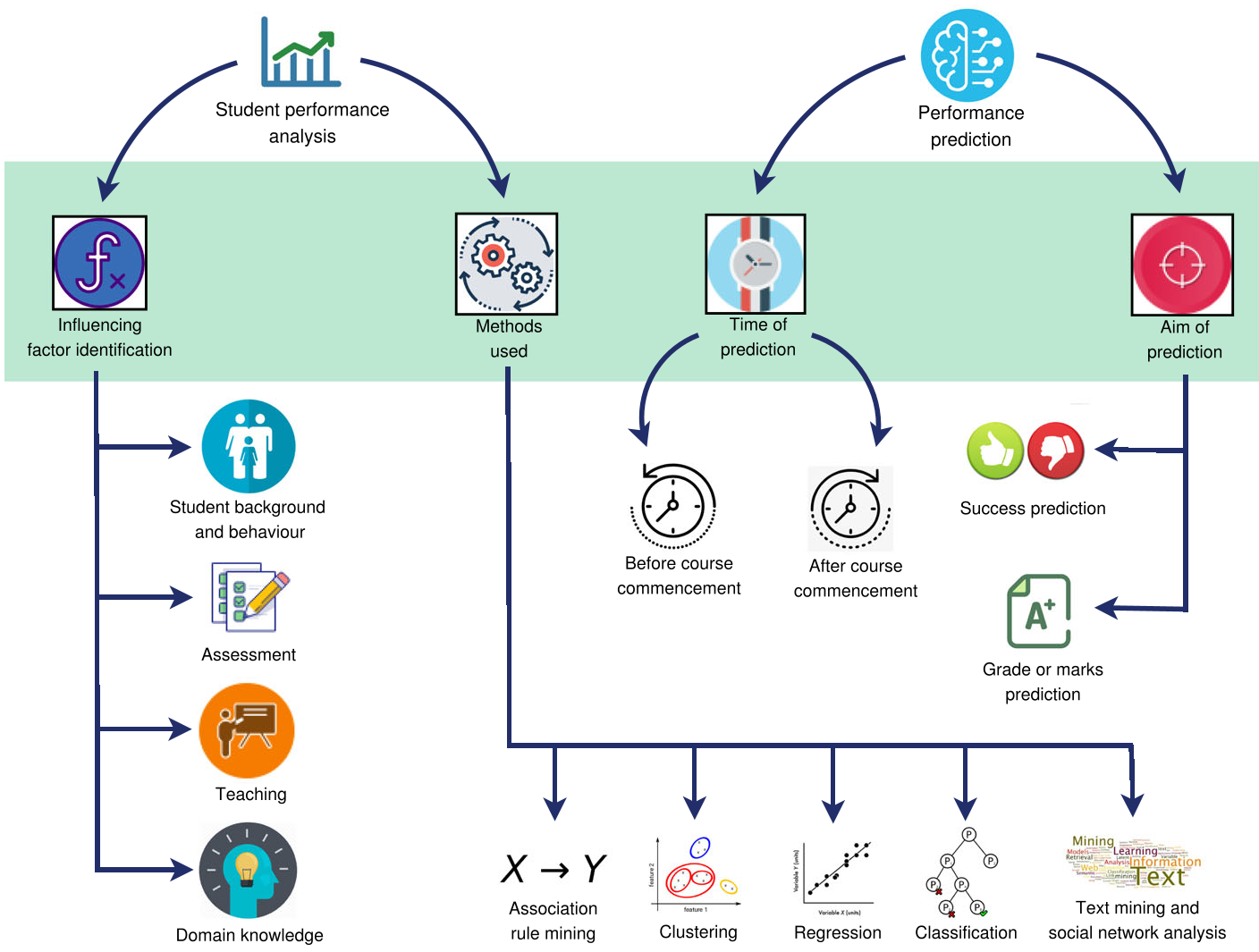
2. Algorithmic Toolbox
The review finds that Classification (predicting Pass/Fail) is far more common than Regression (predicting exact scores), largely because high-resolution score prediction is significantly more complex and sensitive to non-linear noise.
Experimental Insights: Why Timing is Everything
The most striking takeaway is the performance decay when moving backward in time.
| Prediction Timing | Avg. Accuracy | Primary Predictors |
|---|---|---|
| During Tenure | 82.07% | Behavior + Internal Assessments |
| Before Commencement | 71.09% | Background + Emotional Skills |
The "Value Addition" Perspective
A critical insight offered by the authors is that a "superior" student will likely get high marks regardless of teaching quality. To truly measure the impact of external factors (like pedagogy), researchers should move toward a "Value Addition" metric—measuring the delta of knowledge gained rather than the absolute final score.
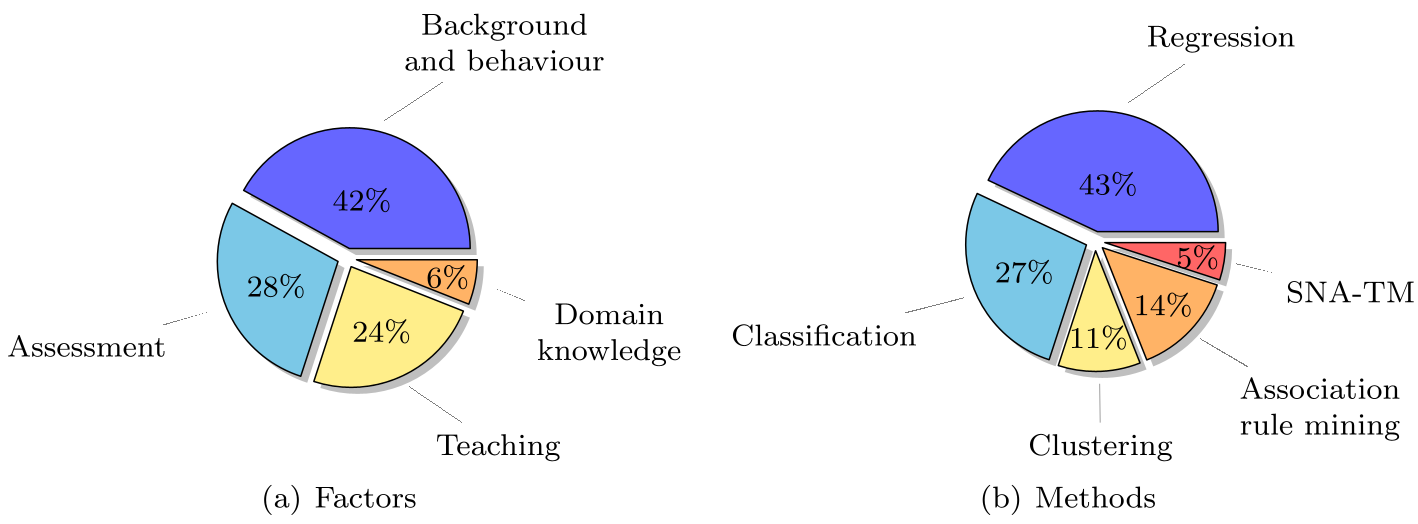
Critical Analysis & Future Outlook
While the field has reached a level of maturity in Success Prediction, several frontiers remain:
- Class Imbalance: Many papers report 90%+ accuracy but ignore that failing students are often a tiny minority. If a model predicts "Pass" for everyone in a class where 95% pass, it is 95% accurate but useless for intervention.
- Unstructured Data: The next leap in EDM will come from Text Mining of syllabi, question papers, and student answer scripts, rather than just tabular grade data.
- Confidence over Classification: Instead of a binary "Fail/Pass" label, models should output a confidence score (e.g., "90% probability of failure") to help educators prioritize resources.
Conclusion
This review serves as a call to action for the EDM community: stop over-optimizing for mid-semester data and start looking at the "Dark Matter" of education—teaching quality, domain prerequisite depth, and emotional intelligence—to fix the early prediction gap.