
Digital Glue: How Facebook Bridges the Gap to Student Offline Life
Student socialization in the age of facebook
This paper explores how university students utilize Facebook to facilitate face-to-face social interactions, moving beyond traditional studies of online-only behavior. By examining the "nomadic" lifestyle of students, the researchers demonstrate how Facebook serves as a critical infrastructure for initiating and managing offline gatherings through various access platforms.
TL;DR
While early social media research obsessed over how people "curate" their digital selves, Barkhuus and Tashiro’s seminal work looks the other way: how does the digital help us meet in the physical? By studying students—the ultimate "nomadic" workers—this paper reveals that Facebook isn't just a site; it’s a coordination tool that facilitates ad-hoc lunches, study sessions, and the maintenance of "weak ties" that would otherwise wither away.
The Nomadic Student: A Professional Without an Office
The authors position university students not just as young users, but as a specific class of mobile workers. They are nomadic: they move between labs, classrooms, and off-campus jobs without a central "base."
Existing literature at the time (2010) often treated online and offline lives as separate spheres. The "nomadic" nature of student life, however, creates a unique pain point: social life is highly scheduled yet relies on serendipity. How do you find a friend for a coffee between two classes in different buildings?
Methodology: Tracking the Mobility Spectrum
The researchers categorized 18 participants into three tiers of digital mobility:
- Mobile (M): Access via early smartphones (iPhone/Blackberry).
- Semi-Mobile (SM): Users who carry laptops everywhere, using them in "bursts" at cafes or libraries.
- Non-Mobile (NM): Users who transit between home and public PCs.

Core Insight: The Power of the "Status Message"
The most profound finding is how the Status Message serves as a "micro-broadcast" for social availability. Unlike a phone call, which is intrusive and demands an immediate "yes/no," a status update like "Hungry" or "Need caffeine" provides plausible deniability.
The paper identifies three new categories of Facebook-facilitated behavior:
- Spur of the Moment Meetings: Using a location-defining status to trigger a text message and a subsequent meetup.
- Meeting Reminders: "Passive" notifications where seeing a friend's status at a BBQ reminds another to attend.
- Social Assistance: Helping shy students attend "Special Events" by seeing that a close friend is already there, reducing the "social friction" of entering a room alone.
The Functional Maintenance of "Weak Ties"
A critical takeaway is that Facebook is the primary tool for Peripheral Friendships. In a physical dorm, you might only see your neighbor. On Facebook, you maintain a "buffer" for people you aren't close enough to call, but are comfortable enough to "Wall post" for class notes or a casual invite.
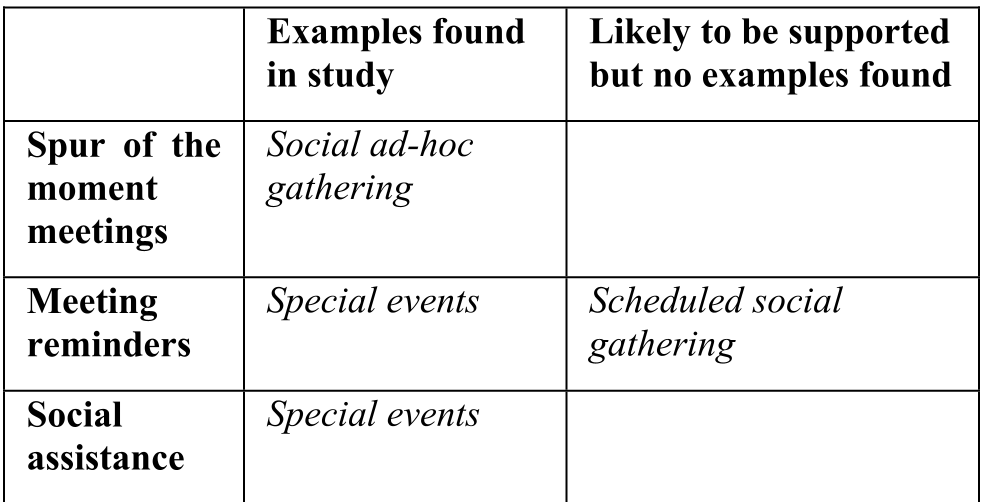 Table 1: Mapping types of social gatherings to Facebook-supported behaviors.
Critical Analysis & Conclusion
In hindsight, this 2010 study predicted the "ubiquitous computing" era we live in now. Its main contribution is the realization that location is the key to integration.
Limitations: The sample size (18) is small, and the technology has evolved—we now have persistent location sharing (Snap Map) and "Stories." However, the underlying social logic remains: we use digital tools to lubricate our physical social machinery.
Future Outlook: For developers and researchers, the lesson is clear: focus on asynchronous informality. Tools that allow users to signal "availability" without "obligation" are the ones that truly integrate into the chaotic, nomadic lives of modern users.