
Beyond the Ledger: How Social Connectivity Drives Metacognition in Engineering Education
Students' collaborative note-taking activities while using electronic and paper-based enhanced guided notes: Viewed from metacognitive and social network perspectives
This study investigates the impact of collaborative note-taking using Enhanced Guided Notes (EGN) on engineering students' metacognitive skills and social network structures. By comparing electronic (iPad-based) and paper-based modalities, the research identifies a strong correlation between high social connectivity and superior self-regulated learning (SRL) strategies.
TL;DR
Is note-taking a solitary act or a social one? This study reveals that for engineering students, the way you connect with peers is just as important as the notes you take. While electronic and paper-based notes yield similar metacognitive results, students who are "social hubs" in their class network demonstrate significantly stronger skills in monitoring and regulating their own learning.
The "15-Minute" Wall and the Note-Taking Crisis
In the high-stakes world of engineering education, the traditional lecture is failing. Research shows student attention craters after just 15 minutes. The result? A frantic attempt to transcribe every word without actually processing any of it. To combat this, researchers Lawanto and Santoso introduced Enhanced Guided Notes (EGN)—a framework that forces students to stop recording and start reflecting.
Methodology: EGN and the Power of Metacognition
The researchers didn't just give students fill-in-the-blank sheets. They added "Metacognitive Prompts" designed to trigger:
- Cognitive Self-Appraisal (CSA): Judging one's own ability to solve a circuit problem.
- Cognitive Self-Management (CSM): Adjusting strategies when a calculation goes wrong.
The study split 66 students into two camps: an Electronic Group (using iPads and shared repositories) and a Paper-Based Group (relying on face-to-face collaboration).
 Figure 1: Sample of the Enhanced Guided Notes (EGN) featuring circuit analysis and metacognitive reflection prompts.
The Social Network Revelation
Using Social Network Analysis (SNA), the study mapped the "In-degree Centrality" of students—essentially measuring who was a "node" that others turned to for information.
The findings were striking. The Paper-Based group actually had a denser network of connections. Why? The digital group could download notes asynchronously from a server, reducing the "friction" of interaction. While efficient, this digital convenience may have inadvertently stifled the face-to-face social bonds that catalyze deeper learning.
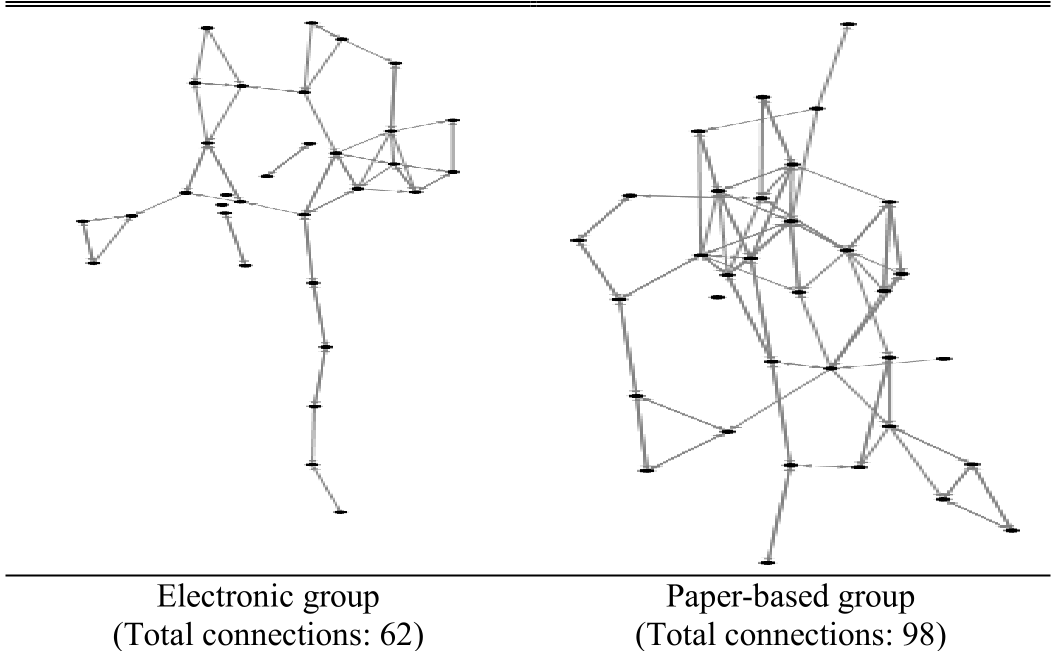 Figure 2: Comparison of In-degree Centrality. Note how the paper-based group (left) shows higher overall interconnectivity compared to the electronic group.
Hubs vs. Spokes: The Performance Gap
The researchers clustered students into "High" and "Low" connectivity groups. The data showed that the "High Connectivity" group (the social hubs) were not just more popular—they were better learners. They scored significantly higher in:
- Monitoring: Checking if their work was "making sense."
- Regulating: Reviewing difficult concepts when they got stuck.
- Cognitive Strategy: Linking new concepts to previous knowledge.
| Strategy Feature | High Connectivity (M) | Low Connectivity (M) | Significance (p) |
|---|---|---|---|
| Monitoring | 3.18 | 2.96 | 0.031 |
| Regulating | 3.11 | 2.80 | 0.015 |
| Cognitive | 3.30 | 3.05 | 0.024 |
Critical Insight: Social Capital is Metacognitive Capital
This study proves that metacognition isn't just an internal monologue. It is socially situated. When students explain concepts to peers (acting as a hub), they are forced to monitor their own understanding more rigorously.
Limitations and Future Outlook
While the study is a breakthrough in linking SNA to SRL (Self-Regulated Learning), the sample size (n=66) is small. Furthermore, the "Electronic Group" may have suffered not from the technology itself, but from the architecture of the repository which allowed them to bypass direct conversation.
The Takeaway for Educators: Don't just digitize your notes. If you move to digital EGN, you must intentionally design "digital friction"—forced discussion or peer-review cycles—to ensure the social network remains robust. Mid-semester "network check-ups" could be the key to identifying at-risk students who have drifted into social isolation.
Conclusion
The future of engineering note-taking isn't just about iPad vs. Paper; it's about fostering an environment where every student is a "node" in a collaborative web. Social connectivity is the engine that drives the metacognitive skills required to master the complex circuits of modern engineering.