
Beyond Ease of Use: Why Perceived Value Drives the Future of Social E-Learning
Understanding Students’ Continuance Intention toward Social Networking e-Learning
This study investigates the factors driving students' long-term engagement with social networking e-learning (SNeL) by integrating "Perceived Value" into the Unified Theory of Acceptance and Use of Technology (UTAUT) framework. Using Partial Least Squares (PLS) analysis on data from 240 students, it identifies Perceived Value and Social Influence as the primary predictors of continuance intention.
TL;DR
What makes a student stick with a collaborative learning tool? This study reveals that it isn't how "easy" the tool is to use, but rather the Perceived Value and Social Influence it provides. By extending the classical UTAUT model with psychological "attainment value," the research highlights that students prioritize becoming more knowledgeable and competent over simple technical convenience.
The Motivation: The Retention Gap in E-Learning
The transition from Web 1.0 (consumption) to Web 2.0 (collaboration) birthed "Social Networking e-Learning" (SNeL). While tools like Facebook, Wikis, and Blogs are ubiquitous, educators face a persistent challenge: Continuance. Many students engage initially but drop off as the novelty fades.
The researchers hypothesized that existing models like the Unified Theory of Acceptance and Use of Technology (UTAUT) were incomplete. They argued that in an academic setting, a student’s decision to continue wasn't just about utility or ease, but about the subjective value of the task—a concept derived from the Expectation-Value Theory.
Methodology: Extending UTAUT
The study proposed an integrated model testing five core hypotheses (H1-H5), linking traditional factors and the new "Perceived Value" construct to Continuance Intention (CI).
Model Architecture
The researchers utilized a Partial Least Squares (PLS) approach to analyze surveys from 240 college students. This method is particularly robust for structural equation modeling with smaller sample sizes and non-normal distributions.
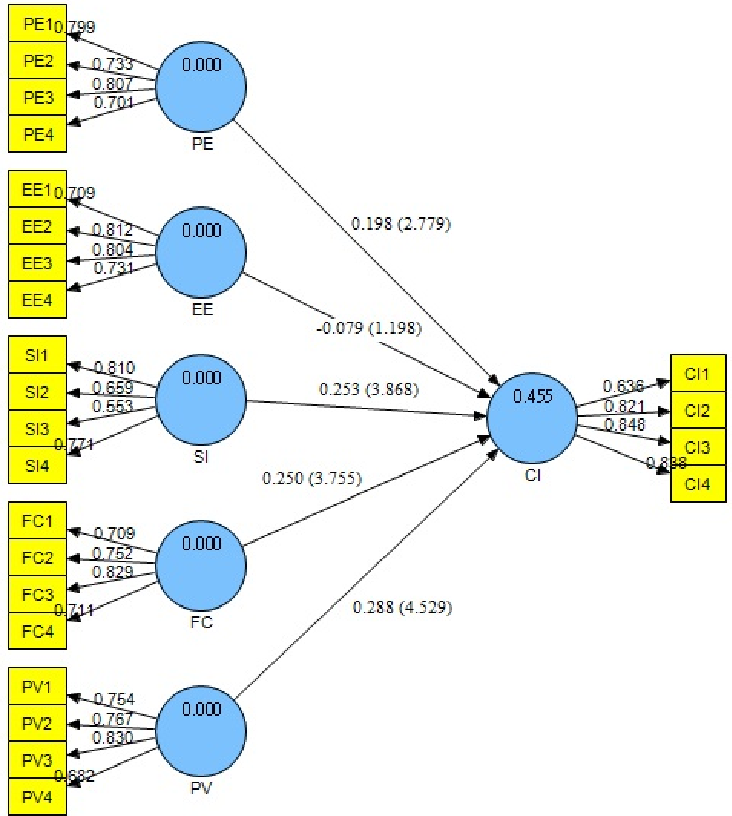
The figure above illustrates the path coefficients, where Perceived Value (PV) demonstrates the strongest impact on Continuance Intention (CI).
Key Findings: The "Ease of Use" Paradox
The experimental results yielded a surprising "failure" of one hypothesis that provides deep insight into the modern student:
- Perceived Value is King (β=0.288): Students continue using tools if they feel the platform makes them more "knowledgeable" or "competent." It is about identity and achievement.
- Social Influence Matters (β=0.253): Because SNeL is inherently interactive, the presence of peers and instructors is a massive retention hook.
- The Effort Expectancy Myth (H2 Rejected): Effort Expectancy (ease of use) had no significant effect on continuance.
Why did "Ease of Use" fail?
In the early days of the internet, technical friction was a dealbreaker. Today, students are digital natives. If a tool is valuable, they will master it regardless of the learning curve. Conversely, an "easy" tool that offers no growth value will be abandoned just as quickly as a difficult one.
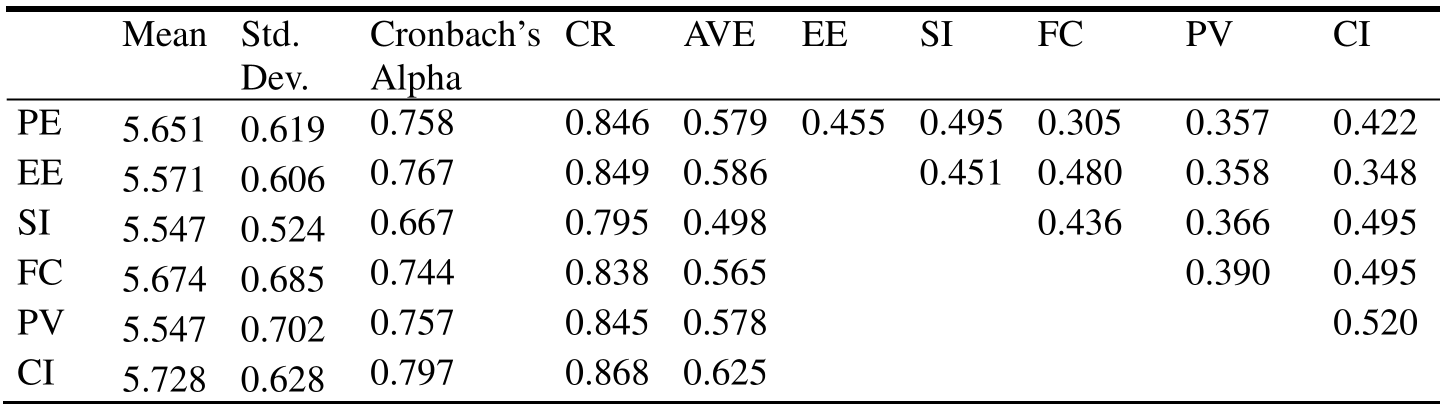
Table: Statistical validation showing that all constructs met the Average Variance Extracted (AVE) and Composite Reliability (CR) thresholds.
Critical Insights & Future Outlook
Takeaway for Educators
Don't just pick "user-friendly" apps. Pick tools that allow students to showcase expertise and receive immediate social validation. The value is in the "attainment"—the feeling of becoming a better student.
Future Research Directions
The study’s primary limitation is its focus on a single geographic location (Macau) and a relatively small sample (n=240). As we move into the era of AI-mediated social learning, future research should explore:
- How AI assistants within social networks alter the "Perceived Value."
- Whether the non-significance of "Ease of Use" holds true for older, non-native digital learners.
Conclusion
This paper serves as a vital reminder that in the crowded landscape of EdTech, Value is the ultimate retention strategy. If a platform provides a sense of achievement and community, the technology becomes secondary to the growth it facilitates.