
Decoding Crowdsourcing Failure: How Task Diversity and Competition Patterns Shape Project Success
Study on Patterns and Effect of Task Diversity in Software Crowdsourcing
This study investigates software crowdsourcing dynamics by proposing a conceptual task diversity model to analyze real-world data from TopCoder. The research identifies three distinct task diversity patterns—Responsive-to-Prize (RP), Responsive-to-Prize-and-Complexity (RPC), and Over-Responsive-to-Prize (ORP)—and evaluates their impact on task success (failure ratios) and worker performance.
TL;DR
Why do 15.7% of software crowdsourcing tasks fail despite offering high rewards? This study analyzes over a year of TopCoder data to reveal that it isn't just about the "prize"—it is about the Task Diversity Pattern of the entire marketplace at any given time. By categorizing markets into prize-responsive or complexity-driven zones, the researchers found that balancing compensation with task difficulty (the RPC pattern) is the most effective way to minimize project failure.
The "Broken" Market: Why High Prizes Aren't Enough
In the world of Crowdsourced Software Development (CSD), we often assume that more money equals more workers and better results. However, the data tells a different story: high-prize "outliers" can actually disrupt the market equilibrium. When a few tasks offer massive rewards, they create a "black hole" effect—attracting a surge of registrations (the Over-Responsive-to-Prize pattern) while leaving other critical tasks starved for talent.
The core problem is Market Opacity: requesters don't know what else is being posted, and workers often over-register for more than they can deliver (an 82.9% drop-rate).
Methodology: Mapping the Diversity Landscape
The researchers proposed a Conceptual Task Diversity Model (see Figure 2) that looks at the market as a living ecosystem rather than isolated tasks.
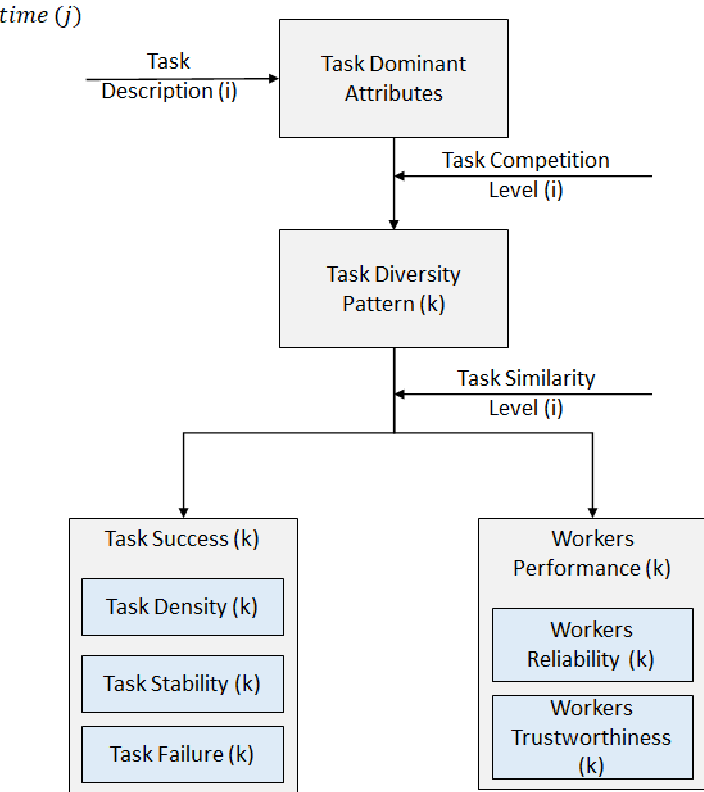
Using K-Means clustering on 4,770 TopCoder tasks, they identified that Monetary Prize and Task Complexity (measured by description length and technical requirements) are the two dominant genes of a task's "DNA."
They identified three "Market Seasons":
- Responsive-to-Prize (RP): A "rational" market where more money consistently leads to more registrations.
- Responsive-to-Prize-and-Complexity (RPC): A "discerning" market where workers weigh the prize against the effort required.
- Over-Responsive-to-Prize (ORP): A "disrupted" market where outliers skew competition.
Key Findings: The "RPC" Advantage
The study’s most significant insight is that the RPC configuration (where competition follows both prize and complexity) yields the lowest failure ratio.
(Note: Per the study, Figure 6 illustrates RPC providing only ~6-11% failure, significantly lower than other patterns for similar tasks.)
Worker Performance Insights:
- Reliability: The probability of a worker actually submitting after registering.
- Trustworthiness: The probability of that submission being valid.
- The RPC pattern attracts the most reliable workers for tasks with 60-70% similarity, while ORP markets tend to attract "prize seekers" who may register but fail to submit high-quality work.
Critical Analysis & Conclusion
Takeaway
If you are a project manager looking to crowdsource a software component, look at the current market state. If the platform is currently in an ORP (Outlier) state, your moderate-prize task is likely to fail unless you adjust the complexity or wait for the "prize-spike" to pass.
Limitations
The study is localized to TopCoder. Other platforms with different mechanisms (like bidding-based Freelancer or micro-task-based MTurk) might exhibit different patterns. Furthermore, it doesn't account for "Worker Networks"—the social influence of developers talking to one another outside the platform.
Future Outlook
The next step for this research is real-time Dynamic Task Routing. Imagine a platform that warns a requester: "Your task has an 80% failure risk because three similar high-prize tasks were just posted; consider increasing the prize by 15% or simplifying the requirements." This moves crowdsourcing from a "post and pray" model to a data-driven engineering discipline.