
The SPI Model: Why More Friends Means Less Influence in the Age of Information Overload
On Studying Information Dissemination in Social-Physical Interdependent Networks
The paper proposes the Social-Physical Interdependent (SPI) model to analyze information dissemination across dual-layered networks (online social networks and offline real-life interactions). It specifically addresses the "information overload" effect and human-computer dependencies, outperforming traditional epidemic models in capturing realistic propagation trends.
TL;DR
Researchers have challenged the long-standing "epidemic" approach to social media. By introducing the Social-Physical Interdependent (SPI) model, they prove that information doesn't spread like a virus; instead, it's governed by a dual-layered online-offline struggle and the reality that the more news we see, the less we actually "infect" others with it.
Background: The Flaw in the "Viral" Analogy
For decades, academic research treated a "viral" tweet exactly like a biological virus. The logic was simple: if you have more friends (higher degree), you are more likely to get infected and pass it on. However, this ignores two human realities:
- Dual-Layered Lives: We don't just live on Facebook; we talk to people offline. A piece of news often jumps between these two layers.
- Attention Scarcity: Unlike a biological cell that can be infected by a million viruses, a human mind has a "buffer." If your feed is flooded, you're less likely to notice a specific message.
Methodology: The SPI Framework
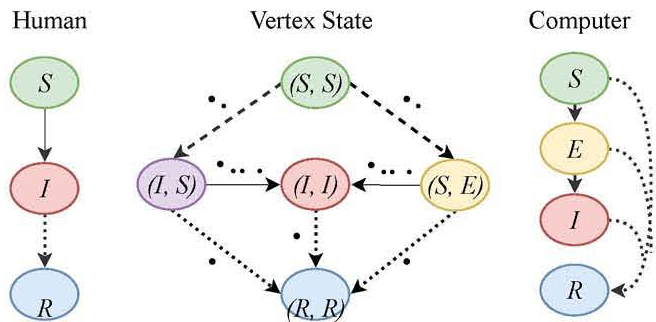
The authors propose a network composed of two subgraphs: (the online network of devices) and (the offline network of humans).
1. State Complexity
Unlike simple Binary (Infected/Susceptible) models, SPI introduces the "Exposed" state. A computer might receive the data (Exposed), but until the human reads it and decides to act, the information is dormant.
2. The Information Overload Equation
The most critical technical insight is the crossover probability . The authors define it as: Where is the number of online friends. This mathematically captures the "flushing" effect where new information overwhelms a user's capacity to process any single post.
Experiments: Real-World Validation
To validate the model, the authors used the "Special Olympic" dataset (tracking a 2009 news cycle involving President Obama).
SPI vs. Traditional Epidemic Models
- The Epidemic Failure: Traditional models (shown in the results below) exhibit an "exponential explosion." Information peaks almost instantly because high-degree nodes amplify the spread too quickly. It fails to show the "waves" of discussion that happen in real life.
- The SPI Win: The SPI model matches the "slow-start" phase. It correctly predicts that information takes time to saturate the offline-online layers and follows the natural peaks and valleys of human daily activity (e.g., people are more active at 15:00 than 05:00).
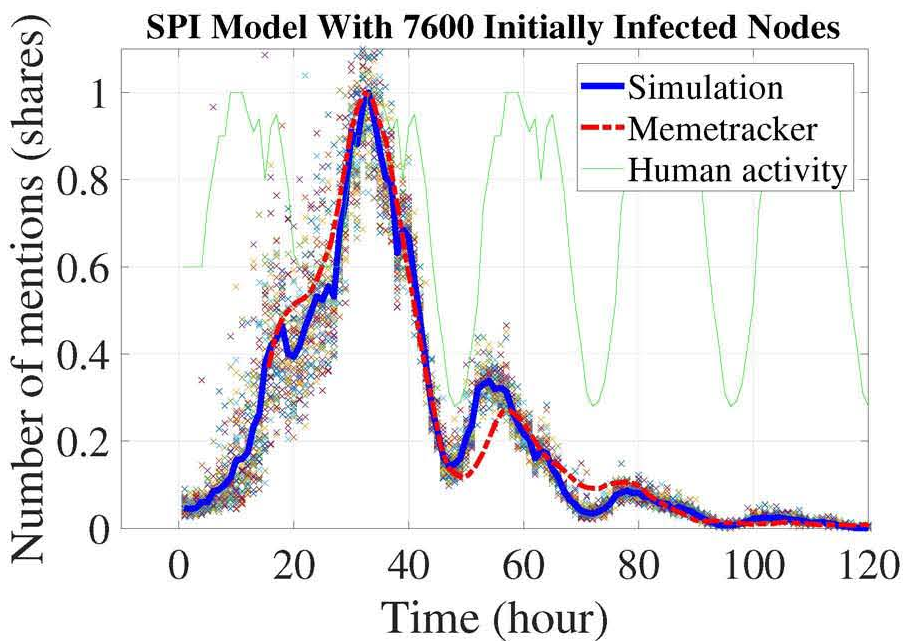 Fig 2a: The SPI model (blue) closely follows the real-world Memetracker data (red dashed line), capturing multiple waves of mention.
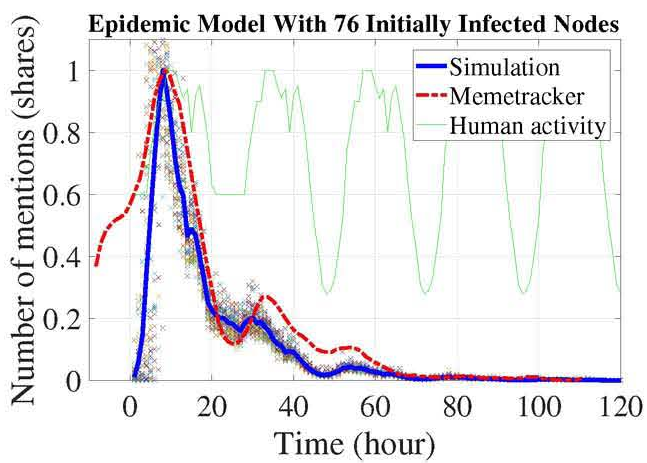 Comparison showing how traditional models (Fig 2b & 3b) create a sharp "spike" that doesn't exist in actual social data.
Critical Insight & Conclusion
This paper shifts the paradigm of "influence." It suggests that Inductive Bias in network modeling must account for human psychology, not just graph topology.
Takeaways for Future Research:
- Information Lifetime: Information doesn't stay "infectious" forever; it has a decay rate that must be modeled.
- Human Activity Cycles: The background noise of daily life (sleep/work cycles) acts as a filter for information propagation.
The SPI model provides a more nuanced, "socially-aware" lens through which we can understand how ideas—and perhaps more importantly, misinformation—permeate our interconnected world.