
Beyond the Waveform: Bridging Human Perception and Machine Logic in Speech Emotion Recognition
Subjective Evaluation of a Speech Emotion Recognition Interaction Framework
This paper presents a subjective evaluation of a multidisciplinary Speech Emotion Recognition (SER) framework designed for theatrical performances and social media. The authors validate the Acted Emotional Speech Dynamic Database (AESDD), a color-emotion lighting mapping system, and a prototype GUI for multimodal data gathering, achieving a human recognition baseline for later algorithmic comparison.
TL;DR
Speech Emotion Recognition (SER) is moving from the lab to the stage. This paper evaluates the AESDD (Acted Emotional Speech Dynamic Database) and an integrated interaction framework. By testing how humans perceive emotions in audio and correlate them with lighting colors, the researchers provide a psychological foundation for AI-driven performance arts. Key finding: Human listeners match the "intended" emotion labels about 74.2% of the time, setting a realistic benchmark for AI models.
Background & Motivation: The Subjectivity Trap
Engineers often treat emotion as a discrete label in a CSV file. However, in the realm of performing arts and social media, "emotion" is a fluid, subjective experience. Previous SER work often ignores the "Communication Gap"—the difference between what an actor intends and what an audience perceives. This paper seeks to close that gap by involving experts from Theatrical Arts and Journalism to validate a new dataset and its application in automated stage environments.
Methodology: A Three-Pronged Evaluation
The authors didn't just test a model; they tested an entire ecosystem:
- AESDD Validation: Using 500 utterances across five emotions (Anger, Disgust, Fear, Happiness, Sadness), they asked 58 participants to label the clips.
- The Color-Emotion Loop: To automate stage lighting, they recorded scenes with 5 different lighting colors (Red, Blue, Green, Yellow, Purple) to see which hues best "visually amplify" specific spoken emotions.
- The Interaction Tool: A GUI prototype was tested on postgraduate engineering students to ensure that gathering emotional data isn't just technologically possible, but user-friendly.
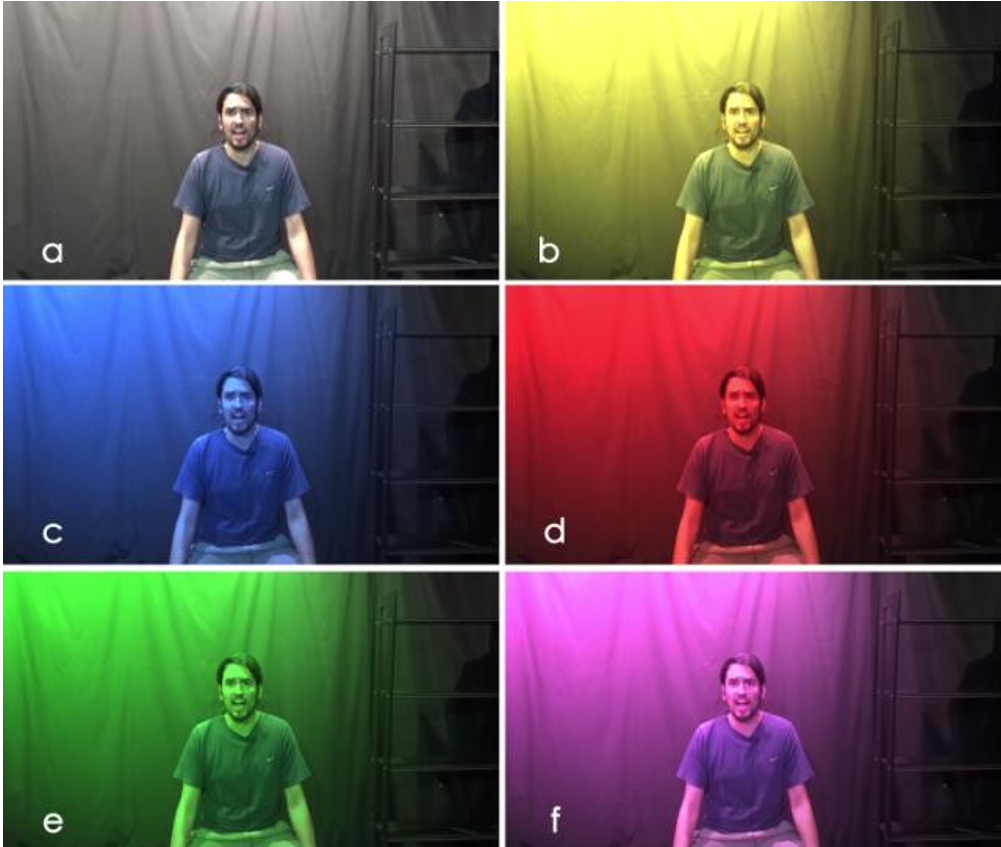 Figure: The questionnaire structure used to evaluate the UI's Usefulness, Ease of Use, Ease of Learning, and Satisfaction.
Experimental Analysis & Insights
1. Human Performance Baseline
The study found that human recognition of speech emotion is far from perfect. While the overall score was ~74%, the "Confusion Matrix" revealed fascinating insights:
- Happiness is easily distinguished from negative emotions.
- Disgust is the most ambiguous, often confused with other negative states.
- Disciplinary Parity: Interestingly, there was no significant difference in recognition accuracy between "Theater" experts and "Journalism" students, suggesting that emotional perception in speech is a universal human trait rather than a learned professional skill.
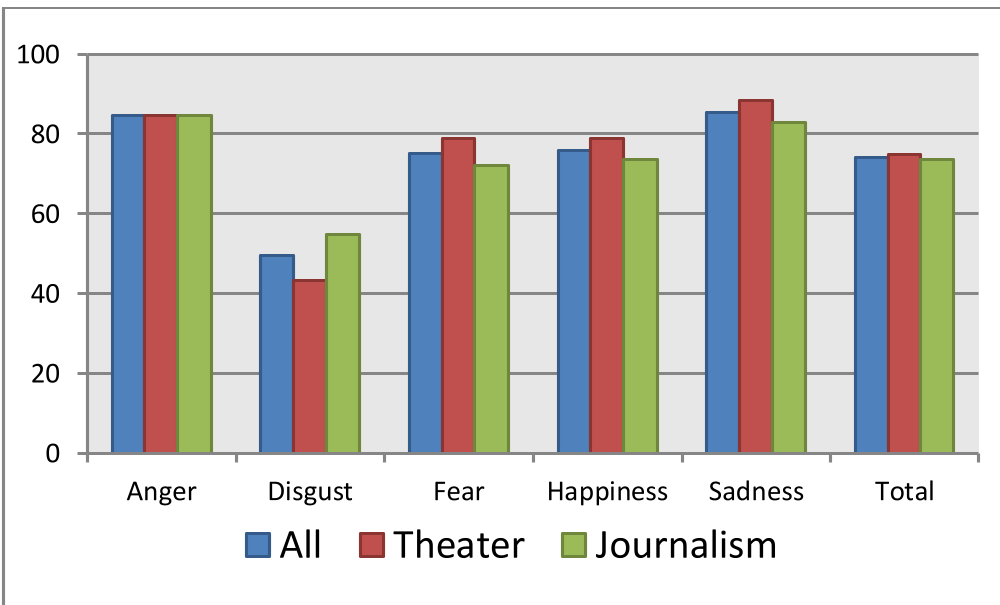 Figure: Recognition rates across different emotional classes. Note the difficulty in identifying Disgust compared to Anger or Sadness.
2. Chromatic Affect: Mapping Audio to Light
The results for lighting selection confirmed strong cultural and psychological ties:
- Anger Red (Primary) / Yellow (Secondary)
- Happiness Yellow
- Sadness Blue / Purple
- Fear Purple
- Disgust Green
This mapping provides a concrete "look-up table" for developers building autonomous stage-management systems.
Deep Insight: Why This Matters for AI
The 74.2% human accuracy rate is a critical takeaway. It suggests that if an AI model achieves 80% accuracy on this dataset, it might actually be overfitting or picking up on cues that are not perceptually relevant to humans. The "noise" in the data (the subjective disagreement) is not a flaw in the database; it is a feature of human communication.
Conclusion & Future Outlook
The AESDD framework successfully bridges the gap between signal processing and the performing arts. While the prototype GUI received high satisfaction scores, the authors acknowledge that current systems are still "subjective." The next frontier involves Multimodal Integration—combining this speech data with facial recognition and linguistic (NLP) analysis to reach a more robust, "objective" understanding of the human heart, as expressed through the voice.
Takeaway: Effective Affective Computing requires us to stop treating "Emotion" as a variable and start treating it as a shared human experience that requires validation from the arts.