
Decoding Social Influence: How Local Diminishing Returns Shape Global Contagion
17979_On the submodularity of influence in social networks.
This paper provides a rigorous mathematical proof for the KKT conjecture regarding the spread of influence in social networks. It establishes that if a diffusion process is governed by locally submodular activation functions, the global expected influence function σ(S) remains submodular.
In the digital age, understanding how ideas, products, or behaviors spread through a social network is more than a sociological curiosity—it is a multi-billion dollar algorithmic challenge. Whether it is viral marketing, the spread of a new technology, or the containment of a pandemic, the core question remains: Which small set of "seed" nodes will maximize the final reach of the process?
TL;DR
This seminal paper by Elchanan Mossel and Sebastien Roch proves a long-standing conjecture in social network theory. They demonstrate that if the "local" influence rules (how one node affects its neighbor) exhibit diminishing returns (submodularity), then the "global" outcome (the total expected influence) also exhibits diminishing returns. This structural insight guarantees that a simple Greedy Algorithm can find a near-optimal set of influential nodes.
The Problem: The Complexity of "Word-of-Mouth"
In 2003, Kempe, Kleinberg, and Tardos (KKT) framed the Influence Maximization Problem. They modeled social networks as directed graphs where nodes become "active" based on the activity of their neighbors.
The bottleneck was the General Threshold Model. In this model, every node has an activation function and a random threshold . If the influence from active neighbors exceeds , the node activates. KKT conjectured that if is monotone and submodular, the set function (the expected number of active nodes at the end) is also submodular.
Why does this matter? Submodularity is the discrete equivalent of convexity. Without it, finding the most influential nodes is notoriously difficult to approximate. With it, a greedy approach is guaranteed to reach at least 63% (1 - 1/e) of the optimal influence.
The Breakthrough: The Antisense Coupling
The primary challenge in proving this conjecture was the "Global-from-Local" gap. Just because each step of a process feels submodular doesn't mean the final result of steps will be.
1. The Strategy: Piecemeal Growth
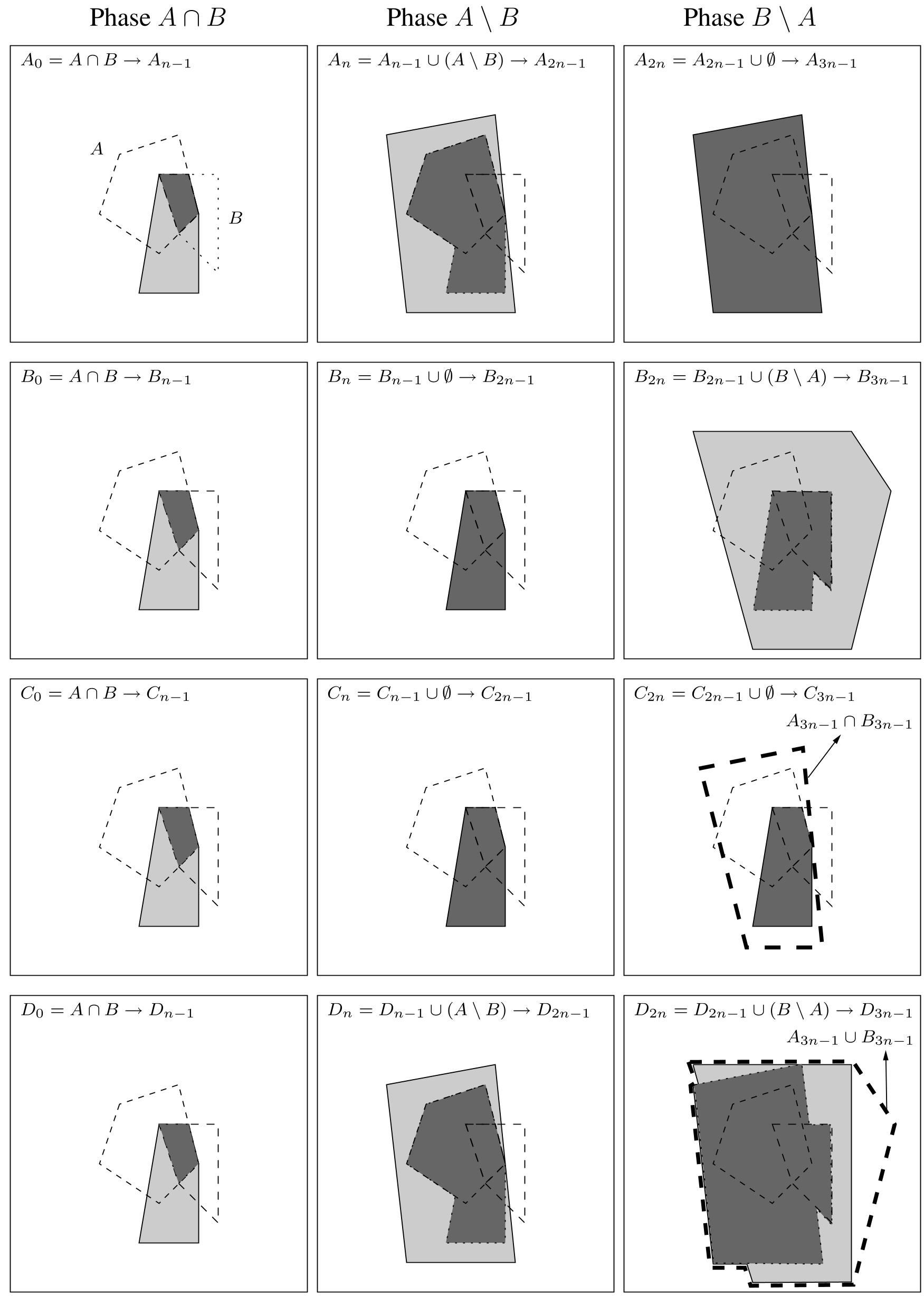
The authors break the growth of the active set into three logical phases to compare two initial sets and :
- Phase 1: Grow the common influence from .
- Phase 2: Add the influence unique to .
- Phase 3: Add the influence unique to .
2. The Innovation: Antisense Coupling
To prove submodularity, one must show that . The authors achieved this by coupling four different processes () using a clever trick.
While a standard coupling uses the same random threshold for all processes, Mossel and Roch introduced Antisense Coupling. By using for one process and for another during specific phases, they "forced" the union of and to behave predictably relative to .
Scientific Impact & Experimental Context
The proof relies on the Need-to-Know Representation, where thresholds are not determined upfront but "uncovered" as the diffusion reaches each node. This allows the mathematical analysis of the probability of activation at each step :
This formula reveals that the "marginal gain" of new active neighbors is what drives the process. By proving that this structure is preserved, the authors validated the use of greedy algorithms for viral marketing.
Key Result
- Optimization Guarantee: Confirmed the -approximation ratio for the General Submodular Threshold Model.
- Theoretical Breadth: The proof works not just for the size of the active set, but for any monotone submodular function of the final set (e.g., weighted influence).
Critical Insight: Why This Matters Today
While this paper was published in 2007, its relevance has exploded with the rise of Large Language Models (LLMs) and Graph Neural Networks (GNNs). Many modern approaches to "Information Cascades" in social media still rely on the submodularity property proved here to ensure that their recommendation engines or ad-placement algorithms are efficient.
Limitations: The model assumes a "progressive" process (nodes never turn off). In contexts like Twitter/X, where users may "unfollow" or stop engaging, the submodularity might break, requiring even more complex dynamical systems analysis.
Conclusion
Mossel and Roch bridged a vital gap between local social dynamics and global algorithmic efficiency. Their work serves as a cornerstone for anyone building tools to navigate the complex, interconnected world of social influence.