
GSR: Bridging Subspace Learning and ELM for Superior Speech Emotion Recognition
17258_Connecting Subspace Learning and Extreme Learning Machine in Speech Emotion Recognition.
This paper introduces the Generalised Spectral Regression (GSR) framework, a novel dimensionality reduction approach for Speech Emotion Recognition (SER). By unifying Extreme Learning Machines (ELM) and Graph Embedding (GE) based subspace learning, it achieves State-of-the-Art (SOTA) performance across multiple emotional datasets.
TL;DR
Researchers have developed a new framework called Generalised Spectral Regression (GSR) that merges the non-linear flexibility of Extreme Learning Machines (ELM) with the structural awareness of Subspace Learning. This hybrid approach overcomes the limitations of traditional kernel methods and significantly boosts performance in identifying emotions from speech across multiple global datasets.
Background & Motivation: Why SER is Challenging
Speech Emotion Recognition (SER) is a cornerstone of human-computer interaction, yet it suffers from the "curse of dimensionality." Acoustic feature sets, such as the INTERSPEECH ComParE set, often contain thousands of descriptors, many of which are redundant or irrelevant to affective states.
Existing solutions fall into two camps, both with flaws:
- Graph Embedding (GE) / Spectral Regression (SR): Powerful at finding low-dimensional manifolds but often limited by "kernelization," where the transformation is rigidly tied to training samples.
- Extreme Learning Machines (ELM): Fast and non-linear, but they tend to treat data points as isolated entities at the output layer, ignoring the "geometry" (how similar sounds cluster together).
The authors' insight? Use the random mapping of ELM to gain non-linearity and spectral graphs to preserve the data's inherent structure.
Methodology: The Three-Stage GSR Framework
The GSR framework breaks the dimensionality reduction process into three distinct, modular stages:
1. Data Mapping (The ELM Intuition)
Instead of fixed kernels, GSR uses "anchor points." By projecting raw features against a set of random anchor points (as in Random GSR) or training samples, the model creates a new, high-dimensional representation that is more expressive than the original input.
2. Graph Decomposition (The Geometric Intuition)
Here, the model builds a graph where nodes are speech samples. It uses techniques like Locally Penalised Discriminant Analysis (LPDA) to ensure that samples of the same emotion stay close together while samples of different emotions are pushed apart. By solving a Generalised Eigenvalue Problem (GEP), it generates "virtual coordinates" for the data.
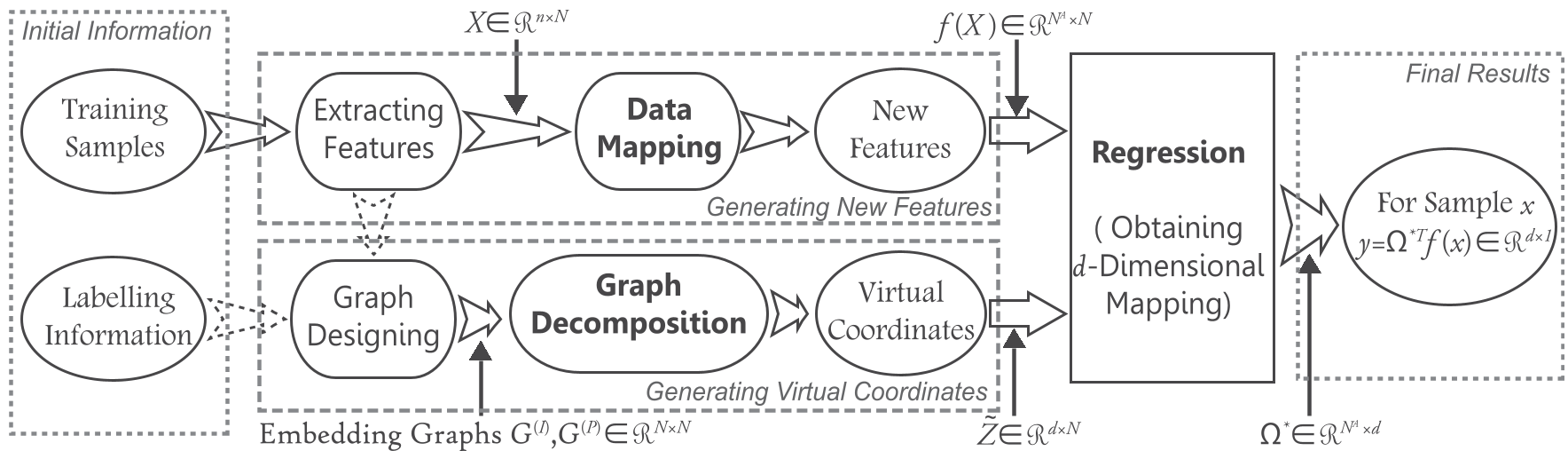 Figure: The GSR workflow showing the transition from mapping to graph decomposition and final regression.
3. Regression (The Connection)
The final step uses Ridge Regression to find a mapping matrix that connects the non-linear features from Stage 1 to the structural virtual coordinates from Stage 2.
Experimental Battleground
The authors tested GSR against legendary baselines like SVM, ELM, and PCA on four major corpora: GEMEP, ABC, VAM, and eNTERFACE.
Key Findings:
- Robustness: The variant using LPDA graphs (RGSR-LPDA) was the most consistent performer, proving that penalizing neighboring "between-class" samples is vital for emotion tasks.
- Anchor Point Influence: The study found that using roughly 3,500 to 5,000 random anchor points provides the "sweet spot" for performance.
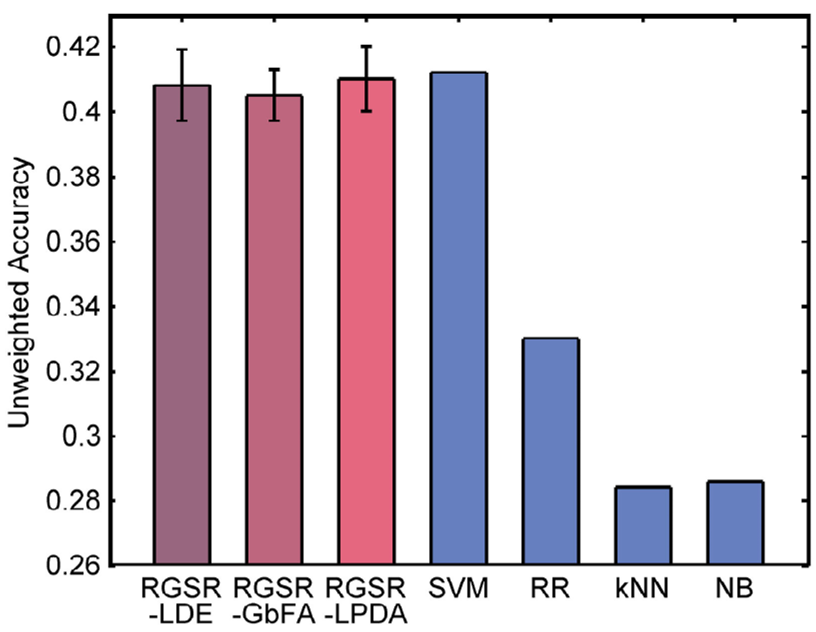 Figure: Accuracy comparison across datasets. Note how RGSR variants (red/blue bars) consistently outperform standard SVM and ELM.
Conclusion & Future Outlook
The GSR framework proves that we don't need to choose between the speed of ELMs and the mathematical elegance of Subspace Learning—we can have both. By replacing rigid kernels with flexible random anchor points and adding structural graph constraints, GSR sets a new bar for how we process paralinguistic data.
What's next? The authors suggest that the regression stage could be further enhanced by Deep Learning architectures, potentially leading to even more nuanced emotional representations in real-time AI assistants.
Summary Takeaway
- Method: GSR (Generalised Spectral Regression).
- Core ID: Random mapping + Manifold preservation.
- SOTA Achievement: Significant UA (Unweighted Accuracy) gains on GEMEP, ABC, and VAM.