
Linear Control in Decentralized Systems: Beyond Partial Nestedness and Quadratic Invariance
Sufficient Statistics for Linear Control Strategies in Decentralized Systems With Partial History Sharing
The paper investigates decentralized LQG control systems with a Partial History Sharing (PHS) information structure. It identifies finite-dimensional sufficient statistics for the best linear control strategies and demonstrates that their update rules follow a Kalman filter-like recursion, achieving structural clarity in systems that are neither partially nested nor quadratically invariant.
TL;DR
This paper solves a fundamental problem in decentralized control: How do we find the best linear control strategy when information is scattered across different controllers? Traditionally, researchers believed we needed "Partial Nestedness" or "Quadratic Invariance" to make the math work. Mahajan and Nayyar prove that as long as the system is linear and we stick to linear strategies, we can find a finite-dimensional sufficient statistic (like a Kalman filter update) to represent the optimal strategy, even in complex networked systems with delays.
Background: The Price of Decentralization
In a centralized LQG (Linear-Quadratic-Gaussian) system, life is simple: the Kalman filter provides a sufficient statistic, and the separation principle allows us to solve for estimation and control independently.
In decentralized systems (like a fleet of drones or a smart power grid), life is a mess:
- Non-Optimality: Linear strategies aren't always global optima (e.g., the Witsenhausen counterexample).
- Non-Convexity: Finding the best linear gain is often a "hard" optimization problem.
- Infinite Dimensionality: The "best" action might depend on the entire history of what every controller has seen and done.
The authors focus on the third point: dimensionality reduction.
The "Common Information" Insight
The core intuition of this paper is the Coordinator's View. Imagine a virtual coordinator who sees only the information shared by all controllers (the "Shared Memory," ).
The control action is split into two parts:
By fixing the local components (how agents react to their private observations), the problem for the coordinator becomes a centralized LQG problem. Since centralized LQG systems possess finite-dimensional sufficient statistics (the conditional mean), the decentralized system must also have one for its linear strategies.
Architecture of the Information Structure
The paper uses the Partial History Sharing (PHS) model, which generalizes many structures like delayed sharing or control sharing.
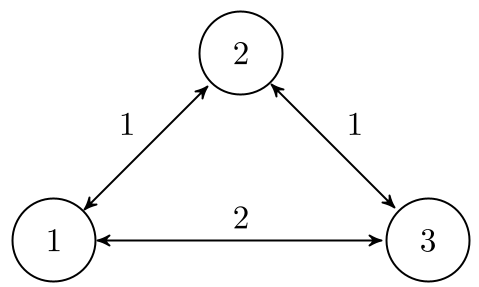 Figure 1: A 3-controller system with asymmetric delays, demonstrating how local information is eventually promoted to shared memory.
Methodology: The Induced Centralized System
The authors transform the decentralized problem into an Induced Coordinated System. They define a new state: where is the plant state, is the current observation, and is the local memory.
By applying standard LQG theory to this augmented state, they derive:
- Kalman Update: A way to update the estimate using only the new shared data .
- Separation Result: The coordinator’s optimal action is a linear gain multiplied by this estimate.
Key Results and Experiments
The most striking result is Theorem 3, which states that the sufficient statistic is simply the conditional mean .
Case Study: Delayed Sharing
In a system where agents share their info with a delay :
- The sufficient statistic consists of a -step window of past observations and a strategy-independent estimate of the delayed state.
- This confirms that even with complicated communication graphs, the memory requirements for the "best" linear controller do not explode over time.
Performance Comparison
The paper notes that while [18] required keeping track of the entire posterior distribution (a very high-dimensional object), this work proves that for linear strategies, you only need the mean.
 The Kalman-like update equation for the sufficient statistic.
Critical Analysis & Takeaways
- Breaking the Assumptions: This work is significant because it moves away from the "Partially Nested" bubble. It shows that structural results (knowing what the controller should look like) are more robust than global optimality results.
- Limitations: The paper identifies the form of the controller but admits that finding the actual values (the optimal gains and ) remains a potentially non-convex optimization problem.
- Future Impact: This provides a rigorous foundation for "finite-memory" decentralized control. For engineers building large-scale networked systems, it means they can focus on Kalman-style architectures without worrying that they are missing a massive chunk of performance hidden in the "forgotten" history.
Conclusion
Mahajan and Nayyar have simplified the "black box" of decentralized linear control. By proving that the conditional mean is a sufficient statistic, they've bridged the gap between complex information theory and practical control engineering.