
Beyond Frame-by-Frame: Scaling Video Copy Detection with Suffix Arrays
A suffix array approach to video copy detection in video sharing social networks
This paper introduces a high-speed video copy detection system that leverages the suffix array data structure to achieve linear-time signature matching. By converting video temporal structures into compact 1D "shot length sequences," the method efficiently identifies duplicates across large-scale social networks.
TL;DR
Researchers from the University of Southern California have decoupled video copy detection from heavy visual feature processing. By treating a video as a sequence of "shot lengths" and utilizing the Suffix Array data structure (commonly used in bioinformatics), they achieved linear-time matching () that is significantly faster than traditional dynamic programming approaches.
Background & Motivation: The Complexity Wall
The explosion of video sharing platforms like YouTube has made manual copyright monitoring impossible. Most existing Content-Based Video Copy Detection (CBVCD) methods fall into two traps:
- Feature Overhead: Using frame-based features like color histograms or SIFT descriptors is storage-intensive and sensitive to simple attacks (e.g., resizing or subtitle insertion).
- Matching Bottleneck: Aligning two video sequences using Dynamic Programming (DP) or Edit Distance incurs a quadratic complexity . In a database of millions of videos, this "quadratic wall" prevents real-time performance.
The authors' insight? Use the temporal structure (the rhythm of the edits) rather than the pixels themselves.
Methodology: The Shift to String Matching
The proposed system transforms the video duplicate problem into a string alignment problem in two major phases.
1. Robust Signature Extraction
The signature is not a vector of pixels, but a 1D sequence of time intervals between "anchor frames" (shot boundaries).
- Temporal Subsampling: Videos are sampled every 0.2s to capture structure while ignoring frame-rate variations.
- Luminance Histogram Difference: An adaptive threshold is used to find stable shot boundaries that survive attacks like re-encoding or camcording.
- Shot Length Sequence: The final signature is the sequence of durations between these boundaries.
2. Matching with Enhanced Suffix Arrays
To find if sequence exists within , the authors use an Enhanced Suffix Array.
- Why Suffix Arrays? Unlike Suffix Trees, they are extremely memory-efficient.
- The Algorithm: They concatenate the query and database signatures () and compute the Longest Common Prefix (LCP) array.
- Maximal Unique Matches (MUMs): By finding local maxima in the LCP array in time, the system identifies identical temporal sub-segments that occur in both videos.
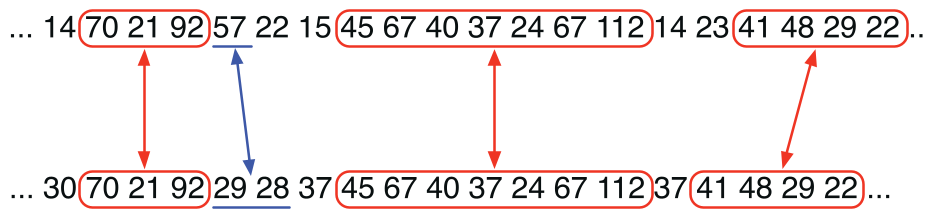 Fig 1: Identifying Maximal Unique Matches between two shot length sequences.
Experimental Validation
Using the MUSCLE-VCD-2007 benchmark, the authors compared their method against 101 database videos (80 hours).
- Storage Efficiency: The entire database's signatures occupied only 1.2 MB, a mere 0.33% of the original 35 GB data size.
- Speed: Comparing 25 queries against the entire database took only 1 minute and 50 seconds.
- Robustness: As shown in Table 1 below, most attacked videos (Query 13, 15, etc.) maintained high match percentages, even after resizing or blurring.
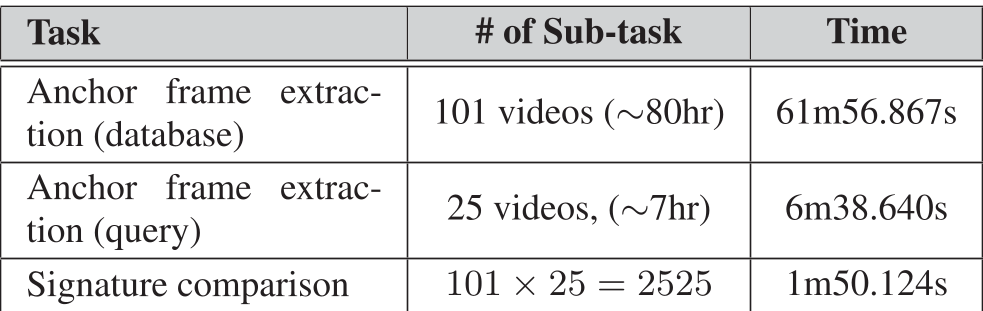 Table 1: Efficiency metrics for signature extraction and comparison.
Critical Analysis & Takeaways
The Achilles' Heel
The method failed (0% match) on videos with very few shot boundaries, such as those with long continuous takes, heavy camera motion, or gradual fades. Because the "anchor frames" are the only source of truth, a lack of distinct editorial cuts leaves the algorithm with no "alphabet" to build its string.
Conclusion
This work demonstrates that structural information is often more robust than content information. By borrowing advanced string-processing techniques from bioinformatics (Suffix Arrays), the authors proved that video copy detection can be scaled to handle the massive throughput of modern social networks without sacrificing linear-time efficiency. For future iterations, combining this with a lightweight motion descriptor could solve the "continuous shot" limitation.
Final Insight: In the era of massive data, the choice of data structure is just as critical as the choice of feature.