
SUPE-Net: Shattering the Scale Barrier in Social Dynamics Simulation
SUPE-Net: An Efficient Parallel Simulation Environment for Large-Scale Networked Social Dynamics
This paper introduces SUPE-Net, an efficient parallel simulation environment designed for large-scale networked social dynamics. Built upon the YH-SUPE optimistic parallel discrete event simulation (PDES) engine, it enables high-fidelity modeling of networks with millions of entities, achieving a 1.4x relative speedup on large-scale gossip dynamics benchmarks.
TL;DR
Simulating how rumors spread or viruses mutate across millions of people is computationally grueling. SUPE-Net is a high-performance parallel simulation environment that leverages Parallel Discrete Event Simulation (PDES) to handle social networks with millions of nodes. By using optimistic synchronization and smart processor virtualization, it turns the irregular structures of social networks into a scalable computational task.
Positioning: This work moves beyond traditional desktop-bound agent-based modeling (like Repast or Swarm) into the realm of supercomputing-driven social science.
Problem: The "Desktop Ceiling" in Social Science
Most social scientists rely on statistical models or small-scale simulators. However, real social systems are massive, irregular, and dynamic. Existing tools suffer from:
- Memory Bottlenecks: Storing the global state of millions of nodes is impossible on a single machine.
- Algorithmic Rigidity: Many simulators are hard-coded for specific topologies (e.g., just scale-free), preventing comparative studies.
- Inefficient Processing: Sequential execution cannot keep up with the complex, concurrent interactions inherent in social dynamics.
Methodology: The Architecture of Scale
The core of SUPE-Net's power lies in its Layered Architecture, built on top of the YH-SUPE (YinHe Simulation Utilities for Parallel Environment) engine.
1. Processor Virtualization
Instead of manually mapping nodes to CPUs, SUPE-Net uses "processor virtualization." It automatically distributes network entities (Nodes and Edges) across processors using strategies like Block or Scatter decomposition. This ensures that even as the network scales to millions of actors, the memory load remains balanced.
2. Optimistic Synchronization
Social networks often have "unpredictable lookahead"—we don't always know when the next interaction will happen. SUPE-Net uses an optimistic synchronization algorithm. This allows processors to process events as fast as possible, only "rolling back" if a causality error (an out-of-order event) is detected.
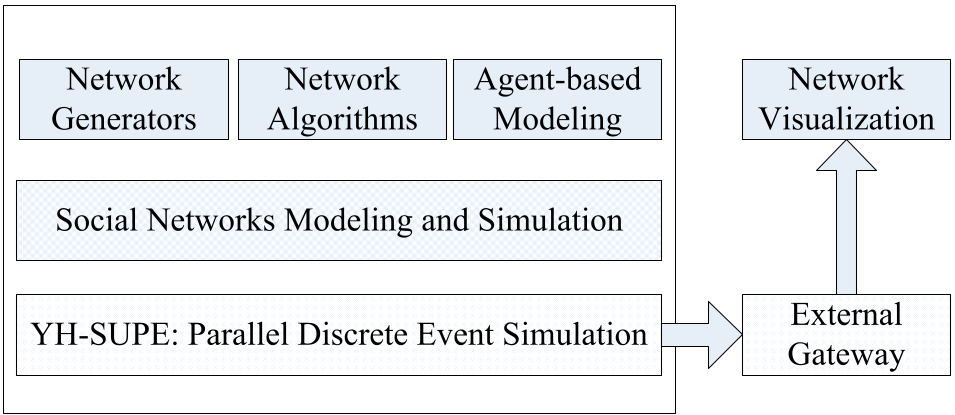 Figure 1: The layered architecture of SUPE-Net, showing the interface between the PDES engine and the social modeling constructs.
3. Event-Driven Interaction
Communication between nodes—even those on different physical CPUs—is handled via asynchronous message passing. The authors introduced efficient event-scheduling chains (like Command-Report) to collect global statistics without needing a bottleneck-prone "global state" structure.
Experiments: Millions of Actors in Parallel
To test the system, the authors simulated Gossip Dynamics (how information spreads) on a massive Actor Collaboration Network.
- The Workload: 383,640 nodes and over 1.2 million links.
- Efficiency: The simulation achieved a 1.4x relative speedup as the number of computing nodes increased.
- Stability: Despite the aggressive optimistic execution, rollbacks were kept under 0.14%, proving that the overhead of "undoing" mistakes is negligible compared to the speed gains of parallelism.
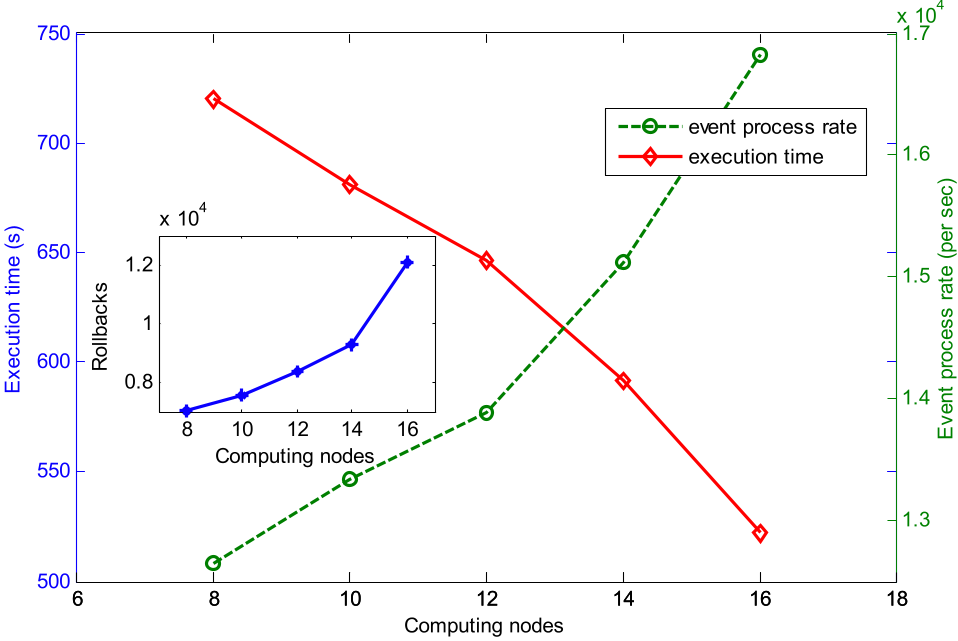 Figure 2: Performance metrics showing execution time reduction and the low incidence of rollbacks on the cluster.
Final Insights
SUPE-Net represents a critical bridge between high-performance computing (HPC) and sociology. By treating social interactions as discrete events that can be computed in parallel, it allows for "what-if" scenarios at a national scale—modeling the impact of a vaccine or the spread of misinformation across an entire population in near real-time.
Limitations: While the system scales well, the initial network generation remains a sequential bottleneck. Future iterations will need to explore parallel graph generation and more advanced community-detection-based load balancing to handle even more irregular, "bursty" social dynamics.