
Super Dots: Bridging the Digital Divide via Tangible Metaphors for Seniors
12413_Super Dots making social media tangible for senior citizens.
The paper introduces "Super Dots," a set of physical co-design props (tangible tools) designed to help senior citizens envision and shape social media services. By transforming abstract networking concepts into colorful, tactile objects, the researchers achieved a "horizontal service model" that empowers the elderly to self-organize communities around everyday activities.
TL;DR
How do you explain the "cloud," "social networks," and "digital channels" to an 82-year-old who refuses to own a cell phone? The Super Dots project answers this by making social media tangible. Using physical props like colored dots and strings, researchers enabled seniors to co-design their own social infrastructures, shifting the focus from "scary technology" to "meaningful activity-based communities."
The Crisis of Social Connectivity in Aging
In Western societies, the growing senior population faces a dual challenge: the potential unsustainability of traditional welfare models and the risk of social isolation. While municipalities want to move toward horizontal service models (where citizens support each other), senior citizens often feel alienated by modern technology.
The researchers identified a critical gap: Most social media focuses on identity (who you are), whereas seniors are often more comfortable with activity (what you do together). However, discussing "activity-based social media" is too abstract. To bridge this, the design team decided to make the digital material.
Methodology: The "Super Dots" Framework
The core insight of the paper is that communities have color. The researchers developed a kit of "props" that served as catalysts for dialogue:
- The Dots: Represent affinity. An "orange dot" might mean you are part of a shopping community.
- The Threads: Physical colored strings that visualize open connections or "channels" between people.
- The Maxi-Props: Oversized physical models of digital interfaces:
- The Seeker: A sphere to find people or places.
- The Messenger: A cylinder for voice or text communication.
- The Screen: A frame for visual information.
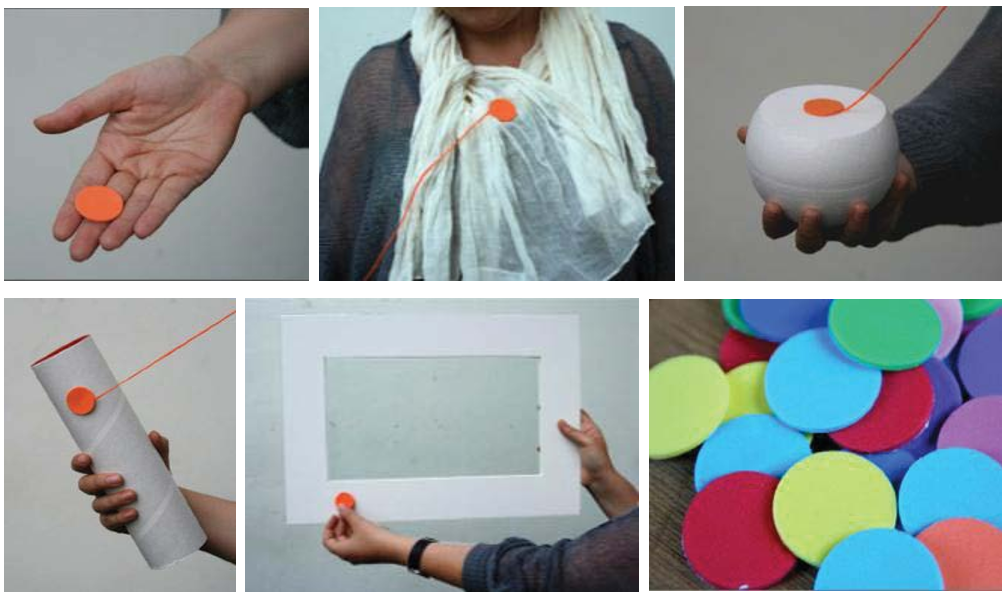 Figure: Initial sketches and final Maxi-Props used to facilitate the co-design dialogue.
From Play to Practicality
By using these props in "doll-scenarios," seniors like Ketty—who initially claimed technology was "not for people like me"—found themselves shouting into a "Messenger" pipe to ask a friend to go shopping. This embodied engagement lowered the psychological barrier to entry. The props weren't just products; they were "malleable materials" for thinking.
Experimental Insights: "This is a Serious Game"
The workshops revealed that when seniors interact with physical props, they bring their real-world social "Inductive Biases" to the table.
- Negotiating Privacy: One participant, Jytte, used the props to express a hard boundary: "I don't want to spend my time with people I don't like!" This led to a breakthrough in understanding how "invitations" to digital communities should be managed.
- Appropriation for Independence: Another participant, Amy, realized the "Screen" prop could replace the burdensome daily "check-in" phone call from her daughter, allowing her to stay independent while remaining "visible" to her family.
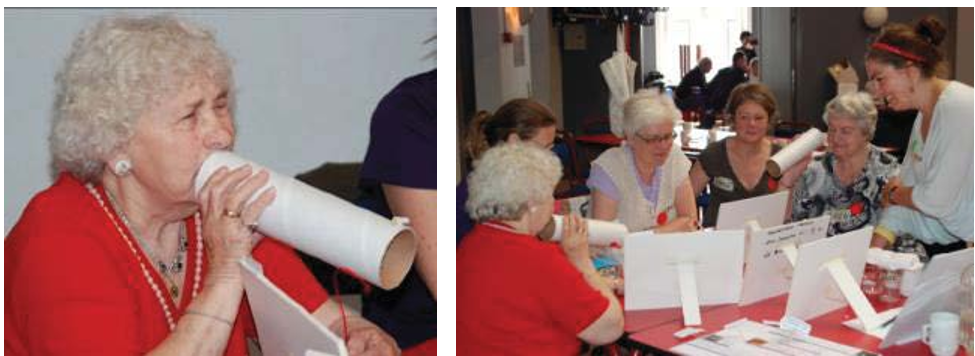 Figure: Participants using the maxi-props to enact a "shopping community" scenario.
Critical Analysis: Why This Works
The value of Super Dots lies in Reification. By turning an abstract concept (a network) into a physical object (a string and a dot), the "black box" of technology is opened.
- SOTA Difference: Unlike standard UCD (User-Centered Design) that asks users to test a pre-made app, this approach asks users to define what the app should be using physical metaphors.
- The "Aha!" Moment: The most powerful result was the "translation" effect. By the third workshop, the physical dots were gone, replaced by "Smart Yoga Mats" and "Smart Shopping Bags." The seniors had successfully mapped the abstract concept of connected activities onto their own lives.
Conclusion and Takeaways
The Super Dots project proves that the "Digital Divide" is often a "Conceptual Divide."
Core Takeaways:
- Design for Activities, not Identities: Seniors prioritize "being someone for someone else" through shared tasks.
- Tangibility is Equity: Physical props allow non-experts to influence high-level technical architecture.
- The Goal is Social, not Technical: Technology should be the "invisible infrastructure" that supports existing everyday practices, like knitting for charity or sailing.
As we look toward the future of aging-in-place technology, Super Dots reminds us that the best way to design for the future is to make that future feel as familiar and tangible as a colored bead or a piece of string.