
Beyond Follower Counts: Engineering Sustainable Communities through Fuzzy System Dynamics
The super user selection for building a sustainable online social network marketing community
This paper introduces an integrated Fuzzy System Dynamic Model (FSDM) for selecting "super users" to build sustainable Online Social Network Marketing Communities (OSNMC). By combining System Dynamics with Takagi-Sugeno fuzzy inference, the model identifies optimal behavioral profiles—specifically popularity, service quality, privacy protection, and organizational relationship—to counter low participation and privacy risks.
TL;DR
Building a successful social media marketing community is easy; keeping it alive is the real challenge. Most communities die due to "lurking" and privacy fears. This paper proposes a Fuzzy System Dynamic Model (FSDM) to select "Super Users"—opinion leaders who provide both high-quality interaction and safety. The key takeaway? High activity without privacy protection is a recipe for short-term hype but long-term failure.
The "Lurker" Plague and the Marketing Bottleneck
Brands invest millions into platforms like Weibo and Instagram, yet they often face a "90-9-1" problem: 90% of users are silent lurkers. Furthermore, the modern user is hyper-aware of privacy. If a community feels unsafe or intrusive, users leave permanently.
The authors argue that current SOTA (State of the Art) methods for finding influencers—mostly based on Social Network Analysis (SNA) or text mining—are too "static." They fail to capture how a super user's behavior changes the community's health over time. They suggest we need a model that accounts for the vague, human, and non-linear nature of social interaction.
Methodology: The Fusion of Fuzziness and Dynamics
The core of this research is the FSDM. It bridges two powerful mathematical worlds:
- System Dynamics (SD): Handles the feedback loops. As a super user posts more, the community grows, which in turn influences the super user's status.
- Fuzzy Inference System (FIS): Handles the "gray areas." How do you quantify "Community Trust" or "Privacy Awareness"? FIS uses expert-derived linguistic rules (e.g., If Service Quality is High AND Privacy is Positive, Then Raise Sustainability) to convert subjective traits into hard data.
The Four Pillars of Super User Behavior
The model evaluates potential super users based on a hierarchical structure:
- Popularity (P): Beyond just fans; it includes fan activity and credit scores.
- Service Quality (SQ): Response time, posting frequency, and information accuracy.
- Privacy Protection (PP): The "secret sauce"—the user’s ability to protect their followers' data.
- Organizational Relationship (OR): Community loyalty and identification.
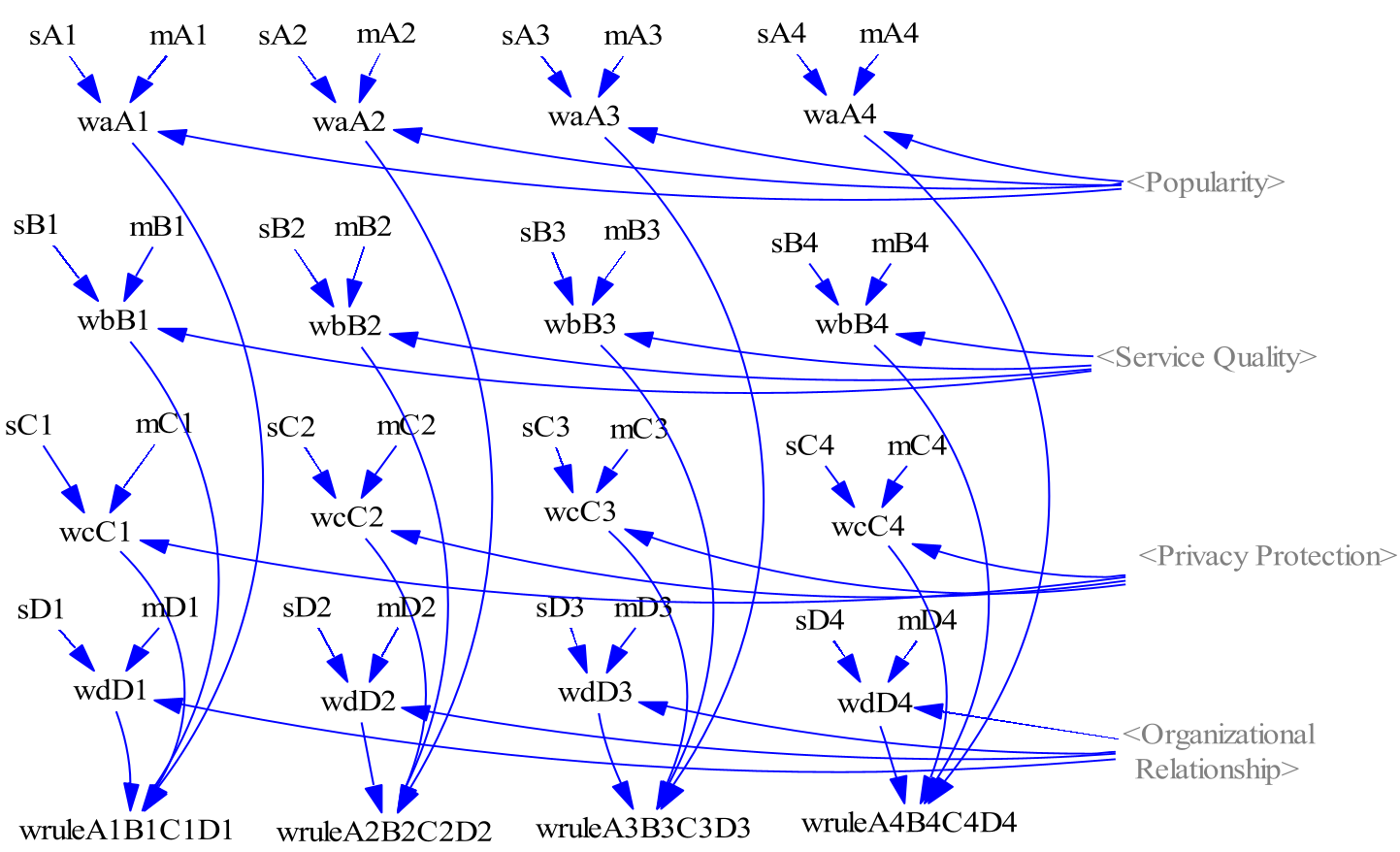 Figure 1: The model architecture shows the feedback loops between behavioral sub-characteristics and the global sustainability index.
Experiments: Why "Private" Doesn't Always Mean "Sustainable"
The researchers simulated four scenarios:
- Inactive & Open: Weak participation, low privacy. (Short-lived growth).
- Inactive & Private: High privacy, low participation. (The "Ghost Town" effect—the community becomes too enclosed to grow).
- Active & Open: High interaction, low privacy. (High initial growth, but eventually crashes due to privacy threats).
- Active & Private: The Gold Standard. Robust interaction protected by a "safety net."
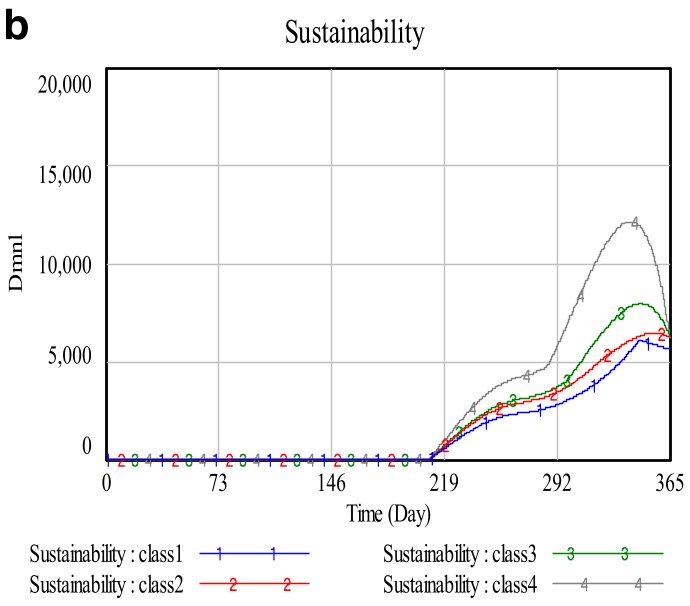 Figure 2: Simulation results showing that Scenario 4 (Active and Private) produces exponential, long-term sustainability compared to the S-shaped or peaking curves of other profiles.
Critical Insight: The Privacy-Quality Synergy
The most striking finding is the non-linear relationship between Privacy and Service Quality. If a super user is highly active but ignores privacy, they can't achieve SOTA sustainability. Conversely, if they are private but rarely post, the community suffocates. Sustainability is an emergent property that appears only when high-frequency service meets high-integrity privacy norms.
Conclusion & Market Impact
This paper shifts the focus of Influencer Marketing from reach to resilience. For practitioners, this means moving away from "zombie fans" (popularity metrics) and toward "privacy-conscious engagement" (community trust).
Limitations: The study is heavily centered on the Chinese Weibo ecosystem (Fashion/Beauty). Applying this "Fuzzy" lens to more fragmented platforms like Discord or Telegram, where privacy is a core feature, would be a logical next step for the industry.