
SuperNova: Solving the Availability Crisis in Decentralized Social Networks
SuperNova: Super-peers based architecture for decentralized online social networks
This paper introduces SuperNova, a decentralized online social network (DOSN) architecture that utilizes a super-peer model to ensure high data availability and seamless user onboarding. Unlike flat P2P designs, SuperNova leverages system heterogeneity to manage data replication across friends, strangers, and high-resource super-peers, achieving superior performance in volatile network environments.
TL;DR
Decentralized Online Social Networks (DOSNs) offer a reprieve from "Big Brother" surveillance, but they often fail at a basic requirement: ensuring your profile stays online when your computer is off. SuperNova bridges this gap by introducing a super-peer architecture that leverages high-resource volunteers and "stranger pools" to guarantee data availability. It moves away from "flat" P2P models to a more pragmatic, heterogeneous structure where nodes earn status and rewards for supporting the community.
Background: The Price of Autonomy
Modern social media users face a trade-off: central servers (Facebook/X) offer 100% availability at the cost of privacy. Decentralized alternatives like Diaspora or PeerSoN protect privacy but suffer from massive data "blackouts." If your friends are offline, your content vanishes.
The authors argue that current DOSN designs are too idealistic. They assume everyone has a stable connection or enough friends to replicate data. In reality, users are heterogeneous—some are online 24/7, while others are highly transient. SuperNova is designed to embrace this reality.
The Core Innovation: Super-Peers as System Anchors
SuperNova departs from the "everyone is equal" dogma of early P2P systems. It introduces three distinct entities:
- Nodes: Standard users who store data at friends.
- Storekeepers: Friends or strangers who agree to replicate a user's encrypted profile.
- Super-Peers: Resource-rich nodes that provide bootstrapping services for new users, maintain global user directories, and act as "rendezvous points" for synchronization.
The Lifecycle of a SuperNova Peer
A node in SuperNova evolves through three stages:
- Initial Phase (IP): The user joins and uses Super-Peers to store their profile immediately.
- Take Care Phase (TCP): The Super-Peer helps the user find friends or "strangers" with complementary uptime patterns.
- Settled Phase: Once a robust circle of storekeepers is found, the user can relinquish super-peer services, making the system self-sustaining.
Why It Works: Strategic Flexibility
One of SuperNova’s most insightful features is the Stranger Pool. Managed by super-peers, this pool matches "strangers" who have high uptime when the data owner is offline. This "Time Track" (TT) matching ensures that even if you have zero friends locally, your data remains accessible via a globally coordinated effort.
Experimental Insights
The researchers conducted extensive simulations using a DBLP co-authorship graph (273,798 nodes). They compared different "mixes" of user behavior—from altruistic to selfish.
Key Findings:
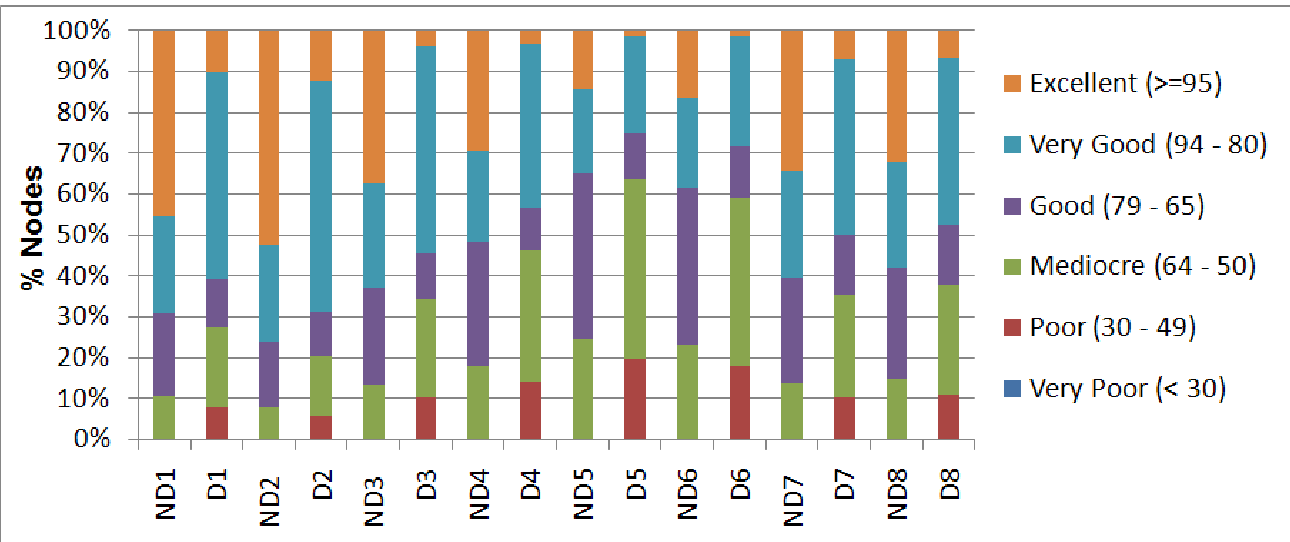
- The Reliability of Strangers: In scenarios where friends are unreliable or "collocated" (all online/offline at the same time), relying on strangers via the super-peer’s directory significantly stabilizes data availability.
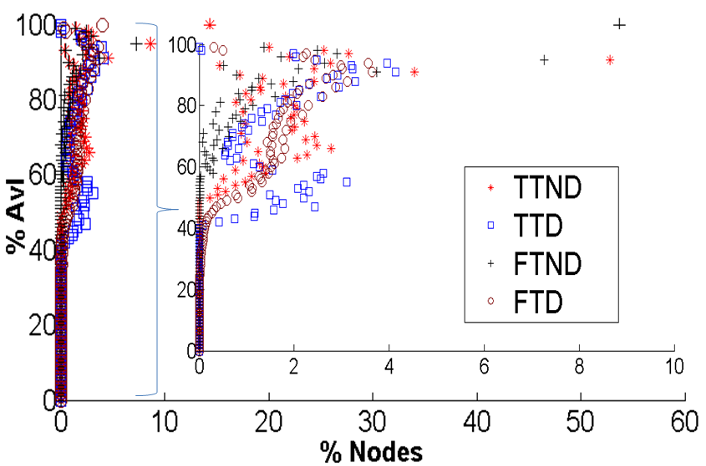
- Flat vs. Super-Peer: The study showed that "Flat" P2P models suffer from a 30% drop in availability when users deviate from their normal habits. SuperNova, by contrast, maintains steady performance because super-peers provide a safety net.
- Incentives Matter: The system performs best ( in the table below) when users are incentivized to act as storekeepers. Without cooperation, the load on super-peers becomes a bottleneck.
Critical Perspective
While SuperNova provides a robust architectural solution, its long-term viability depends on Incentives. Why would someone pay for a cloud server to be a super-peer? The authors suggest "monetization via ads" or "reputation," but in a truly decentralized, encrypted world, ad-injection is tricky without compromising the very privacy DOSNs aim to protect. Future iterations will need to explore cryptographic proofs-of-storage or tokenized rewards to maintain this super-peer layer.
Conclusion
SuperNova represents a maturation of DOSN research. It moves beyond "it could work" to "here is how it scales." By acknowledging that some nodes are more capable than others, SuperNova creates a path for decentralized networks that can actually compete with the UX of centralized giants.
Key Takeaways:
- Heterogeneity is a feature, not a bug: Leverage high-resource nodes.
- The Cold-Start Problem: New users need a "take care" phase handled by stable anchors.
- Stranger Collaboration: Reciprocity with strangers is often more reliable than with social friends due to temporal correlation.