
PRODSUM: Bridging Symbolic and Statistical Learning for Legal Summarization
Supervised Machine Learning for Summarizing Legal Documents
This paper introduces PRODSUM, a supervised machine learning approach using Naive Bayes to perform extractive summarization of Canadian legal documents. By leveraging a large-scale corpus of ~4,000 document-extract pairs, the system achieves state-of-the-art performance across different legal domains (Immigration, Tax) and languages (English, French).
TL;DR
Legal experts require high-precision summaries where every word is a verbatim citation of the court's decision. This paper presents PRODSUM, a probabilistic summarizer that shifts from rigid linguistic rules to supervised machine learning. By training on a corpus of 4,000 federal court decisions, the system demonstrates that a combination of document structure (surface) and visual cues (emphasis) can outperform traditional symbolic AI, especially when moving between distinct legal domains like Immigration and Tax law.
The Problem: The Fragility of Symbolic AI in Law
For years, legal summarization relied on symbolic approaches—vast sets of hand-crafted linguistic rules. While effective for specific niches (like Immigration law), these systems (e.g., ASLI) are "brittle." When applied to a different court or a new legal domain, their accuracy plummets because they cannot adapt to differences in vocabulary or document structure.
The challenge is exacerbated by the legal industry's requirement for extractive summaries. Unlike general AI that might paraphrase a news article, a legal AI must extract original sentences. Any "hallucination" or rewriting could lead to a catastrophic misinterpretation of a judge's ruling.
Methodology: Mining Insights from Legal Experts
The authors' primary contribution lies in transforming 4,000 human-reviewed extracts into a machine-readable training corpus.
1. The Alignment Heuristic
Since historical summaries were stored as plain text while source documents were XML, the team had to "reverse-engineer" which source sentences were picked by experts. They used a sophisticated matching flow:
- Length-first matching: Using Levenstein distance for long sentences.
- Interval constraints: Narrowing the search for short sentences based on the position of already-matched long ones.
- Inclusion checks: Handling cases where lawyers merged or slightly truncated original text.
2. The Feature Set: Beyond Text
The classifier doesn't just "read" words; it looks at how the document is built:
- Surface Features: Where is the sentence? (Paragraph/Section position).
- Emphasis Features: Was the text bolded or italicized in the original HTML? In law, visual emphasis often denotes salient points or subtitles.
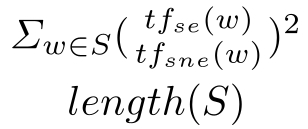
- Specialized Content Score: A unique formula (Equation 1) that weighs words based on their frequency in extracts versus their frequency in non-selected text.
Experiments & Results: Adaptability is King
The researchers tested PRODSUM against ASLI (the symbolic system) and a Lead-baseline.
Cross-Domain Superiority
The most striking result occurred in the Tax domain. ASLI, which was fine-tuned for Immigration law, failed significantly in Tax cases (F1: 0.190). PRODSUM, however, adapted effortlessly, achieving an F1 of 0.445.

The "Reasoning" Challenge
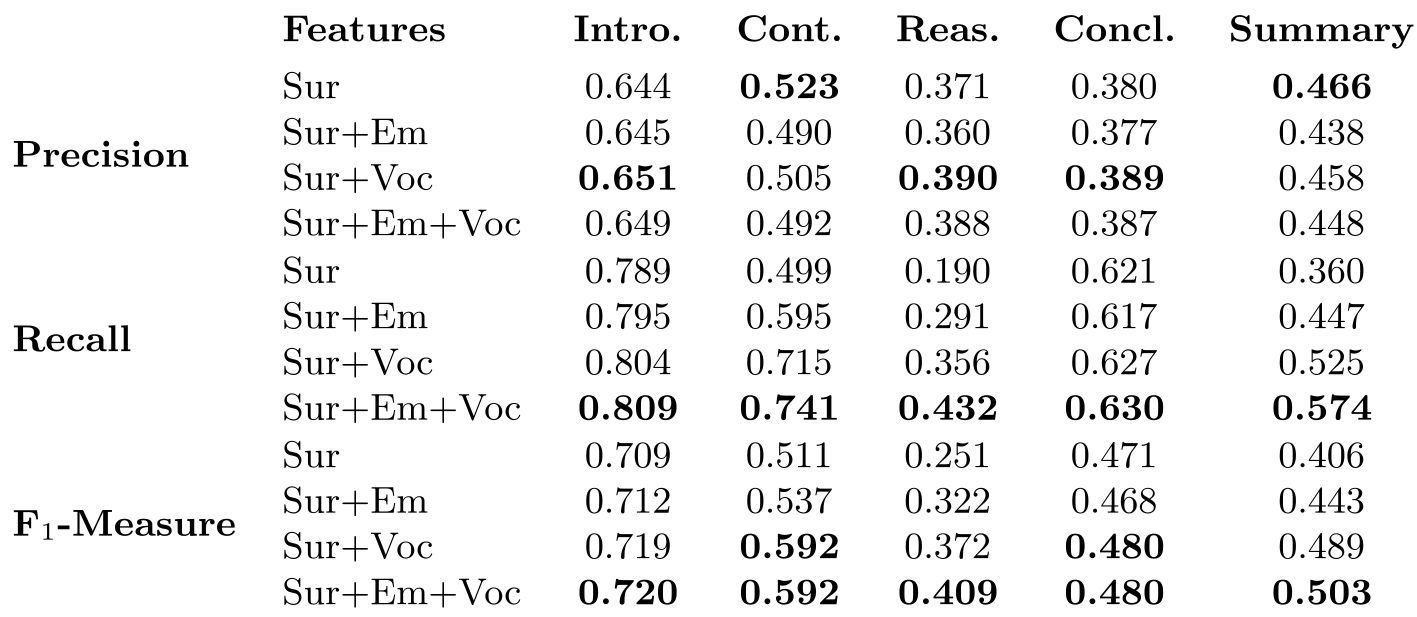
Ablation studies showed that while "Introduction" and "Conclusion" sections can be identified using simple position (Surface) features, the "Reasoning" section—the heart of the legal argument—absolutely requires content and emphasis features to achieve high recall.
Critical Analysis & Conclusion
The core takeaway of this work is that specialized legal knowledge is better captured through data than through static rules. PRODSUM demonstrates that even a "simple" Naive Bayes classifier, when fed with domain-specific features like visual emphasis and structural metadata, provides the robustness needed for professional legal tools.
Limitations: The system still struggles with the "Reasoning" section's recall (0.432). The authors admit that identifying a judge's logic requires more than shallow features—it likely requires an understanding of factual and temporal events.
Future Work: The next frontier lies in integrating Event-based features. By identifying who did what and when, the system could move from identifying "important-looking" sentences to identifying the "turning point" of a legal case.
Reference: Yousfi-Monod, M., Farzindar, A., & Lapalme, G. "Supervised Machine Learning for Summarizing Legal Documents."