
Beyond Static Ties: Mastering Temporal Link Prediction in Heterogeneous Networks
Exploring Supervised Methods for Temporal Link Prediction in Heterogeneous Social Networks
This paper explores supervised temporal link prediction in heterogeneous social networks by extending the 3-node graphlet counting method. It proposes five new scoring metrics that incorporate time-awareness, graph pattern support, and node experience levels, achieving state-of-the-art performance on Dota2 and arXiv datasets.
TL;DR
Predicting who will connect next in a social network is a moving target. This paper introduces a sophisticated supervised framework that moves beyond static topology by injecting time-decay, support-based frequency, and user experience levels into the analysis of 3-node graphlets. Tested on Dota2 player networks and arXiv collaborations, the results show that while heterogeneous features significantly boost accuracy, the "best" predictor changes as the network evolves.
The Limitation of Simple Topology
Most early link prediction algorithms (like Common Neighbors or Adamic/Adar) treat networks as static snapshots. They fail in two major ways:
- Temporality: An interaction three years ago is weighted the same as one from three hours ago.
- Heterogeneity: They ignore that a "friendship" tie on Steam is fundamentally different from a "teammate" tie in a Dota2 match.
- Structural Holes: Simple frequency counts of triangles are often skewed by high-degree nodes that act as "bridges" but don't necessarily imply a strong likelihood of future links.
Methodology: The Triad Evolution
The authors build upon the concept of 3-node graphlets (triads). In a network with two types of links, there are 16 possible triad patterns. The core innovation lies in how these patterns are weighted.
1. From Counts to Support
Instead of simply counting occurrences, the authors use minimum image-based support. This measures the frequency of a pattern based on the number of unique nodes it anchors. This is crucial for identifying "structural holes"—if a single node connects many pairs, it shouldn't disproportionately inflate the probability of those pairs connecting.
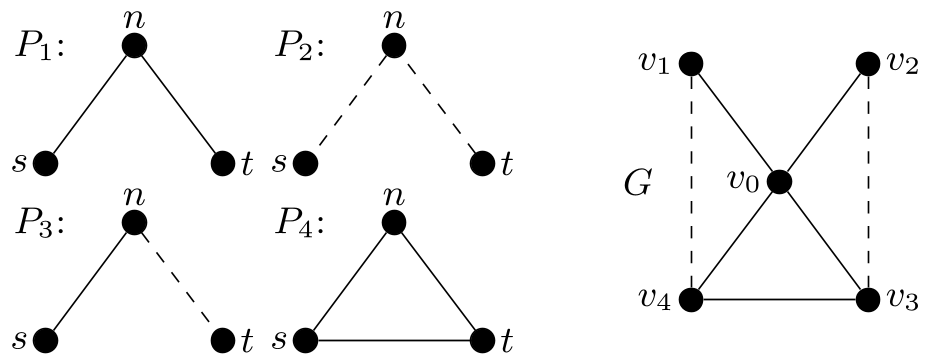 Figure 1: Examples of 3-node graphlets (P1-P4) in a multi-relational network.
2. Time Awareness (TS)
They integrate a "Time Score" that decays the weight of a link as it ages, using a harmonic mean of interaction weights.
3. The Power of Experience (Labels)
The methodology assumes that "experienced" users (e.g., veteran players or prolific authors) form links differently than "ordinary" ones. By labeling nodes, they expand the graphlet diversity, allowing the classifier to learn specific behavioral biases of elite vs. novice users.
Experimental Insights
The study evaluated two distinct datasets:
- Dota2/Steam: Teammate vs. Friend links.
- arXiv (HepTh): Colleague vs. Peer links.
Performance Comparisons
The authors utilized Conditional Inference Trees (CIT) and measured performance via Area Under Precision-Recall (AUPR), which is more robust for the highly imbalanced nature of link prediction (where "no link" is the overwhelming majority).
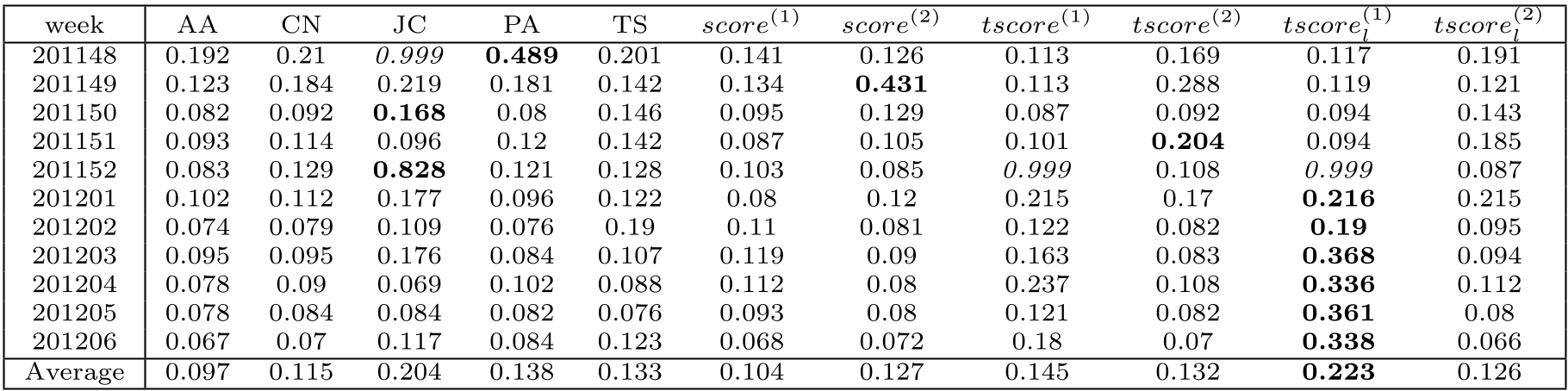 Table 3: Comparison of AUPR across different weeks for Dota2 team mate links.
Key Findings:
- No "Silver Bullet": No single feature dominated all time points. This suggests that as a network matures, the mechanisms driving its growth shift.
- Support Wins in Sparse Nets: On the Dota2 friend network (which is sparse and has low clustering), support-based metrics outperformed traditional counts, effectively handling structural holes.
- The Label Advantage: For professional/academic networks (HepTh), distinguishing between "experienced" authors led to a massive jump in average AUPR (up to 0.718 in certain years).
Critical Analysis & Conclusion
Takeaway
The research proves that heterogeneity is a feature, not a bug. By explicitly modeling different link types and user statuses, the model captures nuances that homogeneous models miss.
Limitations
A major challenge identified is temporal inconsistency. A model trained on Week 1 might be suboptimal by Week 10 because external factors (like a marketing campaign or a new academic season) change the underlying "physics" of the social network.
Future Outlook
The next frontier is combining these triad-based features with Global Network Properties. If we can detect a network's clustering coefficient or transitivity in real-time, we can dynamically switch between different weighting schemes (e.g., switching to Jaccard Coefficient when the network becomes too sparse).