
SVM in Precision Agriculture: Beyond Traditional Neural Networks
The Research of Support Vector Machine in Agricultural Data Classification
This paper introduces Support Vector Machines (SVM) for agricultural data classification focused on precision agriculture. Using the white-clover dataset, it evaluates the SVM's capability to categorize complex biological patterns compared to traditional benchmarks.
TL;DR
This research explores the application of Support Vector Machines (SVM) to the specialized domain of agricultural data classification. By moving from Empirical Risk Minimization (ERM) to Structural Risk Minimization (SRM), the authors demonstrate that SVM provides more robust performance on specialized biological datasets, such as the white-clover persistence dataset, outperforming both Naive Bayes and traditional Artificial Neural Networks (ANN) by nearly 5-7% in F1-score.
Problem & Motivation: The Complexity of "Field" Data
Agricultural data classification is a cornerstone of precision agriculture. However, the data derived from biological systems—like the factors influencing white clover persistence—is often noisy, high-dimensional, and exhibits complex non-linear relationships.
Existing methods such as Naive Bayes often fail because they assume feature independence, which rarely holds true in ecology. Meanwhile, Artificial Neural Networks, while powerful, often require large amounts of data to avoid overfitting and are prone to getting stuck in local minima when working with the typically smaller datasets found in specific agricultural studies. The authors’ intuition was to apply SVM to find a hyperplane that doesn't just minimize error on the training set but maximizes the "safety margin" for unseen data.
Methodology: The Power of the Margin
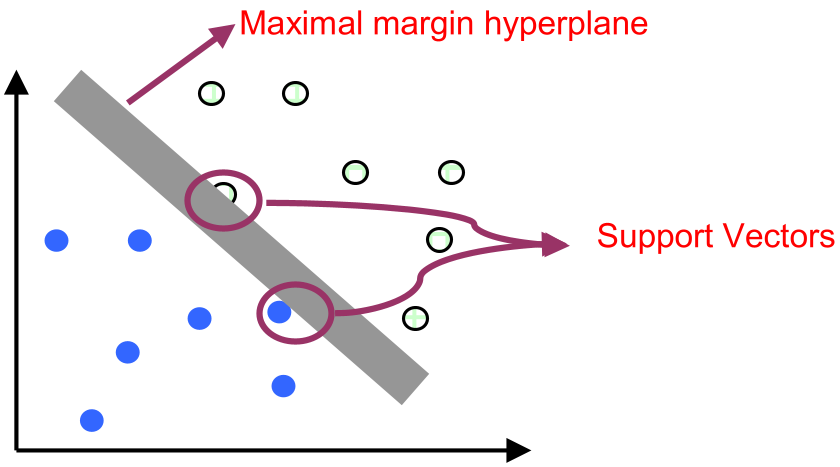
The core of the SVM approach lies in its ability to handle high-dimensional spaces through the Lagrange function. Instead of simply minimizing classification errors, the algorithm seeks to minimize , which is equivalent to maximizing the margin between classes.
Why it works:
- Vapnik-Chervonenkis (VC) Dimension: SVM controls the "capacity" of the model, ensuring it remains simple enough to generalize.
- Hyperplane Optimization: Using the dual form of the optimization problem, the model identifies specific "support vectors" that define the boundary, ignoring redundant data points.
- Kernel Flexibility: While this paper focuses on a linear baseline, the framework allows for non-linear mapping into high-dimensional feature spaces where classes become linearly separable.
Experimental Results
The authors utilized the LIBSVM library and the white-clover dataset from New Zealand. The goal was to classify the persistence mechanisms of clover in summer dry hill land. To ensure the results were valid, 10-fold cross-validation was applied.
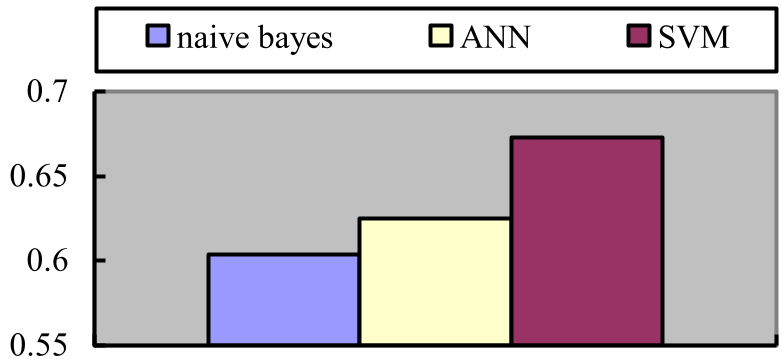
The performance was measured using the F1-measure, the harmonic mean of Precision and Recall, which is critical for agricultural tasks where missing a specific class (False Negative) can be as costly as a wrong identification (False Positive).
| Method | F1-Measure (%) | Improvement (vs SVM) |
|---|---|---|
| SVM | 67.3% | - |
| Artificial Neural Network | 62.5% | +4.8% |
| Naive Bayes | 60.4% | +6.9% |
Critical Analysis & Conclusion
Takeaway
The study confirms that SVM is not just a theoretical tool for computer science but a practical, high-performance solution for the intricacies of agricultural informatics. Its superiority over ANN in this context likely stems from its Structural Risk Minimization approach, which is far more efficient at handling the sample sizes typical of field-based agricultural research.
Limitations & Future Work
While the paper demonstrates the effectiveness of the linear SVM, it does not extensively explore Non-linear Kernels (like RBF), which could potentially push the F1-score even higher given the complex nature of biological data. Furthermore, as agricultural data scales up with IoT sensors and satellite imagery, the computational cost of solving the quadratic programming problem in SVM may become a bottleneck compared to modern deep learning architectures.
Future research should look into Hybrid SVM models coupled with automated feature engineering to further refine the precision of agricultural classification systems.