
Beyond Clicks: Decoding Student Success through Habit-Aware Data Mining
Supporting quality teaching using educational data mining based on OpenEdX platform
The paper introduces an Educational Data Mining (EDM) framework tailored for a lab-based Small Private Online Course (SPOC) on the OpenEdX platform. By integrating an external auto-grading system and a Gradient Boosting Decision Tree (GBDT) model, it predicts student performance with an ROC-AUC of 0.927 to 0.984.
TL;DR
Researchers at Beihang University have developed a predictive framework for a "Computer Structure" SPOC (Small Private Online Course). By combining an automated grading system for hardware design with a Gradient Boosting Decision Tree (GBDT) model, they can predict student failure with nearly 98% accuracy by analyzing deep behavioral patterns such as "molecular study time" and procrastination habits rather than simple login counts.
Background: The Lab-Based SPOC Challenge
Blended learning environments—specifically Laboratory-based courses—present a unique challenge: students must master complex tools like Verilog-HDL and Logisim. Instructors often face an "information gap" between a student’s submission and their actual understanding. This paper bridges that gap by transforming raw OpenEdX logs into a psychological profile of a learner's persistence and time management.
Why Clicks Aren't Enough: The Motivation
Existing Early Warning Systems (EWS) often treat all online interactions as equal. However, the authors argue that the intent behind an action matters more than the action itself. For instance:
- Does a student watch a video before a project or after failing a submission?
- Is a submission made in a "timely fashion" (96 hours after release) or "last-minute fashion" (48 hours before due)?
This shift from volume-based metrics to habit-based features is the core innovation of this research.
Methodology: The Technical Backbone
1. The External Grader via XQueue
To handle non-standard submissions like MIPS assembly or Verilog files, the team built an external grading service. This allows for immediate feedback in a "flipped classroom" setting, enabling students to iterate on their designs.

2. Feature Engineering: Atomic vs. Molecular Time
The paper introduces a crucial distinction in time-tracking:
- Atomic Time (x306): The raw sum of time spent directly on a problem.
- Molecular Time (x307): The total time from the first engagement to the final correct submission, including "side quests" like reviewing e-texts or discussion forums to fix errors.
3. The Predictive Model
The authors utilized GBDT, chosen for its ability to handle non-linear combinations of features and its robustness against overfitting.
Experimental Insights & Results
The model's performance improved significantly as the semester progressed, starting with an AUC of 0.936 at week 6 and peaking at 0.984.
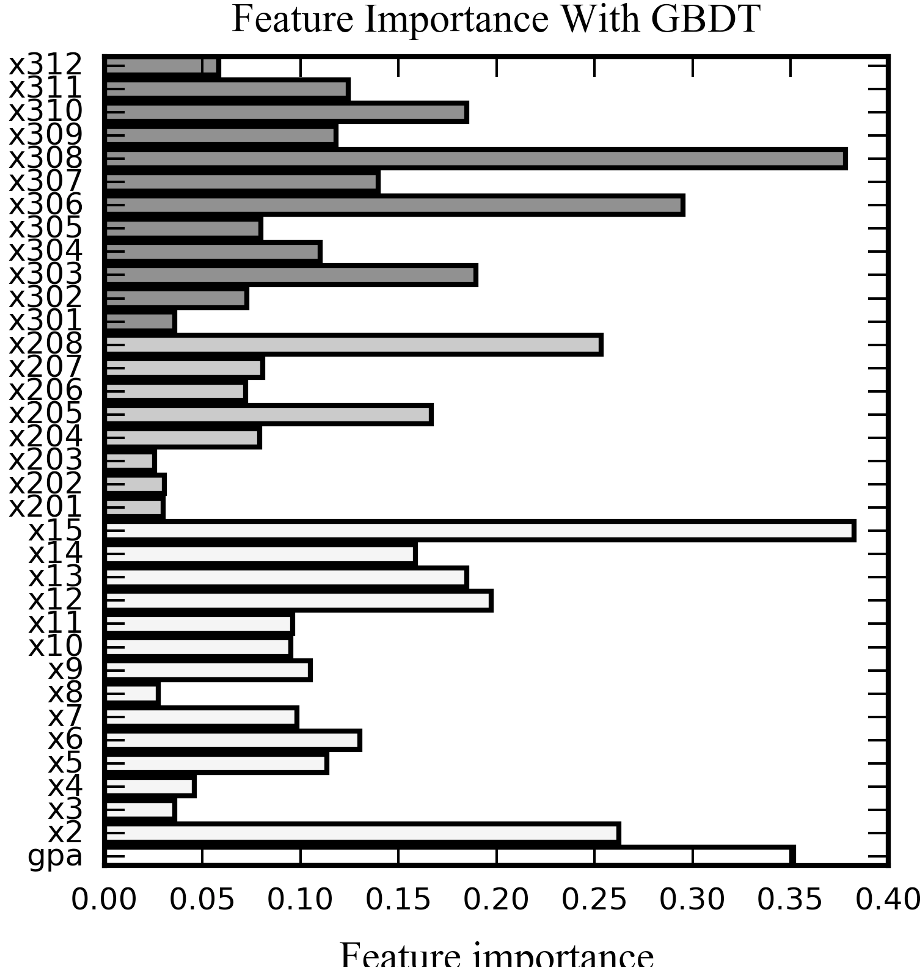
What actually predicts success? Surprisingly, while freshman GPA (prior ability) is a strong indicator, behavioral features like x208 (average pre-deadline submission time) and x310 (time to first visit) were critical. Students who engage early and leave a buffer before the deadline are vastly more likely to succeed than those with similar GPA who procrastinate.
Critical Analysis & Conclusion
Takeaway
The success of this framework suggests that Educational Data Mining (EDM) should prioritize temporal trends and reactive behaviors (how a student responds to failure). The ability to identify at-risk students 4 weeks before a final project allows for targeted human intervention.
Limitations & Future Work
The study is currently localized to a specific "Computer Structure" course at one university. The authors acknowledge that portability across different subjects (e.g., humanities vs. engineering) might vary. Future work will involve A/B testing to see if students actually improve when these predictions are shared with them, or if the "observer effect" alters their natural study habits.
Conclusion
By moving beyond the "what" to the "how," this research provides a roadmap for "Quality Teaching" in the age of automation. It proves that the data left behind in an LMS is not just a trail of clicks, but a signature of a student's metacognitive strategies.