
The Electronic Family Newspaper: Bridging the Transnational Gap through Pervasive Design
13774_Supporting Relationship Maintenance for Elders and Family Living Abroad.
The paper introduces the Electronic Family Newspaper (EFN), a pervasive communication system designed to bridge the emotional gap between elderly individuals in Mexico and their family members living abroad. The system utilizes a tablet PC-based blogging platform and integrates multi-device notifications (TV, mobile) to foster family closeness through shared media and memory-based games.
TL;DR
In the context of the Latin American migration phenomenon, elderly family members are often left behind, facing social isolation. This paper presents the Electronic Family Newspaper (EFN), a specialized communication ecosystem that uses tablet-based blogging and multi-device notifications to help elders maintain emotional intimacy with relatives living abroad.
The Problem: The "Left Behind" and the Digital Divide
Migration is more than an economic statistic; it is a social disruptor. In Mexico, where family cohesion is a core cultural pillar, approx. 10% of the elderly live alone due to younger generations moving abroad (primarily to the US).
Current digital communication tools—while abundant—often fail this demographic because:
- Accessibility Barriers: Standard keyboards and complex OS metaphors are unintuitive for many seniors.
- Context Misalignment: Most tools are designed for productivity or rapid-fire messaging, not for the slow-paced sharing of traditions and memories that seniors value.
Methodology: Designing for Natural Interaction
The EFN isn't just an app; it’s a pervasive system. The authors utilized a user-centered design approach based on ethnographic interviews to ensure the technology fits the "domestic space."
Key Architectural Pillars:
- The Tablet PC Hub: Chosen for its pen-based input, which mimics the natural habit of writing and allows for a more tactile, lower-barrier interaction than a mouse.
- Collaborative Content: Family members abroad use web browsers to post "news," photos, and recipes, which appear on the elder's screen as a newspaper.
- Cognitive Engagement: The system includes a memory game based on family photos, turning communication into a cognitive health exercise.
- Multi-Device Notifications: Recognizing that an elder might not always look at a tablet, the system pushes notifications to the TV and cell phones, treating the entire home as a communication interface.
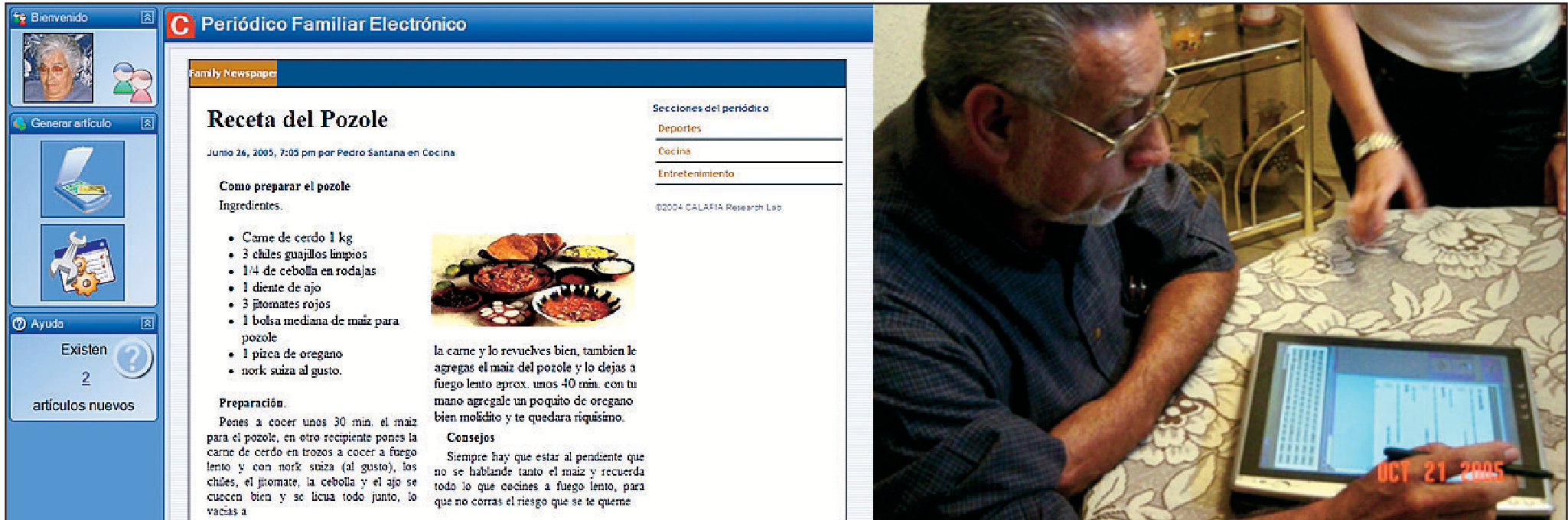 A sample screen of the EFN showing a shared family recipe and a user participating in the evaluation.
The Intuition: Why This Works
The brilliance of the EFN lies in its Inductive Bias toward legacy media. By framing the digital tool as a "Newspaper," it leverages a familiar mental model. It moves away from the "inbox" metaphor of email and toward a "display" metaphor, where digital content becomes a passive, comforting presence in the home.
Experiments & Preliminary Results
The researchers conducted preliminary evaluations with target users in Mexico. Observations showed:
- Usability: The pen-based interface significantly reduced the learning curve.
- Emotional Resonance: The ability to view images of family members living abroad led to a reported increase in the feeling of "closeness," even without real-time interaction.
- Integration: Using the TV as a notification hub was particularly effective, as the TV is often a central fixture in the Latin American elder's household.
Critical Analysis & Conclusion
The EFN represents a significant shift from "functional" communication to "affective" communication. However, several challenges remain:
- Hardware Cost: Deploying tablet PCs and smart-home components remains expensive for many families in developing regions.
- Connectivity: The system assumes stable internet, which might not be ubiquitous in rural Mexican areas.
Takeaway: This work demonstrates that for the elderly, Natural User Interfaces (NUI) are not just a luxury—they are a necessity for social inclusion. Future pervasive systems should look beyond the screen and consider how the entire domestic environment can be "activated" to foster human connection.