
EnStreaM: Bridging Human Expertise and Environmental Big Data Through Rule Validation
Supporting Rule Generation and Validation on Environmental Data in EnStreaM
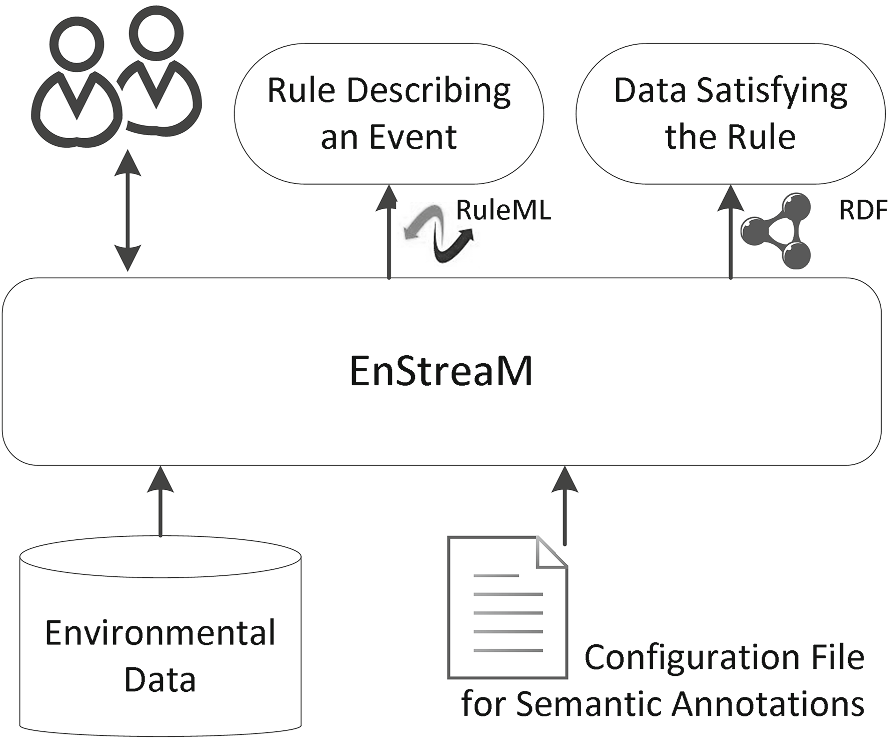
EnStreaM is a rule generation and validation system designed for environmental sensor data, specifically targeting scenarios like landslide detection. It allows domain experts to discover patterns, formulate "if-then" logic, and validate these rules against massive historical datasets using a scalable indexing infrastructure.
TL;DR
EnStreaM is a scalable, visual analytics system that empowers domain experts to transform their environmental knowledge into machine-readable rules. By combining efficient sensor data indexing with semantic annotations and a GUI-driven validation process, it enables the formalization of complex phenomena—like landslide triggers—into interoperable RuleML logic.
Problem & Motivation
In the era of the "data avalanche," Information Flow Processing (IFP) systems must handle high-velocity streams from thousands of environmental sensors. While machine learning can discover patterns, there is a massive gap in leveraging Expert Knowledge.
Domain experts (e.g., geologists) often know precisely what triggers an event—such as a specific rainfall threshold—but lack the tools to:
- Formalize this intuition into executable rules.
- Validate these rules against terabytes of historical sensor archives.
- Standardize the output for use in broader decision-support systems.
Prior work often focused on "unsupervised discovery," ignoring the value of hypothesis-testing by human specialists.
Methodology: The Core of EnStreaM
EnStreaM doesn't just store data; it translates it into a semantic layer that experts can manipulate.
1. Scalable Architecture
The system utilizes specialized indexing methods based on location, measurement dates, and pre-computed aggregates (Min, Max, Mean, StdDev). This allows for ad-hoc exploration of massive datasets without the overhead of traditional relational queries.
2. Semantic Abstraction
To ensure that "Sensor_74" actually means "Rainfall Gauge in Ljubljana," the system uses OpenCyc semantic annotations. This creates a unified view across different data sources, mapping internal raw data to high-level concepts like sensorObservation and measurementResult.
3. Rule Generation Workflow
The user follows an iterative loop:
- Identify past events (e.g., a known landslide date).
- Visualize sensor trends leading up to that event.
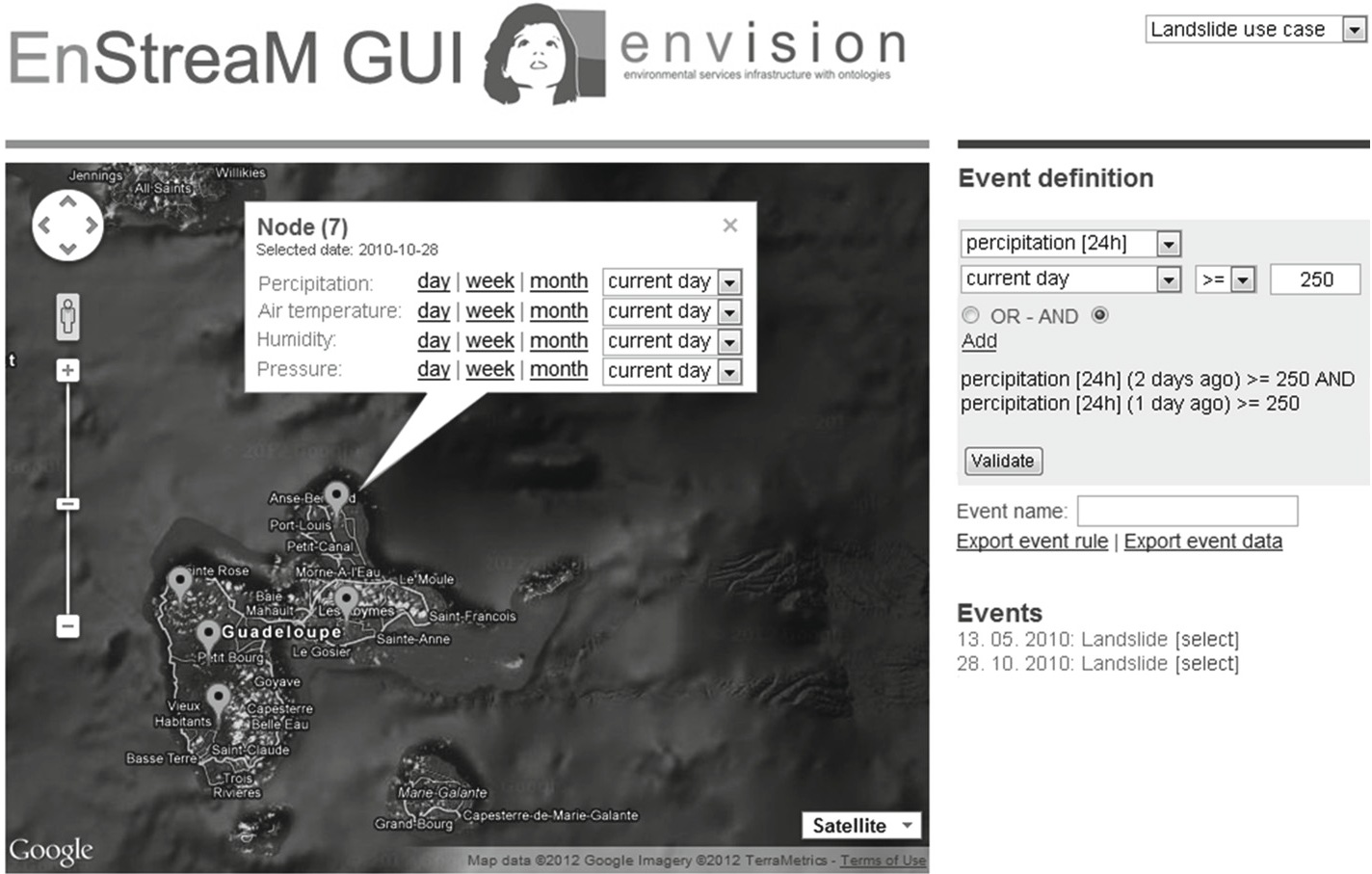
- Formulate logic using an intuitive "Feature-Operator-Value" GUI.
- Validate by running the query over the entire history to see the "Precision/Recall" of their expert rule.
Use Case: Detecting Landslides
The system's power is best seen in its landslide scenario. An expert posits: "If daily rainfall 250mm for 3 days, a landslide is imminent."
By inputting this into EnStreaM, the system generates a RuleML snippet (as seen below) and instantly shows how many historical landslides this rule would have correctly predicted versus how many "false alarms" it would have triggered.
<!-- Example of Generated RuleML Logic -->
<And>
  <Atom>
    <Rel iri="openCyc:greaterThanOrEqualTo"/>
    <Var>val1</Var>
    <Ind type="xs:float">250</Ind>
  </Atom>
</And>
Critical Analysis & Conclusion
EnStreaM represents a significant step towards Explainable AI (XAI) in environmental science. By allowing experts to define the "Why" behind an event, the resulting models are inherently more trustworthy than black-box neural networks.
Takeaway: The real value lies in the RuleML and RDF export. By adhering to these standards, EnStreaM ensures that the rules generated today can be used by any reasoning engine tomorrow, regardless of the underlying hardware.
Limitations & Future Work: Currently, the system is optimized for historical validation. The authors correctly identify that the next frontier is Real-time Monitoring—applying these validated rules to live streams to provide early warnings before the landslide occurs. Moving forward, integrating these manual rules with "Semi-automatic extension of knowledge bases" could allow the system to learn from its own mistakes over time.