
Leveraging the "Social" in Software Engineering: Can Facebook Save Distributed Teams?
Supporting the Software Development Process Using Social Media: Experiences with Student Projects
This paper explores the integration of social media, specifically Facebook, into the software development process for student projects. It proposes a classification system for team interactions and introduces a set of metrics to evaluate communication and coordination effectiveness in distributed environments.
TL;DR
Communication and coordination are the perennial bottlenecks of distributed software development. This paper investigates whether the addictive, "always-on" nature of social media—specifically Facebook—can be harnessed to improve team synchronization. By tracking 18 student projects, the authors demonstrate that social media reduces response latency and provides a rich repository for "just-in-time" knowledge sharing, offering a suite of metrics to measure communication health.
The Problem: The Latency of "Professional" Tools
In the world of distributed software engineering, information is the lifeblood of the project. However, traditional media like e-mail are inherently asynchronous—messages sit in inboxes waiting for a "checking" action. Forums and specialized bug trackers often lack the social motivation to keep developers engaged and online.
The authors argue that for young developers, the barrier to checking a professional workspace is higher than checking a social feed. This creates a "lack of reciprocity" and slow response times, which are fatal for agile coordination. The challenge is: How can we make project communication as frictionless and engaging as a social conversation?
Methodology: Mapping Social Interactions to Software Tasks
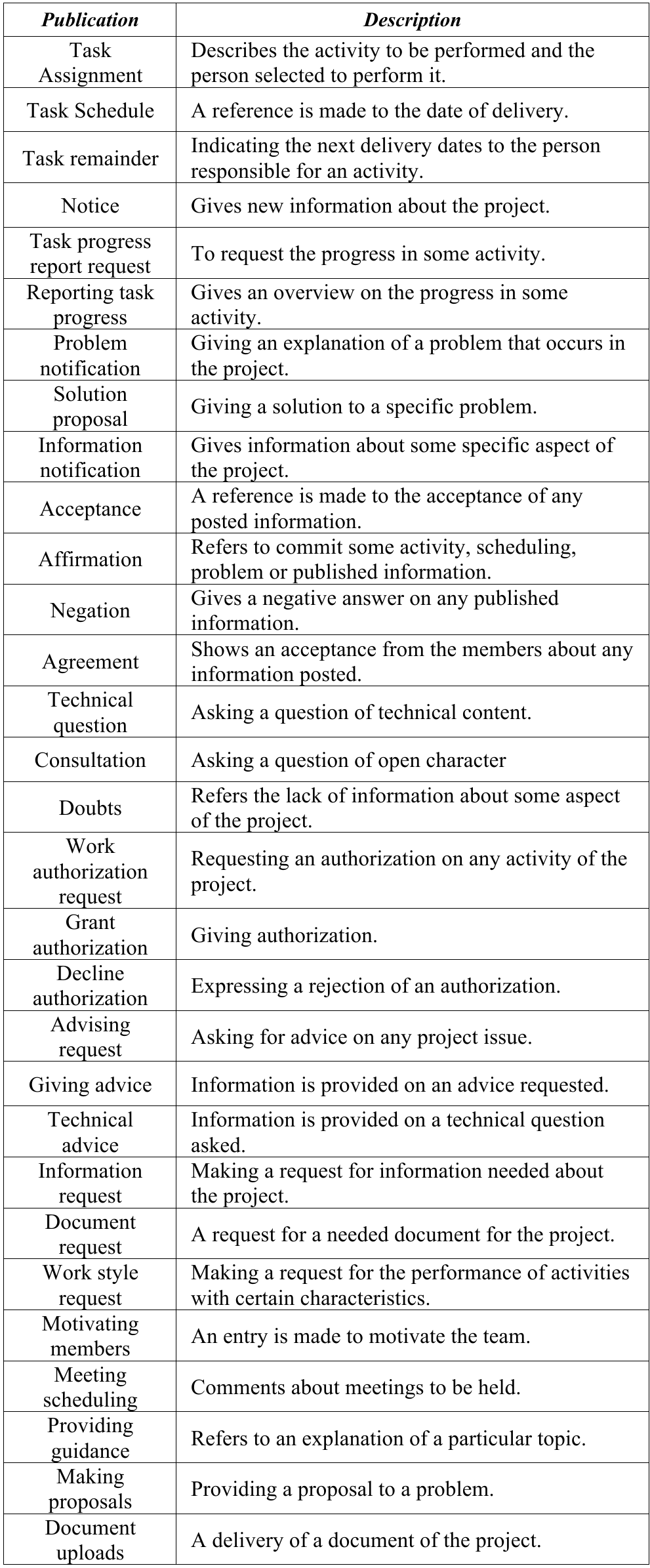
The core of this research is a taxonomy that maps informal social media actions to formal software engineering needs. The authors categorize 30 types of publications and comments, including:
- Coordination: Task Assignment, Table Reminders, and Progress Reports.
- Knowledge Sharing: Technical Questions, Providing Guidance, and Technical Advice.
- Validation: Acceptances, Negations, and Grants of Authorization.
The Interaction Model
They propose a "Publication-Response" pairing logic. For example, a "Task Assignment" post should ideally trigger an "Acceptance" or "Negation" comment. This creates a traceable graph of project accountability.
Experiments & Results: Fast Responses and Knowledge Peaks
The study monitored 18 student teams using private Facebook groups, Dropbox for version control, and Skype for meetings.
Key Findings:
- Response Speed: The metrics (GM01) showed impressive results. While some tasks took hours to resolve, critical items like "Work Authorization" were often handled within 1 to 5 minutes, significantly faster than typical e-mail turnaround times.
- Temporal Dynamics: Activity wasn't linear. "Guidance" and "Technical Advice" peaked during the middle of the term (September/October), which aligns with the heavy coding and implementation phase of the software life cycle.
- The Role of the Leader: The data highlighted that the "Team Leader" role is the primary driver of communication volume, responsible for the majority of task assignments and info requests.
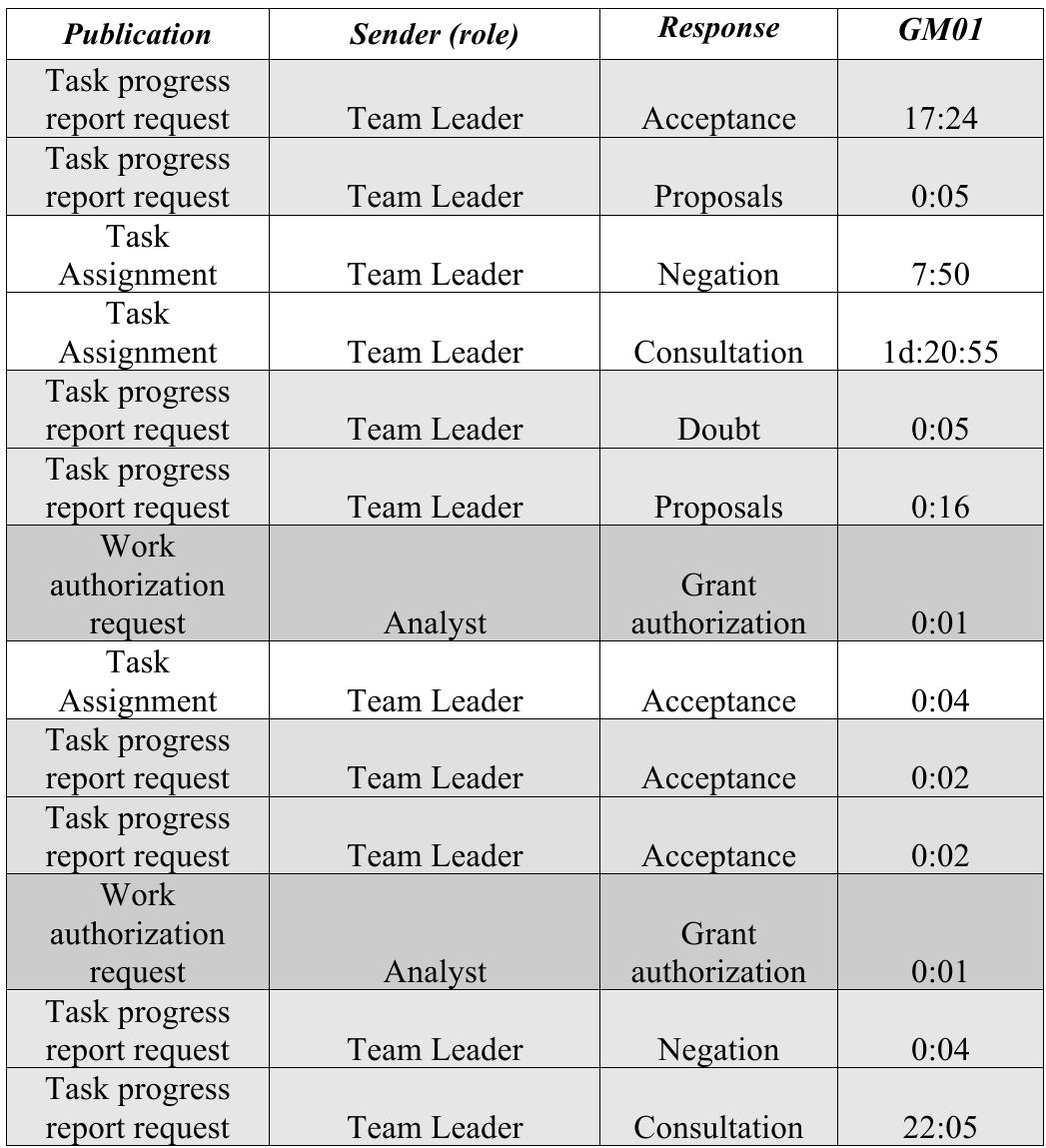 Above: Evidence of ultra-fast response times (GM01) for critical project authorizations.
Critical Analysis & Conclusion
Takeaway
The paper successfully argues that social media's greatest strength in software engineering is not necessarily its "technical" features, but its ability to lower the communication threshold. By meeting developers where they already are (online in social spaces), the "friction" of project management is reduced.
Limitations
- Privacy and Work-Life Balance: The paper glosses over the potential "noise" and privacy concerns of mixing personal social media with professional/academic work.
- Manual Data Processing: The current study manually categorized comments. For large-scale industrial projects, this would be impossible without automated NLP.
- Context: Student projects have different social dynamics than professional corporate environments where Facebook might be restricted.
Future Outlook
The authors suggest that future work should involve using the Facebook Graph API to build automated repositories of "tacit knowledge"—the informal wisdom shared in comments that never makes it into official documentation. As we move toward 2026, the transition from Facebook to newer tools like Slack or AI-integrated workspaces is the natural next step for this research.
Metrics Summary
- GM01 (Time of Response): The gold standard for measuring team agility.
- GM06 (Member Coverage): Measures how many team members are actively participating in the conversation, not just lurking.